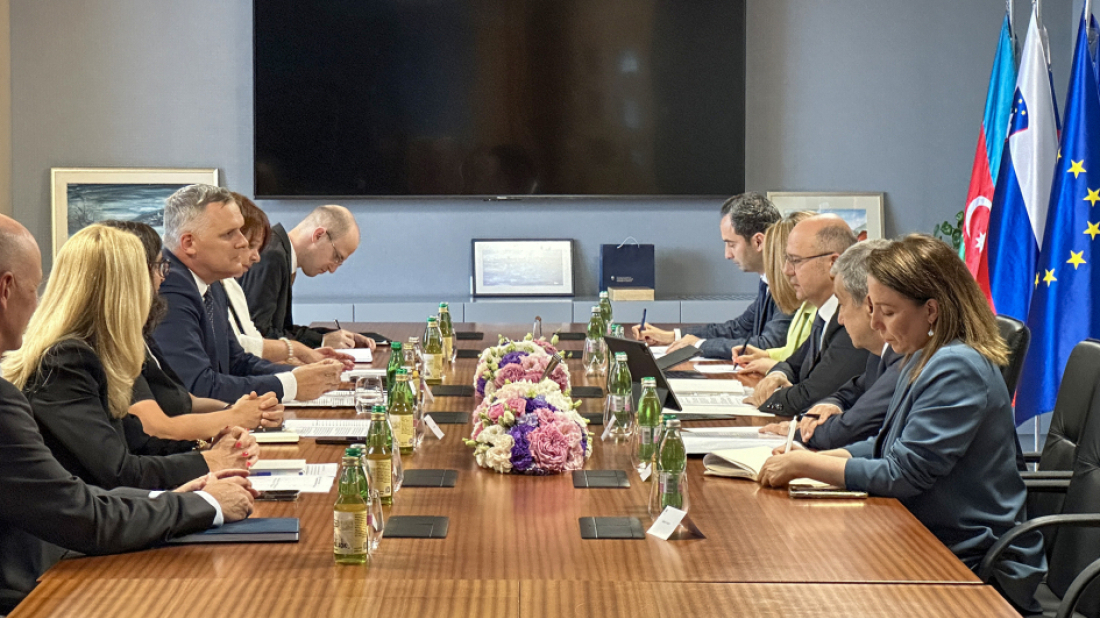
Energy integration between Azerbaijan and Europe, along with opportunities to increase gas supplies was discussed during Energy Minister Parviz Shahbazov’s visit to Slovenia, at the invitation of Minister of Environment, Climate and Energy Bojan Kumer.
During the meeting, the two ministers highlighted the dynamic development of Azerbaijani–Slovenian bilateral relations, which will mark their 30th anniversary next year, and emphasized that cooperation in the energy sector has become more intensive and productive in recent years.
The signing of a Memorandum of Understanding on energy cooperation between the Ministry of Energy of the Republic of Azerbaijan and the Ministry of Environment, Climate and Energy of the Republic of Slovenia, as well as a Memorandum of Understanding on natural gas supply between SOCAR and Geoplin, represent significant milestones in bilateral energy relations.
The commencement of Azerbaijani natural gas supplies to Slovenia was recognized as a tangible outcome of energy cooperation and a significant contribution to both Europe’s energy security and the diversification of energy sources.
Considering Azerbaijan a reliable partner, Bojan Kumer expressed interest in expanding energy cooperation and increasing gas supplies from Azerbaijan, which accounted for approximately 5% of Slovenia’s total gas consumption last year.
As part of the plan to increase gas supplies via the Trans-Adriatic Pipeline (TAP) by 1.2 billion cubic metres by 2026, as well as on a long-term basis, the two sides discussed the possibilities of supplying gas to Slovenia, prospects for the development of production and transportation projects, regional energy security, and the strengthening of mutual consultations.
The energy integration of Azerbaijan with Europe was discussed in the context of key projects such as the Caspian–Black Sea–European Green Energy Corridor, the Azerbaijan–Georgia–Türkiye–Bulgaria interconnector, and the Central Asia–Azerbaijan Energy Corridor. It was noted that these initiatives offer significant opportunities for the development of new trade routes, enhanced energy security, and strengthened regional cooperation through the Caspian Sea. Additionally, prospects for cooperation with Slovenia in the field of green energy were considered.
Cooperation in the supply of oil, natural gas, and green energy was further discussed during meetings with Simon Urbancl, CEO of Geoplin; Sašo Berger, President of the Management Board of Petrol Group; Marjan Eberlinc, CEO of Plinovodi; and Tomaž Štokelj, CEO of HSE.
The discussions covered Slovenia’s energy consumption, the supply of oil, gas, and electricity, the development and strengthening of natural gas transmission links with neighboring countries, as well as measures taken to increase electricity generation from renewable sources, including solar and wind energy.
Slovenian energy companies were invited to participate in Azerbaijan’s green energy projects, both as investors and as offtakers of the energy produced

















What is your opinion on this topic?
Leave the first comment