Iran and Russia are moving ahead with plans to build small modular nuclear reactors, with Tehran announcing that the two countries are preparing to sign an agreement to accelerate their cooperation.
The Atomic Energy Organization of Iran (AEOI) said the two countries were working towards signing a protocol to speed up the joint development and construction of small modular reactors (SMRs).
“We are in a good position in the field of small modular reactors, and in the process of signing a protocol with the Russian side to jointly pursue the construction of these types of reactors at a faster pace,” AEOI spokesman Behrouz Kamalvandi said.
Speaking in a televised interview on Wednesday, Kamalvandi said Iran's nuclear industry had reached “full maturity” and achieved “self-sufficiency” in nuclear power plant construction, according to the AEOI's website.
Kamalvandi, who is also the organisation's deputy for international, legal and parliamentary affairs, said the Darkhovin nuclear power plant near Ahvaz, which remains under construction, had been targeted in Israeli and U.S. strikes aimed at disrupting Iran's nuclear development.
He said the attacks were intended to “prevent the realisation of plans and projects that are considered a symbol of Iran's progress”.
“The enemies oppose the progress of Iran. However, our country has made significant achievements in various areas of the nuclear industry. These advances are not limited to the fuel cycle, but also include areas such as power plant construction and nuclear safety.”
In July, Tehran condemned a U.S. airstrike on the Karoon Nuclear Power Plant in Darkhovin, in southwestern Khuzestan province, calling on the UN to adopt a “zero-tolerance” policy towards attacks on civilian nuclear facilities subject to international safeguards.
“This site is fully under the IAEA supervision and safeguards as well as the Comprehensive Safeguards Agreement between Iran and the Agency. Its activities are peaceful and legal,” the AEOI said in a statement.
Following Israeli and U.S. strikes on Iranian nuclear facilities in June 2025, Tehran suspended cooperation with the International Atomic Energy Agency (IAEA), accusing the UN nuclear watchdog of failing to condemn the attacks.
Iran subsequently barred IAEA inspectors from accessing the damaged sites, while its parliament also banned the agency's Director General, Rafael Grossi, from visiting the country.
Russia's role in Iran's nuclear expansion
Russia remains a key partner in Iran's nuclear energy programme, with the two countries pursuing several projects beyond the existing Bushehr Nuclear Power Plant.
Bushehr, Iran's first 1,000-megawatt nuclear power unit, has been connected to the national electricity grid since 2012 under an agreement with Russia's state nuclear energy company, Rosatom.
The Russian company took over the project after Germany's Siemens withdrew following Iran's 1979 Islamic Revolution, which overthrew the country's pro-Western monarchy. The original construction contract was signed in 1974.
“The Bushehr nuclear power plant has so far prevented the emission of about 86 million tons of pollutants and has saved 132 million barrels of oil consumption,” Kamalvandi said.
He also pointed to global plans to build 1,200 nuclear power plants comparable to Bushehr as part of efforts to reduce environmental damage.
Beyond Bushehr, Iran has four additional nuclear power projects of varying sizes under construction in cooperation with Russia, including the facility at Darkhovin.
In December, Tehran announced plans to develop nuclear power plants using domestic expertise and industrial capabilities.
“We are looking to have our own power plants,” Kamalvandi said at the time.
He said Iran was working with Russia on a 300-megawatt nuclear power plant in Darkhovin, in oil-rich Khuzestan province, adding that the country's industrial sector was capable of manufacturing key components, including steam generators, boilers and turbines.
The partnership gained further momentum in October, when Tehran and Moscow signed nuclear energy agreements covering power generation and the construction of new reactors.
The agreements included plans to develop small modular reactors capable of generating 300 megawatts of electricity, alongside four larger reactors, each with a capacity of 1,250 megawatts.
The four larger reactors are expected to cost more than $25 billion.
Pezeshkian and Putin discuss wider cooperation
Nuclear energy cooperation forms part of broader efforts by Tehran and Moscow to strengthen economic and strategic ties.
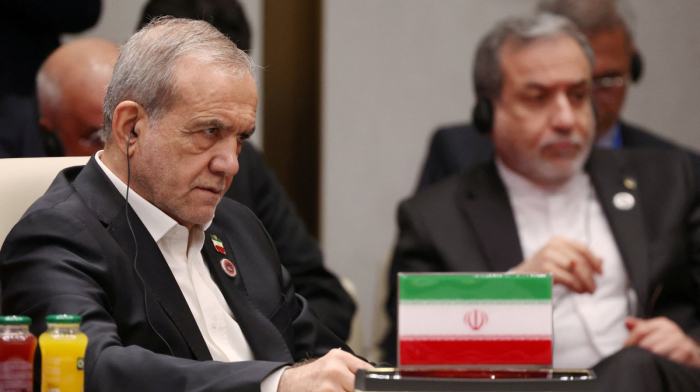
Iranian President Masoud Pezeshkian and Russian President Vladimir Putin reaffirmed their commitment to expanding bilateral relations and advancing joint projects during talks in Moscow on Tuesday.
Meeting on the sidelines of the eighth Gas Exporting Countries Forum summit, the two leaders reviewed progress on joint initiatives and discussed regional developments.
The talks followed earlier meetings this month on the sidelines of the Commonwealth of Independent States summit and the Caspian Sea Environmental Summit in Turkmenistan.
“The two sides reviewed the achievements in bilateral relations and focused on strengthening economic and strategic cooperation in key sectors, including energy, agriculture, transportation, and trade,” the Iranian Presidential Office said in a statement published on its website.








What is your opinion on this topic?
Leave the first comment