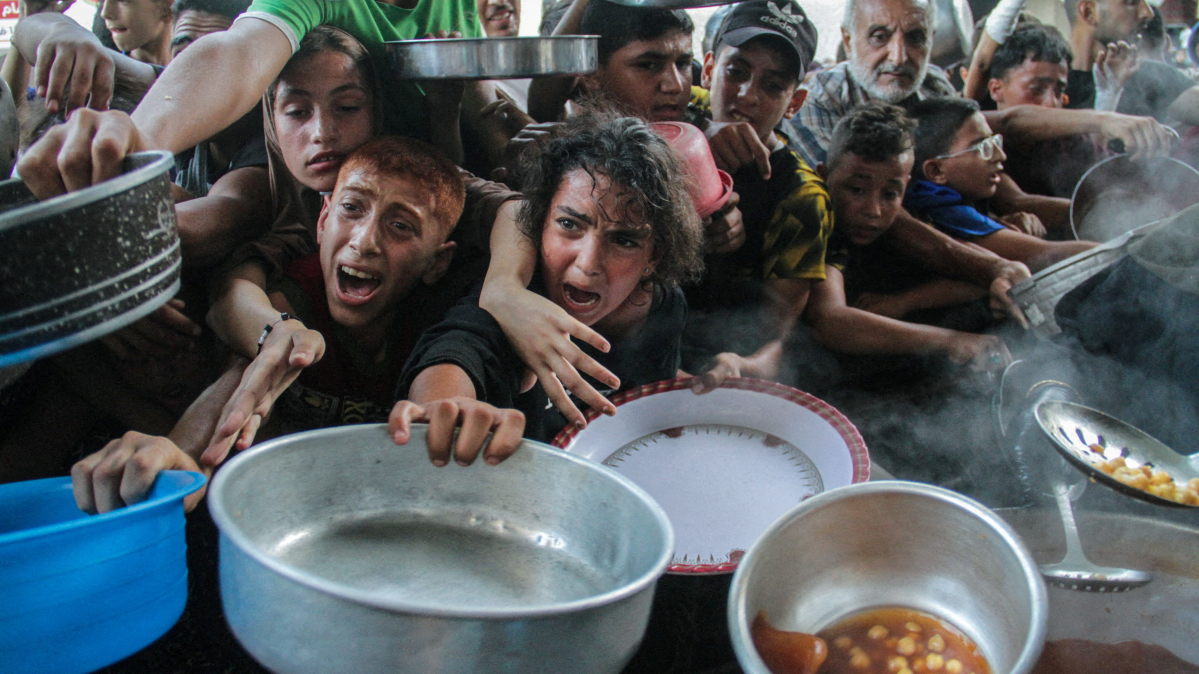
Months of progress against hunger in Gaza are at risk of being reversed as aid funding runs out and relief operations are scaled back, with a new assessment warning that two-thirds of the population could face acute hunger by the end of the year.
The hunger crisis in Gaza is deepening again, with aid agencies warning that months of hard-won progress could unravel as funding dries up and relief operations are scaled back.
A new assessment by the Integrated Food Security Phase Classification (IPC) says more than two-thirds of Gaza's population could be be experiencing acute hunger by the end of the year.
The report paints a picture of a territory where food remains scarce, incomes have disappeared, and many families are surviving only because of humanitarian assistance.
The warning comes less than a year after increased aid deliveries following the October 2025 ceasefire eased fears of famine and helped improve nutrition across the Strip.
Relief efforts losing momentum
The ceasefire allowed humanitarian organisations to expand food distributions and nutrition programmes, reaching around 1.5 million people in May. Clinics treating malnourished children also reported noticeable improvements.
Those gains are now under threat.
The IPC said funding shortages and uncertainty over humanitarian access have forced agencies to reduce assistance, raising concerns that the situation could quickly deteriorate.
Around 1.2 million people were already experiencing crisis levels of hunger or worse between April and June. By December, that number is expected to rise to about 1.4 million, equivalent to 67% of Gaza's population.
The report warns that if food aid is reduced further, as many as 1.9 million people - roughly nine in every 10 residents - could face severe food insecurity before the end of the year.
"Food consumption remains inadequate for most families," the IPC said, noting that some people have resorted to begging or scavenging in search of something to eat.
Children paying the highest price
Young children and mothers remain among those most at risk.
Although malnutrition rates fell after the ceasefire, thanks to expanded feeding programmes and greater access to food, the IPC said those improvements remain "highly fragile".
Only one in five children has access to a sufficiently nutritious diet, while more than 74,000 children under the age of five are expected to need treatment for acute malnutrition by April 2027.
Of those, more than 11,000 are projected to suffer from the most severe form.
Pregnant and breastfeeding women are also becoming increasingly vulnerable. Around 24,600 require urgent nutritional support, yet supplementary feeding programmes have already been cut back because of funding shortages.
Life beyond food remains a daily struggle
The report says hunger is only one part of a much broader humanitarian emergency.
After nearly two years of conflict, livelihoods have largely disappeared. More than four in five households have no income, leaving families almost entirely dependent on aid.
Basic services remain severely disrupted. Nearly half of households survive on less than 15 litres of water per person each day for drinking, cooking and washing.
At the same time, the destruction of homes, farmland, businesses and roads has left little opportunity for people to rebuild their lives. The IPC estimates that around three-quarters of homes have been damaged or destroyed, alongside most agricultural infrastructure and businesses.
A separate assessment by the World Bank, the European Union and the United Nations estimates the war has caused more than U.S.$35 billion in physical damage, with reconstruction needs exceeding U.S.$71 billion.
Ceasefire has not ended the suffering
Although the ceasefire significantly reduced the fighting, the IPC said violence has continued across Gaza.
Drone strikes, air strikes and shelling have persisted, with more than 900 civilians reportedly killed since the ceasefire began. The continuing insecurity has complicated relief efforts and added to uncertainty over humanitarian operations.
The report concludes that maintaining aid deliveries is now critical if Gaza is to avoid another sharp deterioration in food security.
It called for sustained humanitarian access, expanded nutrition programmes and a permanent end to hostilities, warning that recent improvements could quickly disappear without them.
Israel disputes assessment
Israel has consistently rejected accusations that it deliberately used starvation as a weapon during the conflict.
COGAT, the Israeli military body responsible for coordinating aid into Gaza, dismissed the IPC report as biased.
It said large quantities of food, water and medical supplies have entered the territory since the ceasefire and accused Hamas of diverting and looting humanitarian aid.
Read more:
















What is your opinion on this topic?
Leave the first comment