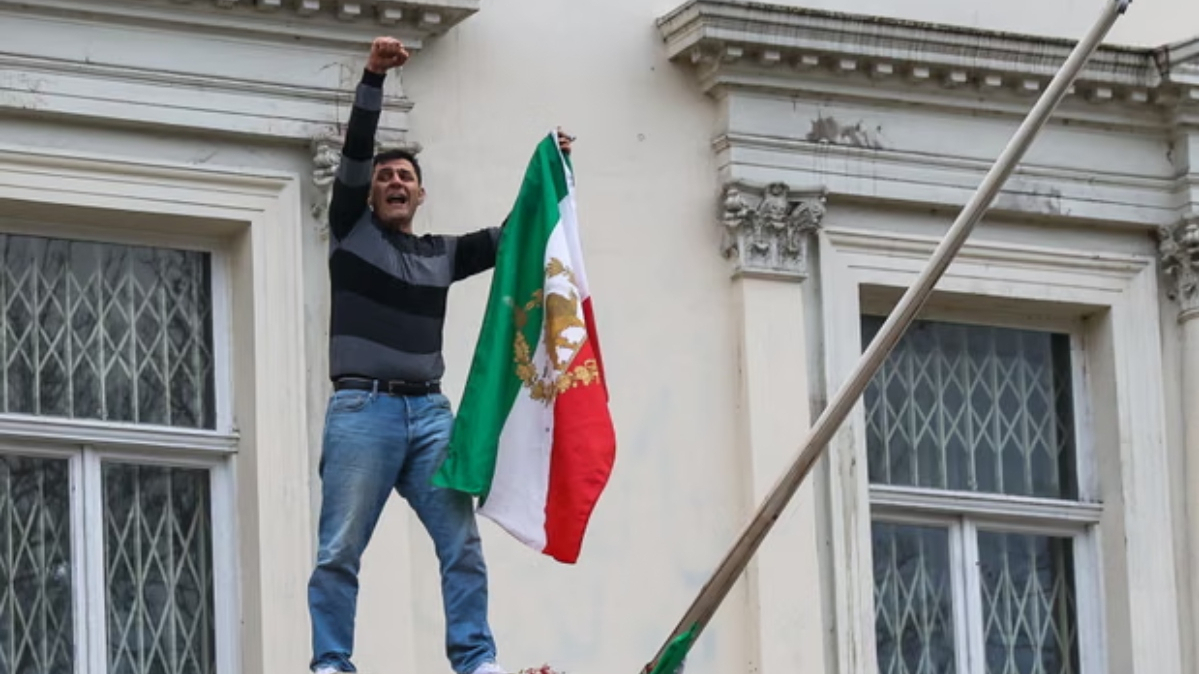
A protester briefly replaced the flag of the Islamic Republic of Iran at its embassy in London with a pre-1979 version during an anti-government demonstration on Saturday, witnesses said.
Video posted on social media showed a man standing on a balcony of the Iranian embassy, near Hyde Park, removing the current flag and raising a tricolour bearing the lion and sun emblem used before the 1979 Islamic Revolution.
The flag remained in place for several minutes before being taken down.
Hundreds of demonstrators gathered outside the building in west London, waving similar flags and chanting slogans including "Free Iran" and calls for democracy.
Some held images of Reza Pahlavi, the exiled son of Iran’s last shah, Mohammad Reza Shah Pahlavi, who was overthrown in 1979.
One protester, Taraneh, 33, said she was demonstrating in support of relatives and friends in Iran.
"The internet has been shut down and we get very little information," she said, adding that protesters inside the country were still taking to the streets despite what she described as a violent crackdown.
"But people are still in the streets. They are being attacked. The Islamic Republic is murdering people," she said. "I want this regime to go. I just want to be able to go back."
London’s Metropolitan Police said two people had been arrested, "one for aggravated trespass and assault on an emergency worker and one for aggravated trespass".
Officers were also seeking a third person in connection with trespass.
In a statement posted online, police said "additional officers are being deployed to prevent any disorder" and to ensure the security of the embassy, adding that the protest was continuing but being "safely policed".
The demonstration comes amid widespread unrest in Iran, where protests began on 28 December after a sharp devaluation of the national currency and rising living costs.
The protests have since expanded into nationwide calls for an end to the Islamic Republic.
Iranian authorities have imposed an internet blackout across much of the country. Human rights groups say this has raised fears of a broader crackdown.
The Norway-based group Iran Human Rights says at least 51 people, including nine children, have been killed, with hundreds wounded.
Iran’s Supreme Leader, Ayatollah Ali Khamenei, has dismissed the demonstrators as "troublemakers" and accused them of acting on behalf of foreign powers.
Western leaders have expressed concern over the violence. In a joint statement last week, UK Prime Minister Keir Starmer, along with France’s Emmanuel Macron and Germany’s Friedrich Merz, said they were "deeply concerned about reports of violence by Iranian security forces" and "strongly condemn the killing of protesters".










What is your opinion on this topic?
Leave the first comment