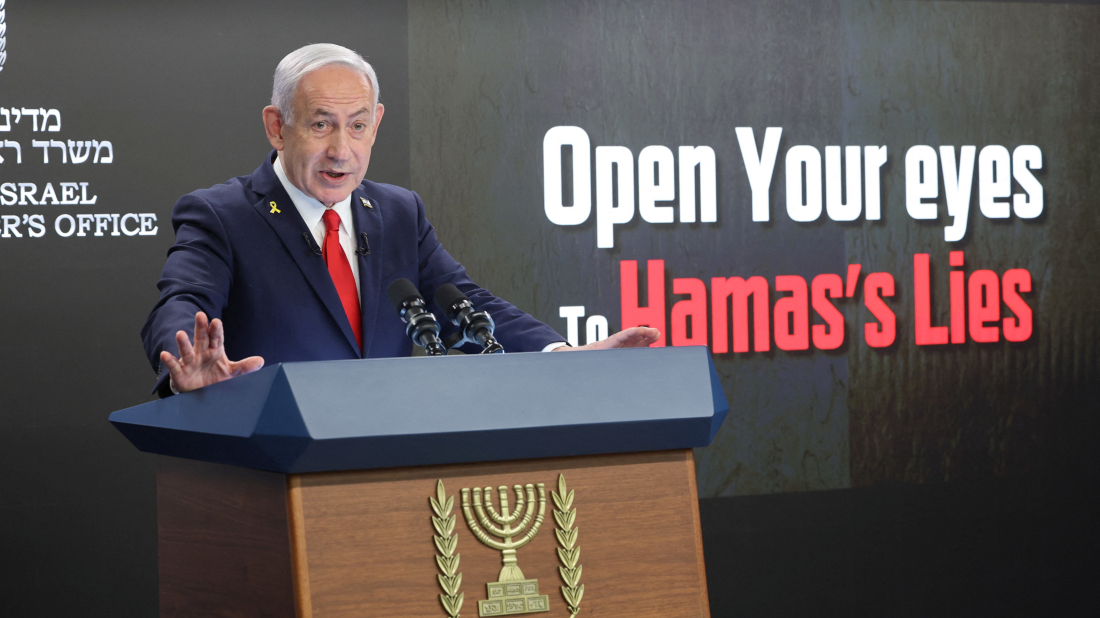
Israeli Prime Minister Benjamin Netanyahu said Sunday that the conflict in Gaza will end once Hamas is disarmed and hostages are freed, unveiling a five-point plan for the territory’s future while accusing international media of spreading “Hamas lies.”
Speaking at a press conference in Jerusalem, Netanyahu said Hamas still has “thousands of armed terrorists” in Gaza who are committed to repeating the 7 October attacks and destroying Israel. He alleged that the group oppresses Gaza’s population, steals aid, and prevents civilians from reaching safe zones.
“Our goal is not to occupy Gaza,” he said. “Our goal is to free Gaza from Hamas terrorists.”
Netanyahu outlined a post-war vision based on five principles: the disarmament of Hamas, the release of all hostages, Gaza’s demilitarisation, Israel’s overriding security control, and the establishment of a non-Israeli civilian administration that does not promote or fund terrorism.
The prime minister said Israeli forces now control 70 to 75 percent of Gaza, with two remaining Hamas strongholds in Gaza City and the central camps. He confirmed that the Israeli Security Cabinet has instructed the military to dismantle these positions while moving civilians to designated safe zones and providing food, water, and medical aid.
Addressing accusations of starvation in Gaza, Netanyahu said Israel has allowed nearly two million tonnes of aid into the territory since the war began, blaming Hamas for looting supplies and the UN for delays in distribution. He presented photographs that he said disproved media claims of famine, accusing outlets such as the New York Times of publishing misleading images.
Netanyahu also said the humanitarian aid system is being expanded through safe corridors, additional distribution points managed by Gazan Humanitarian Foundations, and airdrops coordinated with U.S. President Donald Trump’s administration.
On the question of Palestinian statehood, the prime minister dismissed recent moves by several countries to recognise it, calling such steps a “reward for Hamas” and warning they would “bring the next war closer.” He argued the conflict persists because of the “persistent Palestinian refusal to recognise a Jewish state in any boundary.”
Responding to questions on international criticism, Netanyahu acknowledged a “propaganda war” that he said Israel is not currently winning, citing social media disinformation campaigns. He insisted the fastest way to counter this was by ending the conflict decisively and defeating Hamas.
Netanyahu said Israel’s aim was to conclude the campaign quickly, secure the release of the remaining 20 living hostages, and establish a transitional governance structure in Gaza with regional partners. However, he stressed that no civilian authority would be viable unless Hamas was “completely defeated.”
















What is your opinion on this topic?
Leave the first comment