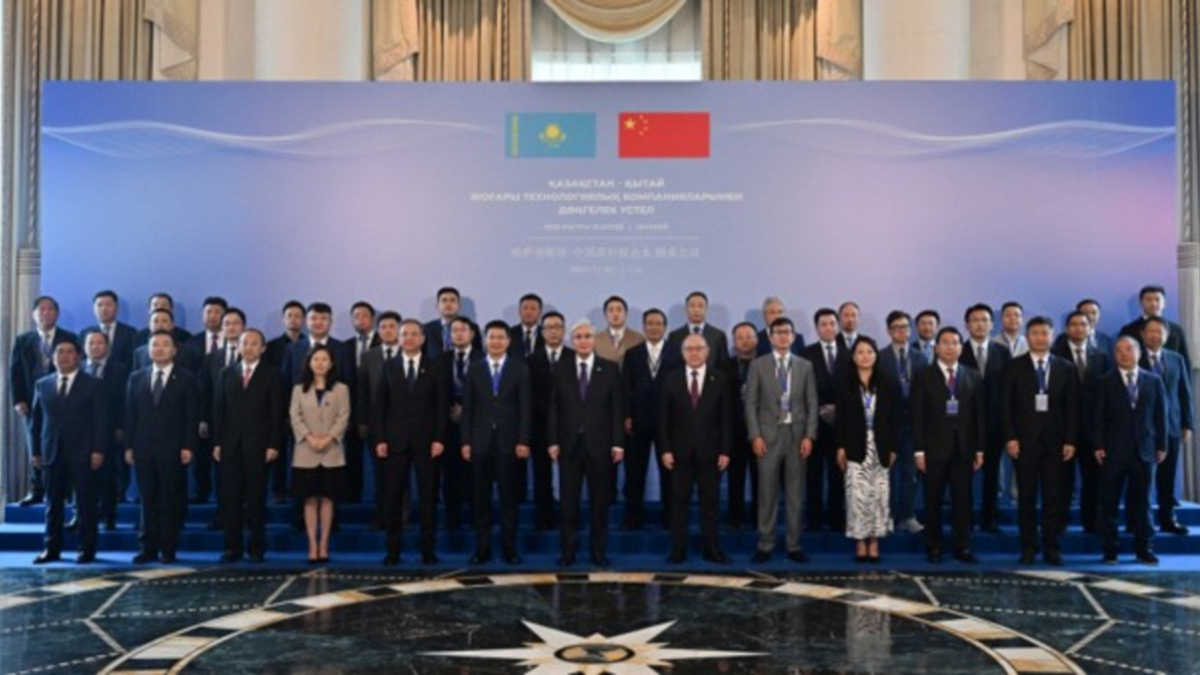
Kazakhstan and China have signed more than $15 billion worth of commercial agreements during President Kassym-Jomart Tokayev’s visit to Shanghai, expanding cooperation in artificial intelligence, digitalisation, transport and industry.
The deals build on a rapidly expanding economic relationship. Bilateral trade reached a record $49 billion last year, while Chinese investment in Kazakhstan has exceeded $30 billion. More than 8,500 companies with Chinese capital are currently operating in the country.
Speaking to senior Chinese business leaders, Tokayev described the next phase of relations as a new “golden thirty years” of cooperation. He said Kazakhstan was seeking more than an inflow of capital and wanted to develop technologies, research centres, production chains and skilled workers together with international partners.
“Our goal is not simply to attract capital. We aim to jointly develop new technologies, establish research centres, build new production chains and invest in human capital that will advance the economy of knowledge,” Tokayev said.
Turning focus to AI
Artificial intelligence is becoming an important part of Kazakhstan’s economic strategy. The government is inviting Chinese technology companies to participate in the development of data centres, smart cities, digital logistics and other infrastructure intended to support innovation and attract international investors.
That digital focus is also being applied to transport. Around 85% of rail freight between China and Europe passes through Kazakhstan, which has invested more than $35 billion in transport infrastructure. Tokayev said the competitiveness of modern trade routes now depended not only on railways and ports, but also on faster data exchange, digital integration and greater transparency.
Adapting technology to logistics
Kazakhstan is developing the Smart Cargo platform to bring customs, logistics and commercial services into a single digital system. The aim is to reduce delays and allow goods to cross borders more efficiently.
Several major infrastructure projects were also discussed during the visit. At a meeting with Zhang Binnan, President of China Communications Construction Company, Tokayev highlighted the planned Bakhty-Ayagoz railway as a strategic project that could increase freight volumes between Kazakhstan and China.
Caspian port complex planned
Kazakhstan also signed an agreement with China’s Guoyou Materials Group to build a multifunctional port complex at Kuryk on the Caspian Sea. Initial investment is expected to reach $300 million, with the total cost potentially rising to $1.1 billion.
Construction is due to begin in 2026, with the facility scheduled to open in 2028. The port will have an annual capacity of 15 million tonnes and is expected to strengthen the Middle Corridor, the trade route connecting Asia and Europe through Central Asia and the South Caucasus.
The agreements signed in Shanghai reflect a broader shift in Kazakhstan-China relations, with both countries combining traditional investment in transport and industry with growing cooperation in artificial intelligence, digital systems and higher-value manufacturing.
Read more:

















What is your opinion on this topic?
Leave the first comment