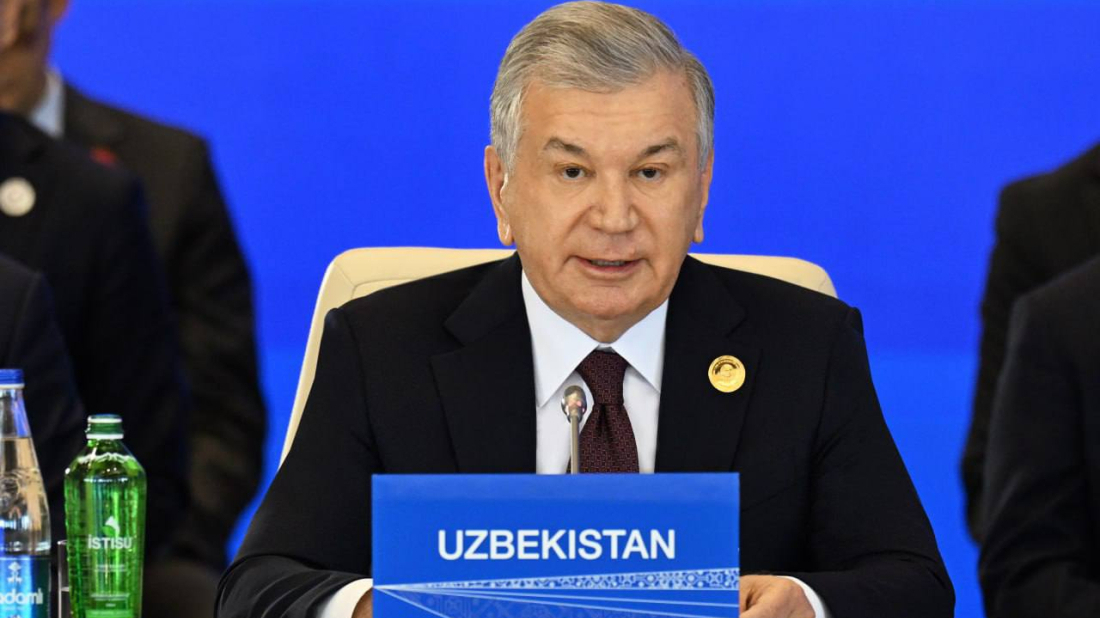
In his speech at the Economic Cooperation Organization Summit held in Khankendi, the President of Uzbekistan urged to define the medium and long-term development priorities of the organization and put forward a proposal to adopt the concept of 'Strategic Goals of Economic Cooperation – 2035.
"The foundation of any peace and development is based, first and foremost, on economic cooperation. Therefore, our partnership within the Organization is not only natural, but also of great strategic importance," - the President Shavkat Mirziyoyev said in the statement published by his press office.
He emphasized the importance of enhancing cooperation in innovation, artificial intelligence, and digital technologies, alongside traditional sectors such as trade, investment, transport, energy, industry, agriculture, ecology, tourism, and education.
Uzbekistan leader stressed that the current volume of mutual trade among ECO member states remains relatively low, according to 2024 data. The trade volume acmounted $95 billion that is only10% of total trade of all ECO member-countries.
"We propose holding a meeting of our trade ministers in Tashkent this year to address strategic issues in this field and to finalize an Agreement on Trade Facilitation,” President Mirziyoyev stated.
“We are also putting forward an initiative to adopt a long-term Eco-Invest Program aimed at elevating our investment cooperation and enhancing the transparency and attractiveness of the investment climate. The primary objective of this program is to attract private investors, banks, and international financial institutions to high-potential projects across our region.”
He drew attention to the impact of recent geopolitical escalations on supply chain stability and underlined the strategic necessity of creating alternative transport routes.
In particular, Mirziyoyev highlighted the launch of the China – Kyrgyzstan – Uzbekistan railway link last year, which would be connected with the Trans-Afghan corridor, effectively integrating transit networks across the region.
Uzbekistan has urged to create a Digital Transport and Customs Office to ensure the digitalization of the transport and logistics sector.
"Among our key priorities are the launch of new regional air routes, the implementation of innovative partnerships between airlines, and the development of integrated marketing strategies linking the tourism and aviation sectors. To address these issues, we propose holding a National Airlines Forum in Samarkand," - President Shavkat Mirziyoyev stated.
"We have the potential to double the number of tourist arrivals. To support this objective, the development of a Roadmap for the Expansion of Tourism Services within the Organization will be essential," - he added.
Uzbekistan leader welcomed the participation of the delegation from the Interim Government of Afghanistan after a prolonged absence and called Afghanistan 'as an integral part of our Organization’s space and as an important partner in broader economic cooperation and regional transport connectivity efforts.'












What is your opinion on this topic?
Leave the first comment