UN chief regrets U.S. decision to withdraw from international organisations
UN Secretary-General Antonio Guterres expressed regret on Thursday over the decision by the Trump administration to withdraw from 31 entities linked t...
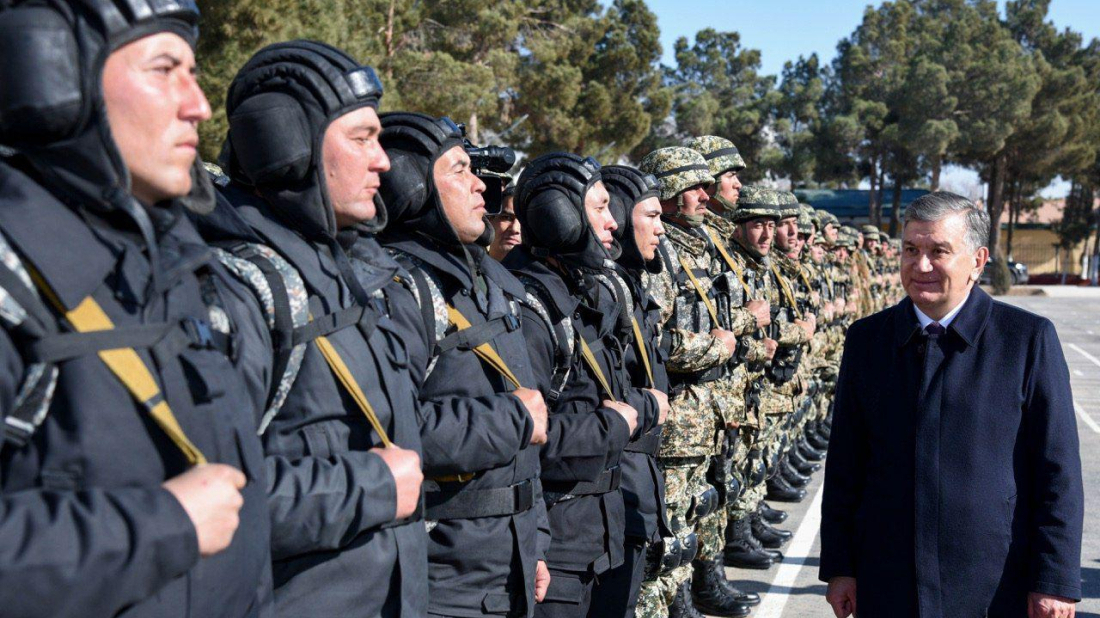
Uzbekistan has officially approved a new concept aimed at overhauling its system of military professional education, focusing on modernization, integration, and broader career opportunities for service members.
The President of Uzbekistan and Supreme Commander-in-Chief of the Armed Forces, Shavkat Mirziyoyev, has approved a series of proposals aimed at reforming the country's military education system.
A new national model for training military personnel has been developed following a study of military education systems in more than 20 foreign countries. The imperative for modernization was underscored at the Security Council meeting on February 21, 2025.
According to the new model, a University of Military Security and Defence of the Republic of Uzbekistan will be establised based on the existing Academy of Armed Forces that has been the center of country's military professional education since 2017.
The new university will consolidate all educational facilities under the Ministry of Defence, including five institutes, the Higher School for Sergeant Training, and the School for Training Specialists in Aviation and Unmanned Aerial Vehicles—both of which will be granted institute status.
“Ultimately, this will create a unified, vertically integrated structure aimed at strengthening the army’s capabilities, expanding dual education programs, and accelerating the practical application of scientific research,” the Presidential Office said in a statement.
Another key innovation is the introduction of a hybrid “2+2” model, under which second-year students at civilian universities will be selected to undergo military training in 18 specialized fields, including psychology, communications, logistics, and supply.
To support talented youth, the State Scholarship of the Supreme Commander-in-Chief will be launched starting this academic year. Recipients of the scholarship will be eligible to enroll in a military master’s programme without entrance exams during five years after completing their bachelor's degree.
A dual-degree system will also be implemented, enabling graduates of military academies to earn diplomas in both military and civilian professions across 36 specialties—ensuring broader career opportunities even after completing their military service.

Open-source intelligence (OSINT) sources reported a significant movement of U.S. military aircraft towards the Middle East in recent hours. Dozens of U.S. Air Force aerial refuelling tankers and heavy transport aircraft were observed heading eastwards, presumably to staging points in the region.
Snow and ice stalled travellers in northwest Europe on Wednesday, forcing around a thousand to spend the night in Amsterdam's Schiphol airport but delighting others who set out to explore a snow-blanketed Paris on sledges and skis.
Diplomatic tensions between Tokyo and Beijing escalated as Japan slams China's export ban on dual-use goods. Markets have wobbled as fears grow over a potential rare earth embargo affecting global supply chains.
Two people have been killed after a private helicopter crashed at a recreation centre in Russia’s Perm region, Russian authorities and local media have said.
Iran’s chief justice has warned protesters there will be “no leniency for those who help the enemy against the Islamic Republic”, as rights groups reported a rising death toll during what observers describe as the country’s biggest wave of unrest in three years.
Tens of thousands of Iranians have taken to the streets in Tehran and across at least 28 cities in a wave of anti-government demonstrations, now entering their twelfth day.
Iran is now facing a near‑total internet blackout as anti-government protests sweep the country. Major cities including Tehran have seen connectivity drop sharply, leaving millions of residents isolated from online communication.
A series of statements by Georgian Parliament Speaker Shalva Papuashvili has reignited debate over freedom of speech, the role of the Orthodox Church, and the influence of the European Union.
A significant development in the complex Azerbaijan - Armenia scenario is the growing confrontation between Armenia’s political leadership and the Armenian Apostolic Church.
President Ilham Aliyev has said the opening of the Zangezur corridor is no longer in question, describing it as a strategic transport link that will connect mainland Azerbaijan with the Nakhchivan Autonomous Republic and carry cargo from China and Central Asia to wider regional markets.
You can download the AnewZ application from Play Store and the App Store.
What is your opinion on this topic?
Leave the first comment