The AnewZ Opinion section provides a platform for independent voices to share expert perspectives on global and regional issues. The views expressed are solely those of the authors and do not represent the official position of AnewZ
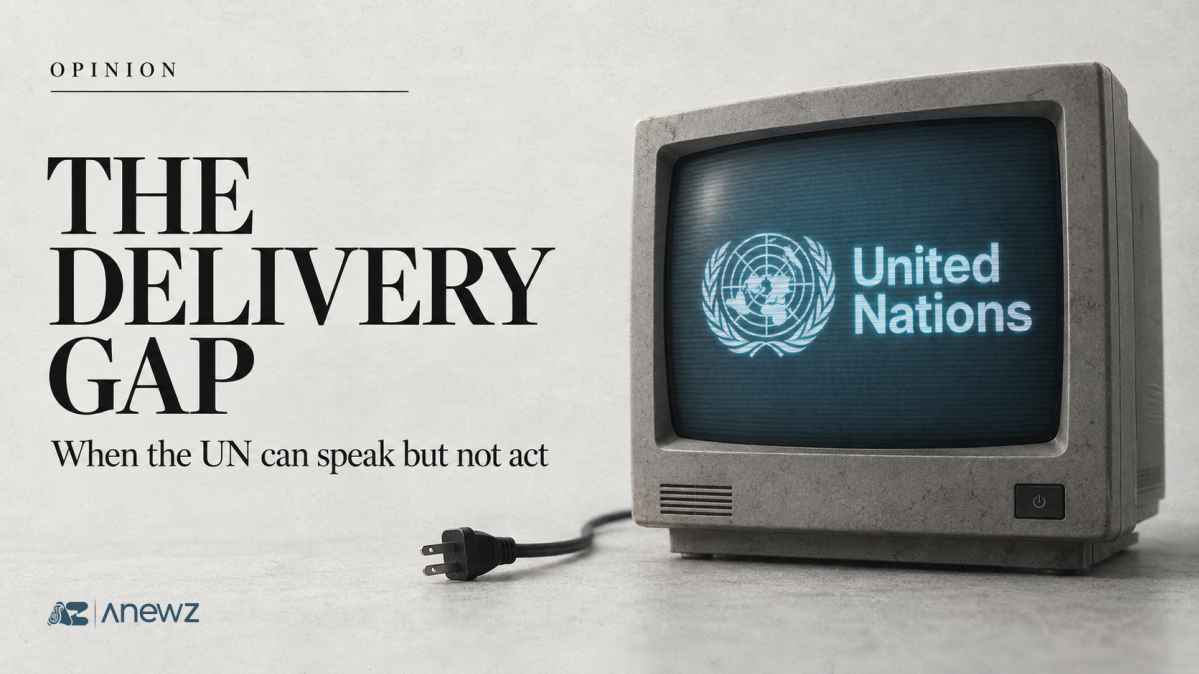
The opening debates of the 81st General Assembly exposed the distance between collective promises and enforceable decisions. The question is what the UN can deliver when the states with the power to act cannot agree.
A speech can describe a crisis. A resolution can record a position. Neither, by itself, implements a ceasefire.
The distinction is written into the United Nations’ own responsibilities. Article 24 of its Charter assigns the Security Council primary responsibility for international peace and security, explicitly to ensure “prompt and effective action”.
The opening debates of the 81st General Assembly brought the distance between that mandate and its delivery back into focus. In his address on 22 September, Recep Tayyip Erdoğan argued that the organisation had been rendered unable to fulfil its peace and security mission and called for reform of the Security Council.
The underlying question extends beyond any one speech: what happens when an institution has responsibility for a crisis but cannot obtain the agreement needed to act on it?
That is the delivery gap. Discussion, political support and enforcement are different stages. Progress at the first does not guarantee progress at the last.
A majority is not enough
The Security Council’s voting rules explain part of the problem. A substantive resolution needs at least nine votes and must avoid a veto from any of its five permanent members. A permanent member can abstain and allow a resolution to pass, but a negative vote blocks it.
The General Assembly operates differently: each member state has one vote. It can debate conflicts and make recommendations, but its peace and security recommendations do not acquire the Council’s enforcement powers because more countries support them.
This creates a specific limit on collective action. A position may attract broad diplomatic support without becoming an enforceable Council decision. The number of governments persuaded and the authority to implement their position are not the same thing.
The 1950 Uniting for Peace mechanism provides a route for the Assembly to consider collective measures when the Council is blocked. Yet the measures it recommends do not become binding orders. The UN’s own legal account makes clear that the Assembly cannot fully substitute for the Council in this area.
Moving a debate to another chamber can prevent an issue from disappearing. It does not remove the obstacle to enforcement. The institution can continue speaking while the decision required for action remains unavailable.
Diplomacy is not the same as delivery
There is an important distinction between negotiating at the UN and negotiating through it. A bilateral meeting during General Assembly week may help governments reach an understanding. But the venue does not determine who controls the terms, supplies the resources or guarantees implementation.
The questions raised by Ukraine and the Middle East illustrate what implementation entails. Who monitors an agreement? Who secures humanitarian access? Who provides guarantees? What follows if commitments are broken? A declaration of support cannot answer all of those questions.
Nor is this an argument that every agreement must be negotiated exclusively by the UN. Direct diplomacy, regional mediation and narrower negotiating formats can all contribute to a settlement. The analytical point is about attribution: convening governments and delivering an enforceable outcome are different achievements.
The Charter gives the Council more than an advisory role. Under Article 25, members undertake to accept and carry out its decisions in accordance with the Charter. That makes the inability to reach a decision consequential: the organisation’s authority exists, but its use depends on the required agreement.
A ceasefire announcement and a sustained ceasefire are therefore different measures of delivery. So are a commitment to protect civilians and an arrangement that actually provides protection. Counting meetings or declarations cannot establish whether those later stages have been reached.
Reform has its own veto problem
Donald Trump’s 22 September address emphasised U.S. sovereignty and criticised international bodies whose actions he contested. Erdoğan’s address concentrated on the distribution of authority in the Security Council and the limits imposed by its five permanent members.
These positions are not identical. They raise different questions about national discretion, representation and the powers of international institutions. Treating them simply as support for, or opposition to, the UN misses those distinctions.
The more immediate institutional problem is how any agreed change could take effect.
Russia’s response illustrated the difference between expanding representation and changing voting power. On 22 September, the Kremlin supported adding permanent Council members while retaining the existing veto system. That is a stated preference for a larger Council, not for removing the present power to block decisions.
The Charter also places a demanding condition on structural reform. Article 108 requires amendments to be adopted by two-thirds of the General Assembly and ratified by two-thirds of UN members, including every permanent Security Council member.
The states holding the existing powers therefore have a decisive role in determining whether those powers change. A large majority in favour of reform is not sufficient on its own.
This is where the discussion moves beyond bureaucracy. A more efficient secretariat, a shorter meeting or a revised administrative process would not, by itself, change the voting rules. Institutional reform and administrative reform address different problems.
Even additional seats leave further questions open. What powers would new members receive? Would the same decisions remain vulnerable to the same vetoes? Would broader participation change the conditions for action, or primarily the composition of the debate?
Representation without a guarantee
The institutional tension concerns three things: the capacity to act, the authority to decide and the support needed to give a decision international legitimacy. At the UN, these do not necessarily sit in the same hands.
For countries outside the permanent five, the Assembly provides a vote and a platform. It does not provide an assurance that a position supported there will produce a Security Council decision.
This is one reason to distinguish the demand for greater representation from the idea of a single Global South bloc. Sharing an interest in having more influence does not require agreement on every security, trade or technological question. A coalition on one issue need not survive the next.
The difficulty is not simply finding a formula that gives more states a voice. It is establishing what that voice changes when interests conflict. Representation can widen participation without resolving the delivery gap.
For a government seeking protection, a diplomatic majority and an operational guarantee remain different assets. The former may help build the latter. It cannot be assumed to supply it.
The next test is technological
Artificial intelligence brings the same problem into a different policy area. In his address, Trump explicitly rejected a global system of control over AI.
The institutional question is how governments with different views on regulation could agree on workable arrangements. What would participating states disclose? Who would assess risks? How would information be checked? What would happen when a government or company declined to cooperate?
A common statement about responsible technology would not, on its own, establish any of those procedures. Nor would broad participation in a discussion necessarily distribute influence over the systems being developed.
This is another version of the gap between power and representation. Access to a forum, access to technology and authority over its use are separate questions. Without an agreed way to connect them, the UN could reproduce its existing delivery problem in a new field.
The implications for Azerbaijan
For Azerbaijan, the practical distinction is between international recognition of a position and the relationships or capabilities needed to support it. Neither legal argument nor diplomatic participation automatically provides an operational guarantee.
Transport connectivity offers a concrete example of cooperation that depends on implementation. The World Bank’s assessment of the Middle Corridor identifies Azerbaijan, Georgia and Kazakhstan as its three core countries and emphasises coordination, logistics and infrastructure investment.
The inference is conditional: functioning connections can create shared interests among partners that disagree elsewhere. But the value lies in reliable movement, workable agreements and continued cooperation — not simply in announcing a corridor.
The same distinction applies to international institutions. Legal recognition, political support and implementation reinforce one another only when the necessary arrangements exist. For smaller and middle-ranking states, the gap between them is not an abstract debate about world order. It affects what international commitments can be relied upon to do.
What follows the vote?
The criticism here concerns the UN’s machinery for collective political action, not a claim that every part of its work should be judged by the same measure. But the Charter’s promise of prompt and effective action cannot be assessed only by whether governments continue to attend its meetings.
The opening debates show why the question of reform persists. States disagree about how much authority international institutions should exercise, how that authority should be distributed and which decisions they are prepared to accept. Those disagreements cannot be resolved by giving the same commitments stronger wording.
The test of delivery comes afterwards: whether an agreement has the authority, resources and cooperation required to work; whether implementation is monitored; and whether a failure to comply produces a response.
A resolution records what has been agreed. The next question is who will carry it out - and what happens if they do not?
















What is your opinion on this topic?
Leave the first comment