The AnewZ Opinion section provides a platform for independent voices to share expert perspectives on global and regional issues. The views expressed are solely those of the authors and do not represent the official position of AnewZ
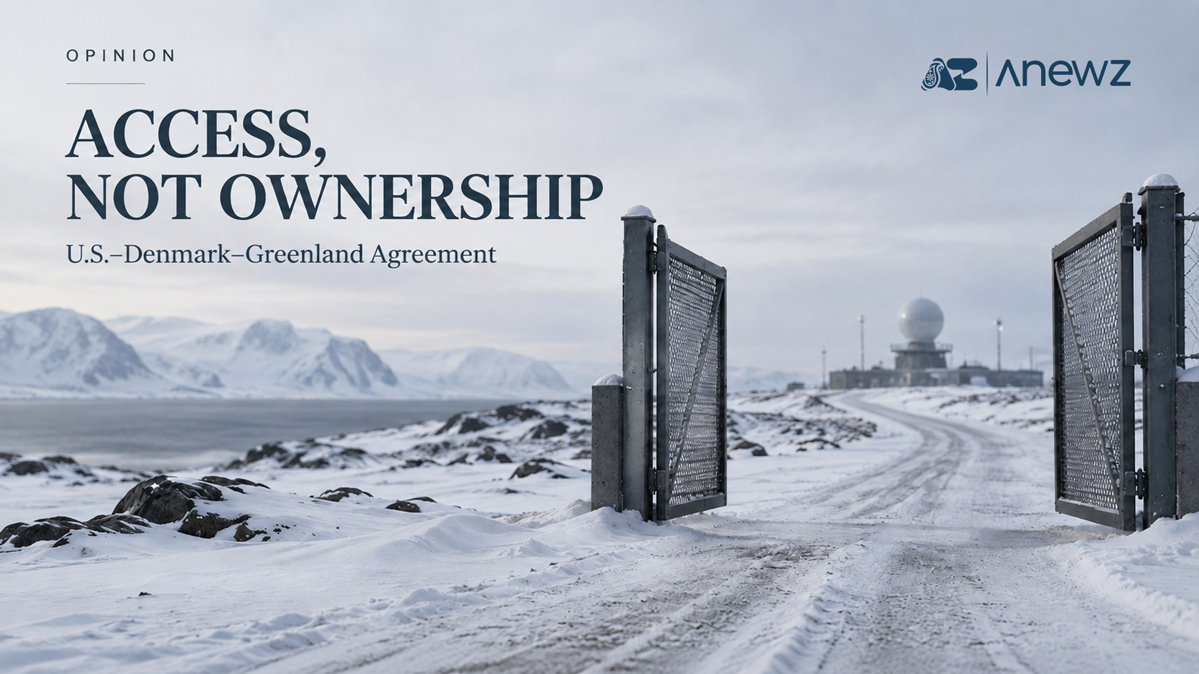
A new U.S.–Denmark–Greenland security deal expands Washington’s military access in Greenland but does not transfer sovereignty to the United States, with the agreement reaffirming Denmark’s territorial integrity and Greenlanders’ right to self-determination.
The agreement, signed in New York on 22 September by U.S. President Donald Trump, Danish Prime Minister Mette Frederiksen and Greenland Prime Minister Jens-Frederik Nielsen, follows an initial announcement by Trump four days earlier.
Trump has described the arrangement as giving Washington “permanent control” over Greenland’s security. But the agreement itself reaffirms the sovereignty and territorial integrity of the Kingdom of Denmark, as well as the Greenlandic people’s right to self-determination.
The distinction is significant: expanded U.S. military access and security rights do not amount to American ownership of Greenland.
The central bargain
The deal gives Washington a larger and long-term military role in Greenland, while placing restrictions on certain foreign military activities and sensitive investments. It also allows the U.S. to expand operations at Pituffik Space Base and establish additional defence areas at Narsarsuaq and Mestersvig.
At the same time, the agreement explicitly preserves the Kingdom of Denmark’s sovereignty and territorial integrity and recognises Greenlanders’ right to self-determination.
Expanded U.S. military presence
The agreement allows the United States to modernise and expand its activities at Pituffik Space Base and establish additional defence areas at Narsarsuaq and Mestersvig, subject to modalities and technical details agreed by the parties.
It also gives U.S. forces broad access and movement rights between defence areas by land, air and sea. U.S. aircraft may fly over and land in Greenland, while U.S. public vessels are granted specified access to Greenland’s territorial waters.
These provisions build on an existing defence framework rather than creating an American military presence in Greenland from scratch.
Restrictions on Russian and Chinese strategic activity
The agreement bars states outside NATO from establishing their own manned or unmanned military installations or maintaining a persistent military presence in Greenland unless the parties agree otherwise.
It also restricts certain investments involving states or investors from countries outside NATO, NATO partnerships or the EU where control, significant influence or access to non-public information could threaten national security or public order in particularly sensitive sectors.
Greenland is responsible for implementing the investment provisions, in close cooperation with Danish authorities, through its current or future investment-screening laws. Danish authorities are also required to consult closely with their U.S. counterparts and other partners.
A deal with no end date
Trump called it an “Infinite Life” agreement. The signed text confirms that the deal has no end date and can be amended only by mutual consent under the existing 1951 defence agreement.
The agreement also addresses what would happen if Greenland became independent. Denmark and Greenland are required to ensure that an independent Greenland agrees to remain in NATO - applying for membership if necessary - and assumes the relevant rights and obligations contained in the agreement and existing defence arrangements.
What the United States has not obtained
The agreement does not transfer Greenland to U.S. ownership. Instead, it explicitly reaffirms the sovereignty and territorial integrity of the Kingdom of Denmark and recognises the Greenlandic people’s right to self-determination.
That marks a clear distinction from Trump’s previously stated ambition to acquire the island.
Danish Foreign Minister Lars Løkke Rasmussen had said before the signing that the agreement respected Denmark’s red lines, while Danish and Greenlandic leaders consistently maintained that sovereignty and self-determination would be preserved.
No general U.S. veto
The agreement does not establish a general U.S. veto over Greenlandic government decisions. Before the signing, The Washington Post reported that the deal would not give Washington such a power.
The published text instead sets out defined restrictions covering military installations, sensitive investments and security around defence areas. In several cases, decisions require agreement or consultation between the parties rather than unilateral U.S. approval.
That distinction is important: restrictions in defined areas of military and investment policy are not the same as a general power to overrule Greenland’s government.
When the agreement takes effect
Although the agreement was signed in New York on 22 September, it has not automatically entered into force.
The text states that it will take effect once the United States receives a diplomatic note confirming that the necessary parliamentary procedures have been completed by the Kingdom of Denmark together with Greenland.
Signing and entry into force are therefore separate stages.
Built on decades of U.S. defence ties
The United States already has a longstanding defence framework in Greenland. The 1951 U.S.-Danish agreement established the legal basis for that presence, while the 2004 Igaliku Agreement amended and supplemented the framework and strengthened consultation involving Greenland’s Home Rule Government.
Under Article 3 of the 2004 agreement, the United States must consult and inform Denmark, including Greenland’s government, before implementing significant changes to U.S. military operations or facilities in Greenland.
The new agreement therefore expands an existing security relationship rather than replacing it. It gives Washington broader military access and establishes new defence areas and security restrictions, while leaving sovereignty with the Kingdom of Denmark and maintaining Greenlanders’ right to determine their political future.
The key change is not who owns Greenland, but the scale and permanence of the U.S. military role there - and the rules governing foreign military activity and strategically sensitive investment on the Arctic island.













What is your opinion on this topic?
Leave the first comment