The AnewZ Opinion section provides a platform for independent voices to share expert perspectives on global and regional issues. The views expressed are solely those of the authors and do not represent the official position of AnewZ
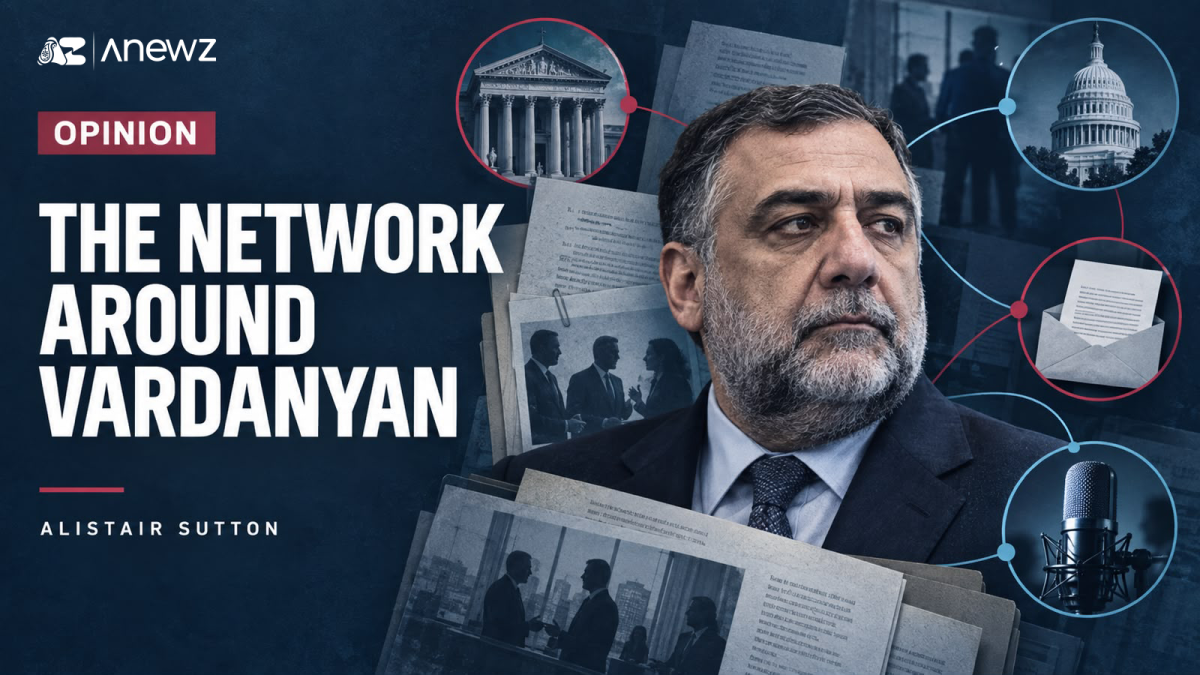
Public records reveal a layered effort spanning a foundation-provided campaign hub, international lawyers, registered lobbyists, diaspora advocates and professional communications firms. The network is not secret, and its existence is not the scandal. The missing provenance often is.
International advocacy rarely arrives wearing a badge marked campaign. It arrives as a family plea, a legal filing, a congressional briefing, a humanitarian mission, an expert report or an opinion column. Each item may be sincere. Together, they can also form a disciplined system.
Open-source records show such a system operating around Ruben Vardanyan, the businessman, philanthropist and former state minister of the breakaway Armenian administration in Garabagh. He was detained by Azerbaijan in September 2023. On 17 February 2026, a Baku military court sentenced him to 20 years after convicting him of offences including terrorism and war crimes. His family and legal team reject the case and the verdict. Amnesty International has raised serious fair-trial concerns.
That dispute is not a side issue. It is precisely why provenance matters. OSINT cannot substitute for a court or determine guilt from a web browser. It can, however, answer narrower questions: who owns the platform carrying a claim, who paid for registered lobbying, which officials were targeted, who supplied media contacts, and how the same framing travelled between legal, political and editorial arenas.
The campaign has a disclosed centre
Begin with Free Armenian Prisoners, the principal campaign website repeatedly cited in statements, petitions and press releases. The site presents Vardanyan as a political prisoner who is being illegally detained. Yet its own terms and conditions provide a crucial disclosure: the website is provided by the Ruben Vardanyan Charitable Foundation. The same page says that all information on the site is posted by the provider.
That does not make the site’s claims false. It makes them the claims of an interested advocacy platform, not the findings of an independent monitor. This distinction is often lost once a statement moves through syndication or is described simply as coming from a ‘campaign group’. The branding becomes visible; the institutional provenance recedes.
The site is more than an archive. It asks visitors to sign a petition, contact President Ilham Aliyev and write to ambassadors. It supplies a ready-made narrative, mobilisation tools, news updates, legal papers, interviews and a list of supporters. In communications terms, it is the campaign’s owned-media hub.
One lawyer, several arenas
The next layer is both legal and political. A U.S. Lobbying Disclosure Act registration effective from 10 January 2024 names Washington law firm Perseus Strategies as registrant and Vardanyan’s son, David, as the client. The client’s activity is described as advocating for the release of his father. Jared Genser and Brian Tronic were initially listed as lobbyists. Later filings name Genser with Zara Salman and then Yumei Lin.
The stated dollar amounts are concrete. Perseus reported $30,000 in lobbying income for the first quarter of 2024, $20,000 in the first quarter of 2025, $20,000 in the second quarter and $5,000 in the third. Those stated figures total $75,000. They are lobbying-income disclosures, not a complete account of legal, communications or campaign expenditure. A termination report ended the engagement on 31 March 2026 and reported no lobbying activity for that quarter.
The filings say the work concerned U.S. political, economic, human-rights and humanitarian interests relating to Azerbaijan and the release of political prisoners. They identify contacts with the Senate and State Department in 2024, expanding in 2025 to the House of Representatives and National Security Council.
Perseus itself explains the method. Its public description says the firm combines international law, political advocacy and media engagement. It describes contacting senior officials, advocating resolutions or legislation, building coalitions, issuing press releases, pitching interviews and placing opinion articles. In other words, the overlap is not accidental. It is the operating model.
There is nothing improper about that model. Registered lobbying is lawful, and disclosure is the mechanism that lets the public inspect it. The same record also sets limits on any inference: the named client was David Vardanyan, not the Armenian government or the foundation, and the registration did not identify an affiliated organisation contributing above the statutory threshold or a foreign entity controlling the work. The evidence shows an integrated family-backed engagement. It does not establish a hidden state operation.
Legal claims become political material
The legal campaign has moved through several international mechanisms. Vardanyan’s team petitioned UN procedures and publicised allegations of mistreatment. But the record is not uniformly favourable to the campaign. In Opinion 46/2024, the UN Working Group on Arbitrary Detention concluded that his case was not one of arbitrary detention. Supporters later challenged the opinion’s integrity, alleging a conflict of interest involving the Working Group’s chair. No public UN record located for this review showed that the opinion had been withdrawn or replaced by the research cut-off.
In July 2026, Armenian lawyer Siranush Sahakyan said she had filed an application with the European Court of Human Rights alleging violations of eight articles of the European Convention. That is a significant procedural step, but an application records allegations; it is not a judgment on them.
The same lawyers also appear in political advocacy spaces. In September 2025, the Armenian National Committee of America and the Armenian Legal Center organised a Capitol Hill briefing whose speakers included Genser and Sahakyan. The event promoted prisoner releases and sanctions legislation. This is a documented point of intersection between the legal and diaspora-advocacy layers. It is not proof that those organisations were contractors to the family. Alignment is not the same as control.
Reputational capital becomes political reach
Vardanyan entered detention with a substantial international network built through business and philanthropy. The Aurora Humanitarian Initiative identifies him as one of its founders alongside Vartan Gregorian and Noubar Afeyan. That history matters because prominent supporters do not emerge from a vacuum. They are connected to years of humanitarian projects, institutions and personal relationships.
A December 2023 syndicated release announced that more than 150 humanitarian, business and political figures had called for Armenian detainees to be freed. The release highlighted former heads of state, Nobel laureates and business leaders. It also acknowledged Afeyan’s longstanding collaboration with Vardanyan.
A signature proves endorsement, not payment, direction or knowledge of every campaign decision. Yet the communications value is obvious: a family cause is converted into a global coalition headline. The reputations of individual signatories become transferable political capital. Responsible reporting should identify prior institutional ties where they are relevant, without dismissing the signatories’ sincerely held views.
The professional communications layer
The press-release trail makes the communications layer visible. The December 2023 release lists Nia Jackson of Edelman Global Advisory and Anahit Akopian of H/Advisors as media contacts, alongside Free Armenian Prisoners. An April 2024 family statement about Vardanyan’s hunger strike was distributed through the same wire ecosystem; it identifies Free Armenian Prisoners as the source and Jere Sullivan of Edelman Global Advisory as the media contact.
Those credits document professional communications support at specific moments. They do not, by themselves, reveal who contracted the firms, the fees paid, the complete scope of work or whether those relationships continued. No such contract or fee schedule was located in the public materials reviewed.
The campaign then closes the distribution loop. Its ‘Key Materials’ page curates legal explanations, supportive columns, news reports and interviews featuring family members, lawyers and allies. That is normal advocacy practice. It is also why a campaign archive should not be mistaken for a neutral evidentiary record: it is designed to reinforce one interpretation and mobilise action around it.
The language matters. ‘Political prisoner’, ‘hostage’, ‘illegal detention’, ‘rigged trial’ and ‘ethnic cleansing’ are not interchangeable with neutral description. Some may reflect genuine legal or moral judgments; others remain disputed characterisations. Repetition across a website, wire release, briefing and opinion page can make a contested label look like an independently verified fact. It is still the same claim travelling through several channels.
A humanitarian mission can also be a communications event
The latest example is Veronika Zonabend’s proposed international women’s humanitarian delegation to Baku. In a statement published on 8 July 2026, Vardanyan’s wife said she had written openly to Azerbaijan’s human-rights commissioner, the president of the International Committee of the Red Cross, Armenia’s prime minister and the European Union’s foreign-policy chief. The stated goals were to visit Armenian detainees, meet the ombudsman and deliver permitted family items.
The humanitarian purpose deserves to be taken seriously. So does the communications effect. Four open letters create four institutional decision points and a public record before any visit occurs. Agreement can deliver access; silence or refusal can become evidence in the next advocacy cycle. The two functions can coexist. A humanitarian initiative does not stop being humanitarian because it is strategic, and it does not stop being strategic because it is humanitarian.
The public-record map - what the open record establishes
(This map records disclosed links. It does not imply that every participant is funded, directed or controlled by a single centre.)
Campaign hub
The Free Armenian Prisoners terms identify the Ruben Vardanyan Charitable Foundation as the website provider and say the provider posts all site information.
Law + lobbying
U.S. filings register Perseus Strategies for Vardanyan’s son David. Quarters with stated amounts total $75,000 in lobbying income.
Advocacy
Filings name the U.S. Senate, House, State Department and National Security Council; diaspora groups hosted public briefings with Vardanyan’s lawyers.
Communications
Syndicated releases list Edelman Global Advisory and H/Advisors personnel as media contacts; the campaign site curates supportive coverage and interviews.
Where the evidence stops
The network is real in the ordinary, verifiable sense of the word: named people and organisations are connected through a foundation-provided platform, a registered lobbying engagement, legal representation, public briefings, philanthropic relationships and professional media contacts.
The open record reviewed here does not prove that every supporter, civil-society organisation or media outlet was paid, directed or even coordinated by one centre. It does not prove that every article listed by the campaign was commissioned. It does not establish Armenian government control. Nor does mapping the campaign resolve the merits of Vardanyan’s conviction or erase independent criticism of Azerbaijan’s trial process.
These limits are not a weakness. They are the discipline OSINT requires. A connection should be described as a connection; a contract as a contract; a common message as a common message. The temptation to turn a map into a conspiracy theory is as misleading as the temptation to ignore the map altogether.
The missing label
The central journalistic question is therefore not whether Vardanyan should have advocates. Every detainee is entitled to legal representation, family contact, humane treatment and a fair process. The question is whether audiences are told when a message comes from a foundation bearing his name, from his son’s registered lobbyists, from allied diaspora groups or from a professionally distributed campaign release.
Azerbaijan’s conviction and serious fair-trial criticism can both be part of the record. Rights advocacy can be principled and strategically organised at the same time. These propositions are not contradictions. What should be unacceptable is allowing professional repetition to turn an interested party’s conclusion into an unlabelled fact.
A petition counts supporters. A lobbying filing records influence work. A press release records distribution. None of them, alone, proves the truth of the underlying case. Journalism’s first duty is to show the chain of custody of a claim — who made it, who paid to advance it, who amplified it and what contrary evidence remains. In a contested case, provenance is not a footnote. It is part of the story.
The views expressed in this article are the author’s own. This OSINT review uses publicly accessible records and does not allege unlawful conduct by any person or organisation named.

















What is your opinion on this topic?
Leave the first comment