The AnewZ Opinion section provides a platform for independent voices to share expert perspectives on global and regional issues. The views expressed are solely those of the authors and do not represent the official position of AnewZ
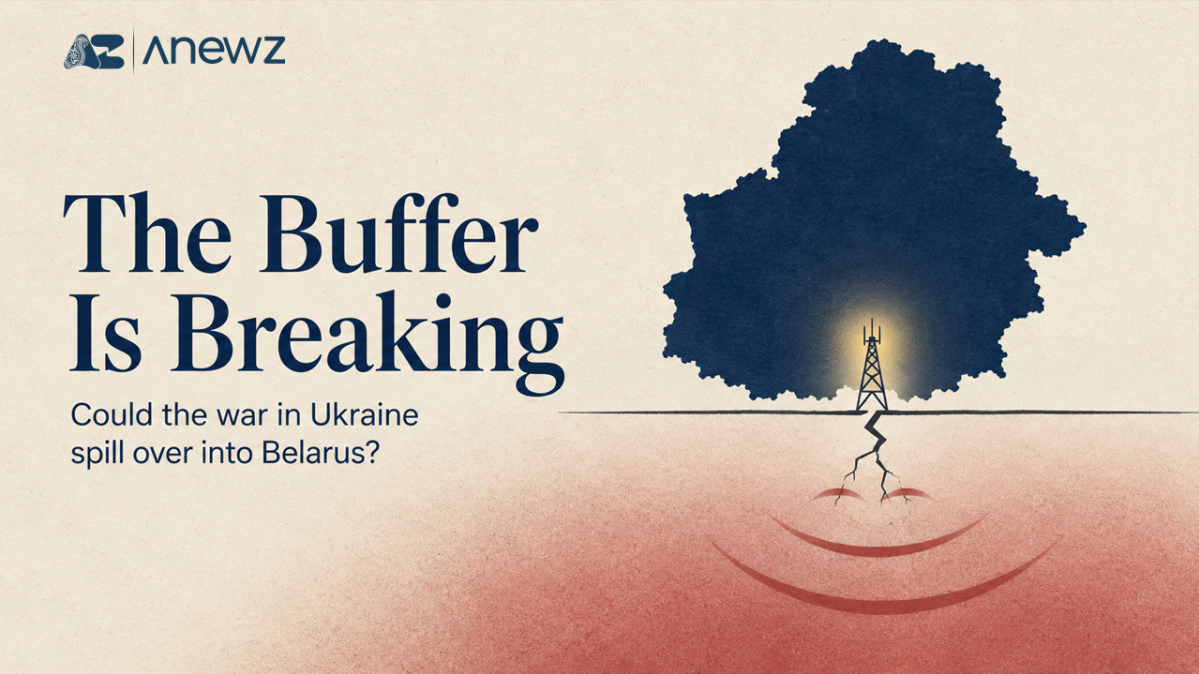
Belarus has not sent its army into Ukraine, but it is no longer outside the war.
President Volodymyr Zelenskyy's warning to Alexander Lukashenko over signal relay stations allegedly helping Russian attacks on Ukraine marks a new phase in Kyiv's pressure campaign. The message was clear: if Belarusian territory is used to support Russian strikes, Belarusian territory may no longer be treated as untouchable.
For Lukashenko, this creates a difficult calculation. Belarus has tried to avoid direct military participation while remaining Russia's closest ally in Europe. That balance is becoming harder to maintain.
Belarus's uneasy position
In the first phase of Russia's full-scale invasion in 2022, Belarus played a crucial supporting role. Russian forces used Belarusian territory to attack northern Ukraine, including the Kyiv region. Although Belarusian troops did not directly enter the war, Minsk's decision to open its territory to Moscow had a lasting impact on relations with Kyiv.
Ukraine has since fortified its northern border. For Kyiv, Belarus is not a neutral neighbour. It is a state whose territory helped Russia launch one of the most significant early offensives of the war. Even after Russian forces withdrew most of their presence from Belarus following the failed attempt to capture Kyiv, strategic suspicion remained.
The situation has now shifted. It is not only Ukraine that fears Belarusian territory. Belarus also has reason to fear that its own involvement in Russia's war infrastructure could bring consequences on to its soil.
Zelenskyy's warning on 19 June was direct. He said equipment located in Belarusian regions bordering Ukraine was being used to help guide attacks against Ukrainian civilians. He gave Lukashenko one week to remove or switch off the equipment, adding that Ukraine would act if Belarus did not.
A risk of escalation
This does not mean a Ukrainian invasion of Belarus is likely. Such a move would carry serious military, political and diplomatic risks. It could also allow Lukashenko to present himself domestically as the victim of foreign aggression. Kyiv is aware of that danger.
A more plausible scenario is targeted Ukrainian pressure on military-linked infrastructure used to support Russian attacks. That would still be a major escalation, but it would be very different from a ground operation or any attempt to occupy Belarusian territory.
Such a scenario would place Russia in an uncomfortable position. Belarus is a member of the Collective Security Treaty Organization (CSTO), the Russian-led security bloc that also includes Kazakhstan, Kyrgyzstan, Tajikistan and Armenia, although Armenia's participation has become politically strained. In theory, Article 4 of the Collective Security Treaty treats an armed attack against one member as an attack against all.
In practice, however, the CSTO's response would depend on political will. That is where the bloc's weakness becomes visible. Ukraine has repeatedly struck Russian territory in response to Moscow's invasion, yet the CSTO has not acted as a collective military shield for Russia. If Belarus were hit, the organisation would face another test of credibility.
Questions for Moscow
For Moscow, the problem would extend beyond legal language. Russia has presented itself as Belarus's security guarantor. But the war has already exposed limits in Russia's ability to defend its own infrastructure against Ukrainian long-range strikes. If Belarusian territory were also struck, Minsk and Moscow would both face a damaging question: what is Russia's protection really worth?
The fuel issue adds another layer. Zelenskyy has also pointed to Belarusian fuel supplies to Russia, arguing that Minsk is helping to sustain Moscow's war effort. After Ukraine damaged several Russian energy facilities, Russia's dependence on external supplies has become more sensitive. Belarusian refineries therefore matter not only economically but strategically.
That does not mean Ukraine has a green light to strike Belarusian energy infrastructure. Such an action would carry serious escalation risks. But the fact that Zelenskyy raised the issue publicly is important. It signals that Kyiv sees Belarus not only as a political ally of Russia but as part of the material system supporting Russia's war.
The shrinking buffer
Lukashenko has often warned that Belarus would respond strongly to aggression. Yet his room for manoeuvre is limited. Belarus hosts Russian tactical nuclear weapons, but it does not independently control their use. Any nuclear decision would be made in Moscow, not Minsk. Russia, for its part, has so far calibrated its escalation against Ukraine carefully. Nuclear threats remain part of Moscow's deterrence language, but a nuclear response to a limited strike on Belarusian infrastructure would be an extreme and unlikely step.
The more realistic danger lies below the nuclear threshold: drone strikes, border incidents, air defence exchanges, sabotage fears and a steady erosion of Belarus's claim that it is outside the war. This is the grey zone into which the conflict has increasingly expanded.
It is also possible that Zelenskyy's warning is partly political signalling. Kyiv may be trying to force Lukashenko to reduce the usefulness of Belarusian territory for Russia without opening a new front. It may also be a message to the Kremlin: if Russia uses Belarus as a rear platform, Ukraine can make that platform costly.
For Lukashenko, there is no comfortable option. If he removes the equipment or publicly distances Belarus from Russian military activity, he risks looking weak in Moscow's eyes. If he ignores Zelenskyy's warning, he risks drawing Belarus closer to direct confrontation with Ukraine.
That is the real danger: not necessarily a full spillover of the war into Belarus tomorrow, but the slow collapse of the buffer that has protected Lukashenko from the consequences of his alliance with Moscow.
Belarus may not be on the battlefield. But the battlefield is moving closer to Belarus.













What is your opinion on this topic?
Leave the first comment