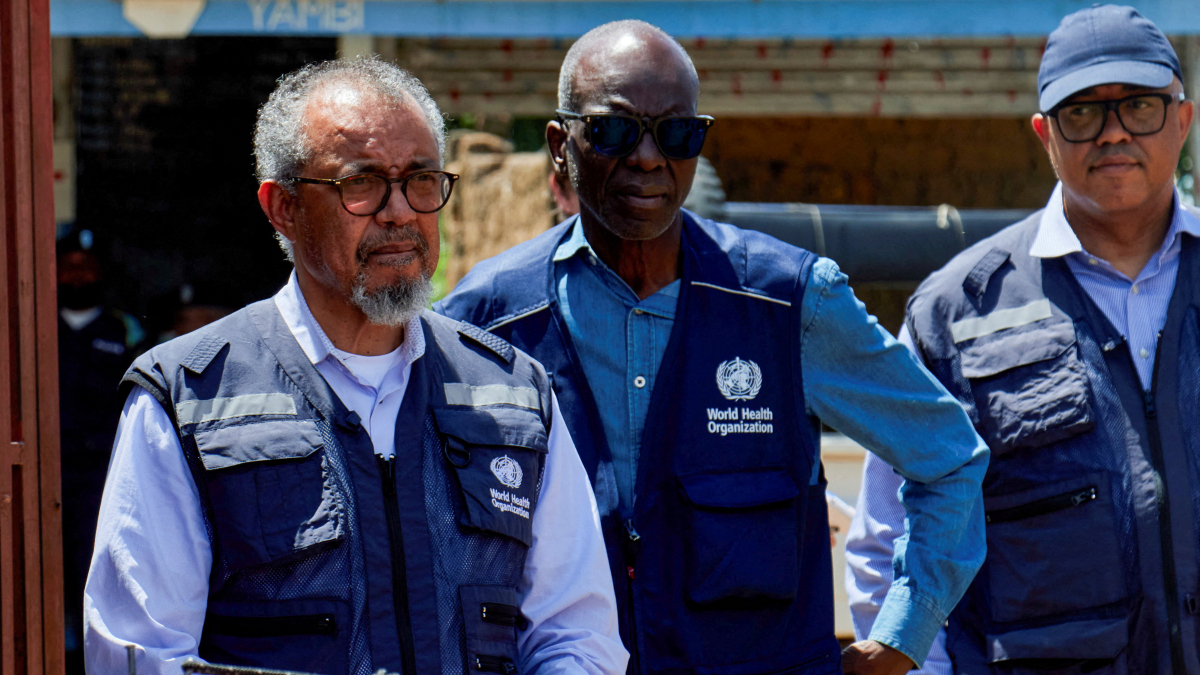
The head of the World Health Organization (WHO) has warned that the Ebola outbreak in the Democratic Republic of Congo may be significantly larger than official figures suggest, following a visit to the country where he briefed President Felix Tshisekedi on the ongoing response.
WHO Director-General Tedros Adhanom Ghebreyesus concluded his visit to Kinshasa on Monday (1 June) after travelling to Ituri province, where the outbreak was first confirmed, and urging stronger international support to contain the spread of the virus.
“This Ebola can be stopped when the community owns the agenda and with strong government leadership,” Tedros said after meeting President Tshisekedi.
“We need to strengthen the capacity of the health systems in the affected areas,” he added.
The outbreak is already the third-largest on record in the country and is now affecting multiple provinces, including Ituri, North Kivu and South Kivu, all of which are experiencing armed conflict and population displacement.
The number of confirmed cases in the country has now risen to 282, with 42 deaths recorded after 19 new positive tests, according to data from the Congolese communications ministry.
Outbreak “ahead of detection curve”
Health officials say the outbreak was likely circulating undetected for weeks before the first confirmed cases were identified, leaving responders struggling to contain transmission.
According to the WHO and Congolese authorities, there are hundreds of suspected and confirmed cases under investigation, while contact tracing remains limited in heavily affected areas.
An aid agency, the International Rescue Committee (IRC), warned that the outbreak is likely significantly larger than reported, saying only around 20% of contacts are currently being traced.
“When four out of five contacts are not being traced, it becomes incredibly difficult to contain the outbreak or even understand its true scale,” said Rachel Howard, senior technical emergency health adviser at the IRC.
Security challenges
The outbreak has been further complicated by insecurity in eastern Congo, including attacks by armed groups such as the Allied Democratic Forces, which continues to disrupt health operations and displace communities.
Cases have also been confirmed in neighbouring Uganda, raising concerns about cross-border transmission.
Recoveries give hope
Four nurses being treated for Ebola caused by the Bundibugyo strain have been discharged from hospital in Bunia, eastern Democratic Republic of Congo, after recovering from the disease, the WHO said on Sunday.
A laboratory worker had also recovered earlier in the week, bringing the total number of recoveries to five.
WHO said more recoveries are expected, particularly where cases are detected early and patients gain timely access to care as the response effort is scaled up.
International response
Global health organisations are accelerating response efforts, with CEPI announcing funding of around $60 million to support the development of vaccines targeting the Ebola Bundibugyo strain, which is responsible for the current outbreak and has no approved vaccine.
Health authorities have warned that the outbreak is outpacing the initial response, with over 1,100 suspected cases under investigation, according to Africa Centres for Disease Control and Prevention Director-General Jean Kaseya.
He said in a Financial Times op-ed that “the risk of regional spread is already happening,” as neighbouring countries and international health systems remain on alert.
In Italy a suspected case in Sardinia also tested negative. Health authorities there said the risk of Ebola in the country remains very low.
China has also announced it will send a team of medical specialists to assist Congo’s response efforts.
Separately, health authorities in Brazil said on Monday that two suspected Ebola cases had tested negative, with both patients confirmed to have other illnesses instead.











What is your opinion on this topic?
Leave the first comment