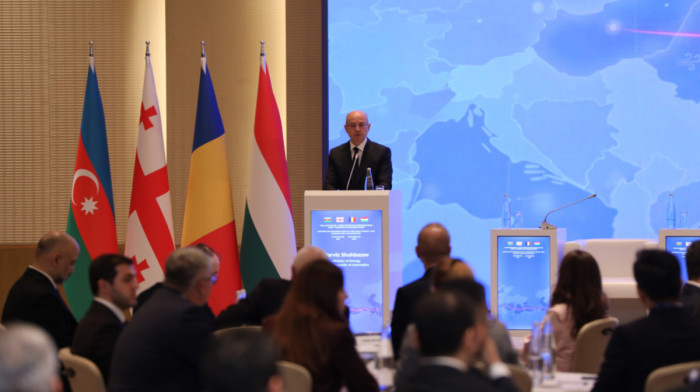
Renewed U.S. engagement puts South Caucasus higher on Washington’s agenda
A renewed wave of U.S. diplomatic activity in the South Caucasus highlights Washington’s growing focus on regional connectivity, trade and security,...
The U.N. weather agency plans to cut some posts and is reviewing its priorities as dozens of countries, including the United States, are late with their fees, a spokesperson said on Friday.
The World Meteorological Organization, set up in 1951 to coordinate global data for weather forecasts, created a review task force this week during a meeting in Geneva aimed at improving early-warning systems for deadly climate disasters.
The WMO, whose budget is separate from the United Nations', began restructuring in August to cut costs amid broader U.N. reforms, even as accelerating man-made climate change increases the risk of weather-related deaths, especially in developing countries where early-warning systems are lacking.
The WMO envisages cutting 26 posts and reducing travel, according to a budget document seen by Reuters.
"We do need to make sure we are fit for purpose and that we can face the future," spokesperson Clare Nullis told a press briefing on Friday.
She said a task force would begin in January to "tweak" the WMO's work based on current funding constraints as well as new opportunities such as the use of artificial intelligence in weather predictions.
Outstanding late payments to the WMO amount to around 48 million Swiss francs ($60 million) as of the end of August, a WMO document showed, equivalent to two-thirds of its annual budget.
The U.S. owes over 30 million francs.
A U.S. State Department spokesperson said that the administration was focused on ensuring that any U.S. taxpayer dollars at the U.N. advance U.S. interests. U.S. delegates participated in the congress.
Under President Donald Trump, Washington has announced it is quitting some U.N. bodies, as well as the U.N.-backed Paris Climate Accord on slowing climate change, and is late in paying others.
Trump has repeatedly questioned the effectiveness, cost and accountability of international bodies, arguing they often fail to serve U.S. interests.

The U.S. and Iran have reportedly reached a preliminary 60-day ceasefire and nuclear talks deal, pending Donald Trump’s approval, Axios reports. Meanwhile, the GCC condemned Iran’s missile strike on a U.S. airbase in Kuwait, which Tehran said was retaliation for a U.S. strike near Bandar Abbas.
The World Health Organization (WHO) says ongoing conflict, funding pressures and international travel restrictions are complicating efforts to contain a fast-growing Ebola outbreak in the Democratic Republic of Congo (DRC).
Bolivia’s President Rodrigo Paz has taken steps towards potentially declaring a state of emergency as anti-government protests intensify in the early months of his administration.
A group of Azerbaijani civil society organisations has called for increased scrutiny of Swiss building materials giant Holcim, citing court rulings and ongoing investigations linked to its subsidiary Lafarge's activities during the Syrian conflict.
Russia and Kazakhstan signed 15 agreements during President Vladimir Putin’s state visit to Astana on Thursday (28 May), including deals on Kazakhstan’s first nuclear power plant and expanded oil cooperation with Russia.
As climate pressures and urbanisation accelerate worldwide, governments are increasingly investing in smart cities and villages to build more sustainable and resilient communities. Across the world, digital technologies are reshaping how cities and rural areas are planned and managed.
The UK is experiencing potentially record-breaking temperatures after forecasters confirmed some areas reached highs close to 34°C on Monday.
More than 100 people were killed in a violent storm that battered India's most populous state, Uttar Pradesh, with rain and hail, the state Disaster Management and Relief office said on Thursday.
Climate change has driven a record surge in wildfires across Africa, Asia and other regions this year, with scientists warning that conditions are likely to worsen further as the northern hemisphere enters summer and El Niño weather patterns intensify.
Destruction of the world's tropical forests eased in 2025 from a record high, a report showed on Wednesday, underscoring how decisive policy can help keep trees standing despite pressures from a warmer climate and expanding agricultural frontiers.
You can download the AnewZ application from Play Store and the App Store.
What is your opinion on this topic?
Leave the first comment