The 61st Venice Biennale has opened under grey skies and political tension, with disputes over Russia and Israel, resignations on the jury, and protests marking the start of one of the art world’s most high-profile events.
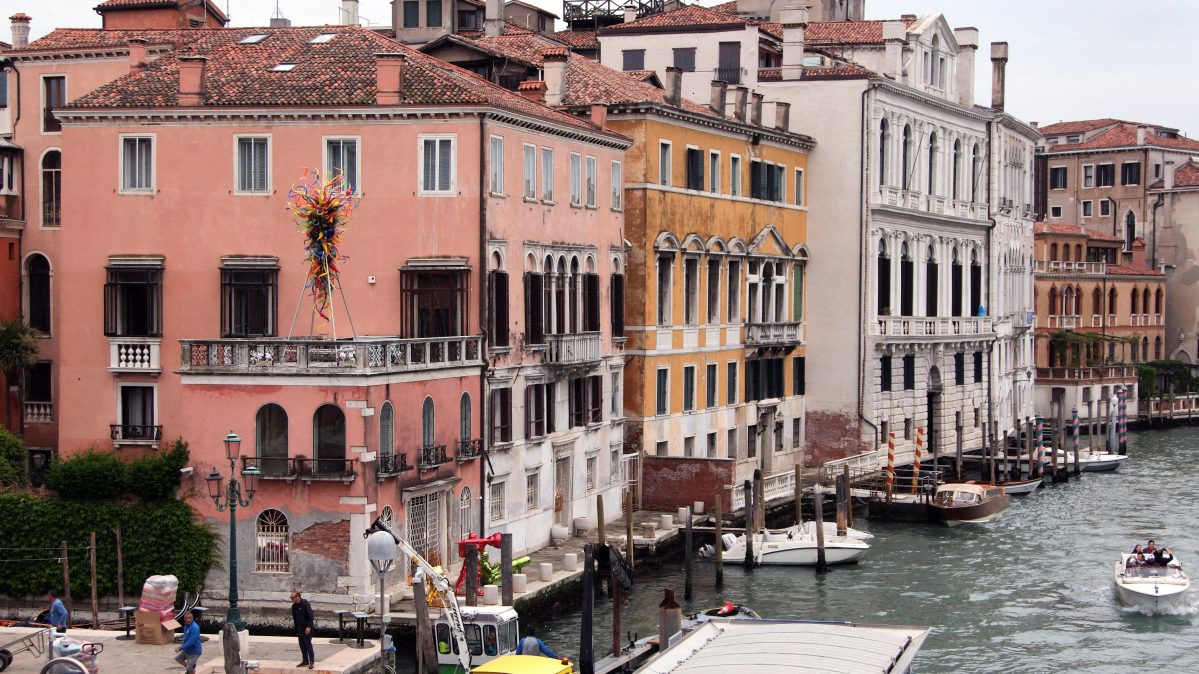
The vernissage began on Tuesday (5 May) in Venice, where heavy rain accompanied a preview programme dominated by geopolitical controversy as much as art.
Lubaina Himid, representing the United Kingdom, presented large-scale paintings and a sound installation reflecting Britain’s colonial past, while other national pavilions reflected sharply contrasting moods and messages.
Controversial participants
The Russian pavilion drew particular attention after returning to the Biennale for the first time since 2022, despite widespread criticism over Moscow’s war in Ukraine.
Although Russia is present, access to its pavilion has been heavily restricted.
Visitors will only be allowed inside during press preview days, while the exhibition will otherwise be experienced from outside, with projections and live music visible and audible through the building.
The decision to allow Russia’s participation has triggered political backlash, including threats from the European Union to withdraw funding, and criticism from Italy’s government.
Biennale organisers have argued that all countries have the right to maintain their national pavilions, but legal constraints linked to sanctions have limited public access.
Tensions were heightened further after the Biennale jury resigned en masse, citing opposition to considering entries from countries whose leaders are subject to international arrest warrants.
The move raised questions over the inclusion of both Russia and Israel in the event.
The Iranian pavilion has also withdrawn from the event without explanation.
Open letter
Protests also took place within the Giardini, where around 60 artists staged a procession called Solidarity Drone Chorus, calling for greater attention to conflicts and the role of cultural institutions.
An open letter signed by more than 200 artists, including Lubaina Himid and Alfredo Jaar, demanded the cancellation of the Israeli pavilion.
Tribute to curator
This year’s Biennale is being delivered without its appointed curator, Koyo Kouoh, who died in May 2025. Her curatorial team has continued her plans, with works across the exhibition referencing her influence and legacy.
Despite the controversy, large crowds gathered at some installations, including Austria’s pavilion, which featured a performance work involving water tanks, live choreography and mechanical staging.
Outside, even an unplanned seagull nesting near the site attracted attention from visitors, with some mistaking it for an installation.
Organisers say the Biennale, which includes around 100 national participants, is expected to draw significant global attention, with past editions attracting hundreds of thousands of visitors.
Read more:











What is your opinion on this topic?
Leave the first comment