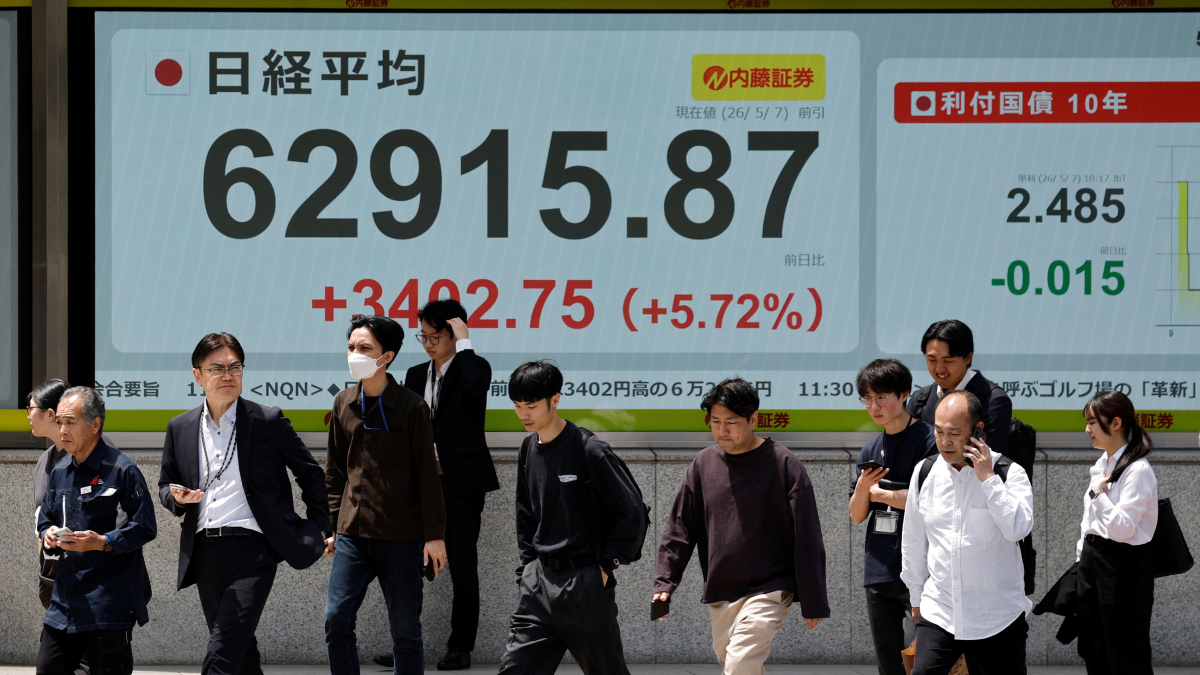
Asian stocks surged to record highs on 7 May as investors priced in growing hopes of a potential Middle East peace deal, while oil prices eased and the U.S. dollar weakened amid shifting global risk sentiment.
Japan’s Nikkei 225 crossed the 62,000 level for the first time after reopening from a holiday, extending a technology-led rally supported by strong corporate earnings.
South Korea’s KOSPI and Taiwan’s Taiwan Weighted Index also hit record highs.
The broader MSCI Asia-Pacific index excluding Japan rose around 1%, marking another all-time high and extending gains for the week.
Kyle Rodda, Senior Financial Analyst at Online Trading said she was being cautious.
"But we've seen this story before, and the rug could get pulled out of the market pretty quickly too. Ultimately, if we keep seeing progress in talks, Asian markets will keep rallying."
Markets rely on peace
Investor sentiment improved after reports that Iran was reviewing a peace proposal linked to efforts to end the ongoing conflict and stabilise energy flows through the Strait of Hormuz.
Analysts, however, warned that uncertainty remains over whether key issues - including Iran’s nuclear programme and the reopening of the strategic waterway - can be resolved.
Oil prices, which had fallen nearly 8% in the previous session, steadied in early Asian trade but remained volatile after recent swings driven by conflict risks.
Oil, inflation and policy risks
Brent crude oil traded slightly higher at around $102 a barrel, still well above levels seen before the conflict began.
The war, which began in February, has pushed oil prices roughly 40% higher overall, adding pressure to global inflation and bond yields.
U.S. Federal Reserve officials have warned that sustained high energy prices could fuel inflationary pressures and strain global supply chains.
Analysts from Oversea-Chinese Banking Corporation (OCBC) noted that the reopening of the Strait of Hormuz would not have an immediate effect on the prices.
Dollar weakens, yen soars
In currency markets, the dollar index slipped to 98.03 as the euro and sterling extended gains.
The Japanese yen remained in focus after sharp moves in recent sessions, with traders speculating about possible intervention by Japanese authorities amid volatility.
According to OCBC analysts, the main question is whether the Ministry of Finance will continue to defend the yen or has already deployed sufficient firepower.
"Intervention alone is unlikely to shift the broader trend unless backed by stronger policy support like a more assertive BOJ (Bank of Japan) hiking cycle or better alignment with external drivers such as lower oil prices and U.S. yields," the analysts stated, sticking to their year-end target of 155.
On Wall Street, both the S&P 500 and the Nasdaq Composite closed at record highs, supported by strong corporate earnings, particularly in the technology sector.
Investors are now awaiting U.S. non-farm payrolls data due on Friday, which is expected to provide further clues on the health of the world’s largest economy.
Read more:






















What is your opinion on this topic?
Leave the first comment