After the dissolution of the Soviet Union in 1991, newly independent Armenia emerged with the promise of democracy. But in the years that followed, conflicts and political assassinations sidetracked politics in the country, until a 2018 revolution restored momentum to the promise.
As voters in the South Caucasian nation prepare to head to the polls on 7 June for the third time since the Velvet Revolution, AnewZ spoke to two regional experts about Armenia’s political trajectory and traced the history of key elections since independence.
Post-Soviet teething problems
Armenia’s first parliamentary elections in 1995, after the collapse of the Soviet Union, were described by a delegation from the Organization for Security and Cooperation in Europe (OSCE) as a “first and vital step towards democratic development”, but “not fair”, with one of the major opposition parties banned. The Republic Bloc, an alliance led by Armenia’s first president, Levon Ter-Petrosyan, won the elections.
Ter-Petrosyan resigned in 1998 after supporting a compromise settlement with Azerbaijan over Garabagh. He was succeeded by hardliner Robert Kocharyan, a former leader of the self-proclaimed Nagorno-Karabakh Republic.
The OSCE described the next parliamentary elections in 1999 as an “improvement” and praised the “generally peaceful” way they were conducted, saying they were “free of intimidation”.
The Unity bloc, co-led by Vazgen Sargsyan and Karen Demirchyan, secured victory in the 1999 elections. While the bloc cooperated institutionally with Kocharyan, Demirchyan’s broad popularity and Sargsyan’s control over much of the security apparatus provided a counterweight to the president’s dominance.
Parliament murders and rise of ‘competitive authoritarianism’
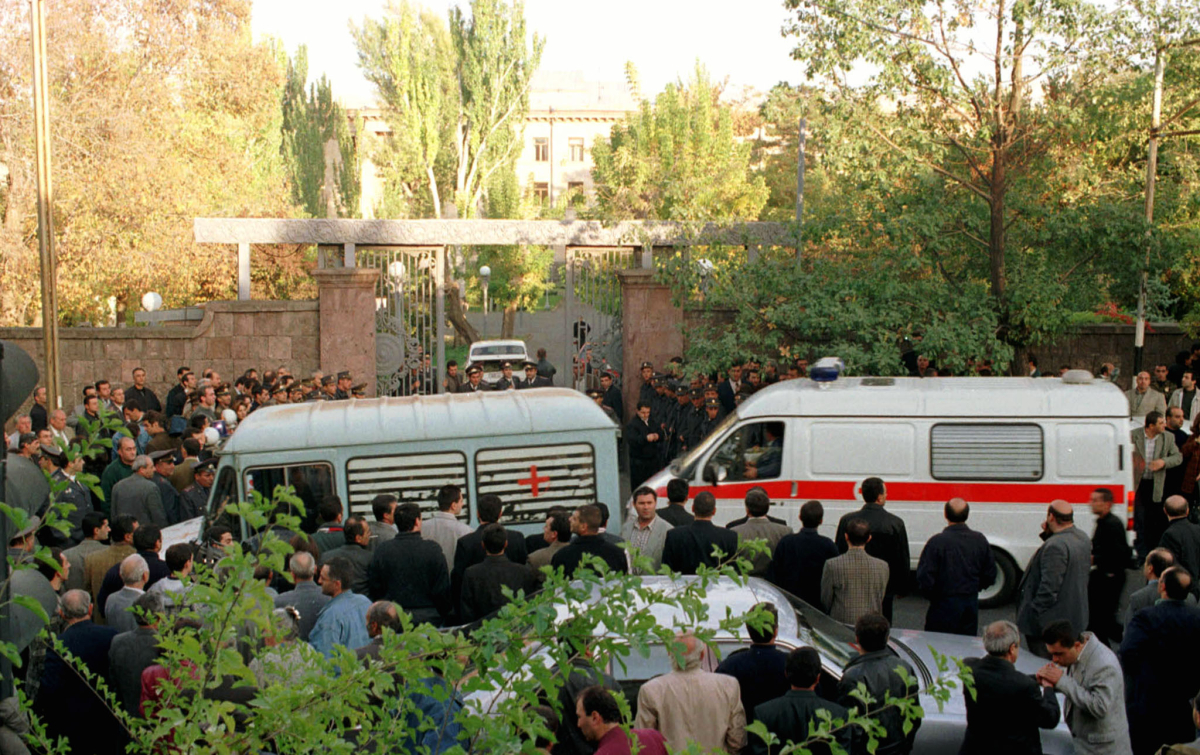
In October 1999, five armed men entered the Armenian National Assembly in Yerevan and shot dead Sargsyan, Demirchyan and five other lawmakers. In the shock that followed, Kocharyan reasserted his grip on power and appointed an ally to replace Sargsyan as prime minister.
Laurence Broers, a researcher specialising in the South Caucasus and an Associate Fellow at Chatham House, says Armenia in the following two decades “exemplified a ‘competitive authoritarian’ regime, where elections were fiercely contested but not necessarily fair.”
The 2003 parliamentary elections, won by Kocharyan’s Republican Party allies, “fell short of international standards for democratic elections,” according to the OSCE. Flaws identified included falsified vote counts and intimidation of observers.
As the 2007 parliamentary elections approached, Kocharyan - barred by law from seeking a third term as president - looked to anoint a successor. Republican Party leader Serzh Sargsyan (not related to Vazgen Sargsyan), emerged as Kocharyan’s preferred choice.
Sargsyan reinforced the party’s grip on power in the 2007 parliamentary elections, laying the foundation for his presidential run. In the 2008 presidential election, he defeated Ter-Petrosyan, who had returned to politics after a decade away.
Protests and deadly crackdown
Ter-Petrosyan refused to accept the result and alleged voter fraud, while his supporters launched mass protests in Yerevan. For nine days, demonstrations remained peaceful, but on 1 March 2008, police and the army violently dispersed protesters. 10 people were killed.
Broers says the incident was the “worst post-electoral violence in the history of the post-Soviet South Caucasus.”
The OSCE’s verdict on the 2008 election was mixed. It praised the pre-election period and voting day, while also noting “deficiencies of accountability and transparency” during the ballot count.
In the aftermath of the protests, Broers says the government “developed more sophisticated methods of controlling elections to pre-empt protest at election time itself, including through vote-buying and a centralised ruling party structure under the Republican Party of Armenia.”
Serzh Sargsyan cements control
The Republican Party consolidated its grip on power in the 2012 and 2017 parliamentary elections under Sargsyan’s leadership. The OSCE’s assessments were mixed, although it noted broad improvements in how both votes were administered compared with previous years.
In 2015, the government held a referendum on replacing Armenia’s semi-presidential system - in which the president was the dominant political figure - with a parliamentary system, where the president’s role would become largely ceremonial.
The proposed changes proved controversial, as critics argued they gave Sargsyan an underhand route to remain in power after his presidential term ended by shifting into the strengthened role of prime minister.
At the time, Sargsyan was nearing the end of his second term as president and was constitutionally barred from seeking a third.
The changes were approved in a referendum, although the OSCE noted “serious problems” at polling stations, including “interference and intimidation”.
The opposition’s suspicions appeared to be confirmed in 2018, when the Republican Party announced it would nominate Sargsyan as prime minister two days after his second presidential term expired.
The Velvet Revolution
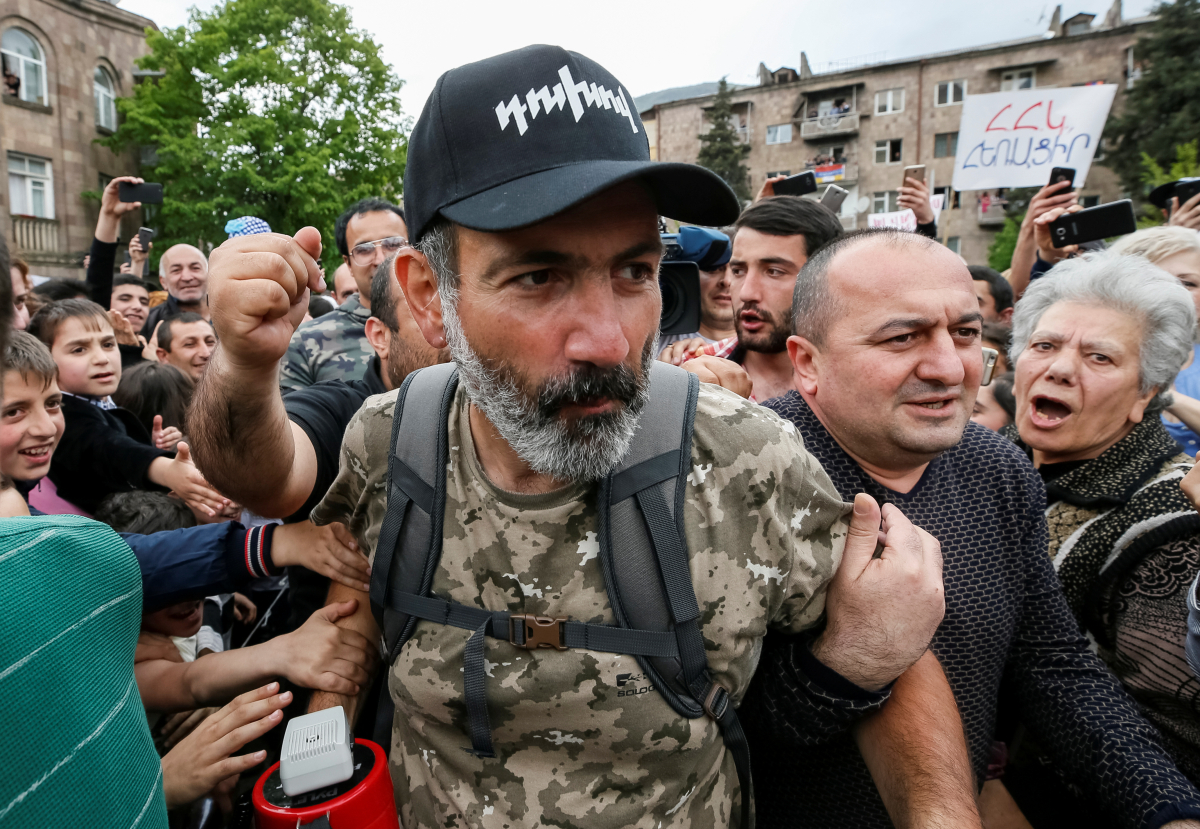
In response, anti-corruption journalist and opposition politician Nikol Pashinyan began a protest march from Gyumri, Armenia’s second city to Yerevan.
While initially small in size, Pashinyan livestreamed much of the walk on social media and the march soon expanded into demonstrations against corruption and oligarchy across the country. Pashinyan named the movement a Velvet Revolution, reflecting its non-violent approach.
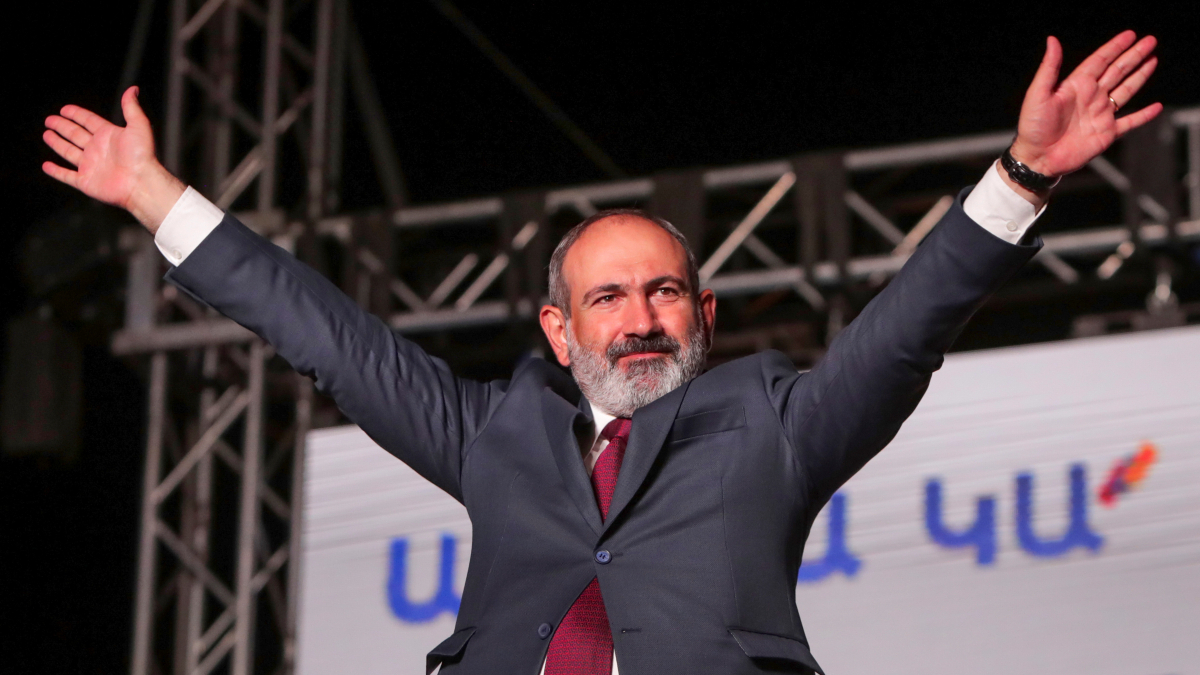
Under growing pressure, Sargsyan resigned. Snap parliamentary elections were held and Pashinyan’s My Step alliance - which took its name from the march - swept to power in a landslide victory.
According to Broers, the Velvet Revolution beckoned in a new era in Armenia.
“The 2018 Velvet Revolution essentially removed the competitive authoritarian regime that had previously ruled the country and introduced an ambitious domestic reform agenda,” he says, including electoral reform.
Observers generally regarded the 2018 vote as the freest and fairest since independence. The OSCE said the elections were “held with respect for fundamental freedoms and enjoyed broad public trust,” noting an “absence of electoral malfeasance, including of vote-buying and pressure on voters,” which had marred previous elections.
A key electoral reform introduced by Pashinyan was the abolition of the ratingayin regional list system, under which multiple candidates from the same party competed against one another for votes.
Critics argued the system strengthened wealthy and well-connected individuals while encouraging vote-buying. Pashinyan’s government replaced it with a fully proportional system, in which voters selected parties rather than individuals.
Richard Giragosian, Director of the Yerevan-based Regional Studies Center, says Pashinyan’s democratic reforms have made Armenia of increasing interest to the European Union (EU), as the bloc’s relations with neighbouring Georgia have deteriorated.
“As the EU moves to punish Georgia’s…retreat from democracy, the EU is expected to only increase its engagement in Armenia, focusing on efforts to reward Armenia’s hard-won gains in democratisation and to bolster resilience to preempt and prevent any possible regress,” Giragosian says.
A divided society and weak opposition
In more recent years, Pashinyan’s initial overwhelming popularity has faltered. After Armenia’s defeat to Azerbaijan in the 44-Day War (Second Garabakh War) in 2020, he faced mass anti-government protests demanding he resign.
The situation came to a head in February 2021 when the Armenian army’s Chief of the General Staff and 40 other high-ranking military officers joined the call in what Pashinyan branded “an attempted military coup.”
In response, Pashinyan dismissed the chief of the general staff and called a snap election to break the deadlock. Many observers expected him to lose, but he defied expectations as his party secured more than 50% of the vote.
The OSCE praised the elections as “competitive and generally well-managed”, but noted the campaign was marked by “intense polarisation” and “increasingly inflammatory rhetoric”.
As Armenians prepare to vote again, Broers says the scale of division within society remains the country’s biggest domestic threat.
“The campaign is taking place under febrile conditions, as various vitriolic encounters between Pashinyan and ordinary citizens on the streets of the country have attested, as well as a constant background of arrests of oppositionally-aligned figures on charges of vote-buying,” he says.
In March, Pashinyan apologised after a video showed him raising his voice and pointing at a woman who criticised him while travelling on Yerevan’s metro.
A month later, anti-corruption authorities raided the offices of the main opposition party, Strong Armenia, and arrested 14 people on suspicion of vote-buying. Critics say the detentions are politically motivated.
Strong Armenia’s leader, Samvel Karapetyan, is himself currently on trial, accused of making public calls to overthrow the government and remains under house arrest.
The accusations partly relate to comments he made in 2025, accusing the government of waging a campaign against the Armenian Apostolic Church, saying he would act "in his own way" to stop it.
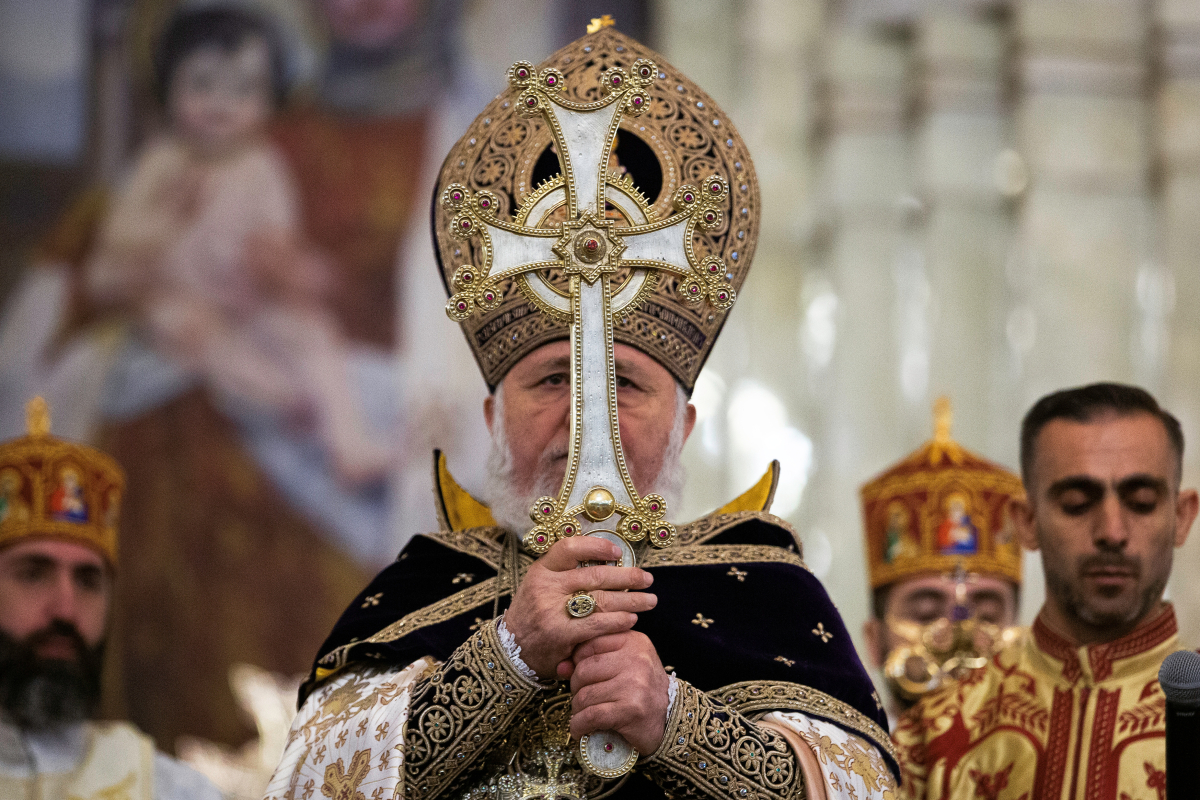
Pashinyan has been locked in an ongoing public feud with the head of the Armenian Apolistic Church, Karekin II, who he had accused of fathering a child and of having links to a foreign intelligence service, assumed to be Russia.
For Broers, the extent of the polarisation risks undermining trust in the upcoming elections and discouraging voter participation, which “could have longer-term delegitimating effects”.
For now, however, Pashinyan’s party maintains a double-digit lead in most opinion polls. While the opposition remains weak and fragmented, he appears likely to secure a third term. As Giragosian notes, “the main failure of the opposition is rooted in its inability to offer any competing strategy or vision to challenge the incumbent government.”














What is your opinion on this topic?
Leave the first comment