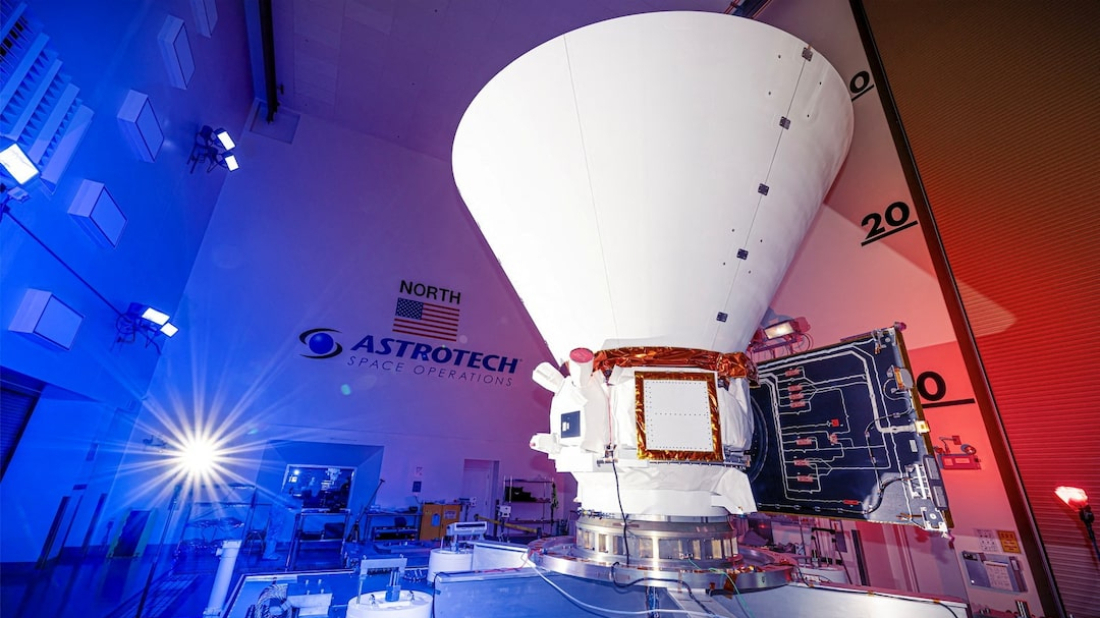
NASA is preparing to launch its groundbreaking SPHEREx space telescope on Friday aboard a SpaceX Falcon 9 from Vandenberg Space Force Base in California.
Designed to shed light on the cosmic dawn and the immediate aftermath of the Big Bang, SPHEREx - short for Spectro-Photometer for the History of the Universe, Epoch of Reionization and Ices Explorer - will map the cosmos in unprecedented detail.
Over the course of its planned two-year mission, SPHEREx will collect data on more than 450 million galaxies and over 100 million stars within the Milky Way, creating a comprehensive three-dimensional map of the universe in 102 distinct colors. This spectral mapping will allow scientists to study the distribution of galaxies across vast cosmic scales and directly investigate the rapid expansion known as cosmic inflation - a phenomenon believed to have occurred in a fraction of a second after the Big Bang roughly 13.8 billion years ago.
“By mapping the distribution of galaxies over the whole sky, we can directly constrain unique properties of inflation,” said cosmologist Olivier Doré of Caltech and NASA’s Jet Propulsion Laboratory. “The fact that we can connect these large-scale structures to the physics of inflation is very powerful, almost magical.”
In addition to probing the early universe, SPHEREx will search for reservoirs of water and other key molecules such as carbon dioxide and carbon monoxide on the surface of interstellar dust grains. These molecular clouds - dense regions of gas and dust that give rise to new stars and planets - are thought to be the primary sites for water formation in the universe, a crucial ingredient for life.
SPHEREx will employ its innovative spectro-photometry techniques to split the light from billions of cosmic sources into their component wavelengths, determining their composition and distance. The telescope will also measure the collective glow from the vast space between galaxies, offering new insights into the cosmic web that binds the universe.
Jim Fanson, SPHEREx project manager at the Jet Propulsion Laboratory, emphasized the mission’s transformative potential: “Cosmic inflation is the consensus framework for explaining the universe’s large-scale structure. SPHEREx will provide an unprecedented dataset to mine, and there is no doubt we will discover new cosmic phenomena.”
Launched alongside a constellation of satellites for NASA’s PUNCH mission - aimed at studying the sun’s corona and solar wind - SPHEREx represents a major step forward in astronomical research. As it prepares to look at the sky in entirely new ways, scientists are optimistic that the mission will uncover hidden chapters of our universe’s history and enhance our understanding of the forces that shaped the cosmos.
With its innovative design and ambitious goals, SPHEREx is poised to open a new window on the early universe, promising discoveries that could reshape our understanding of cosmic origins and the potential for life beyond Earth.






















What is your opinion on this topic?
Leave the first comment