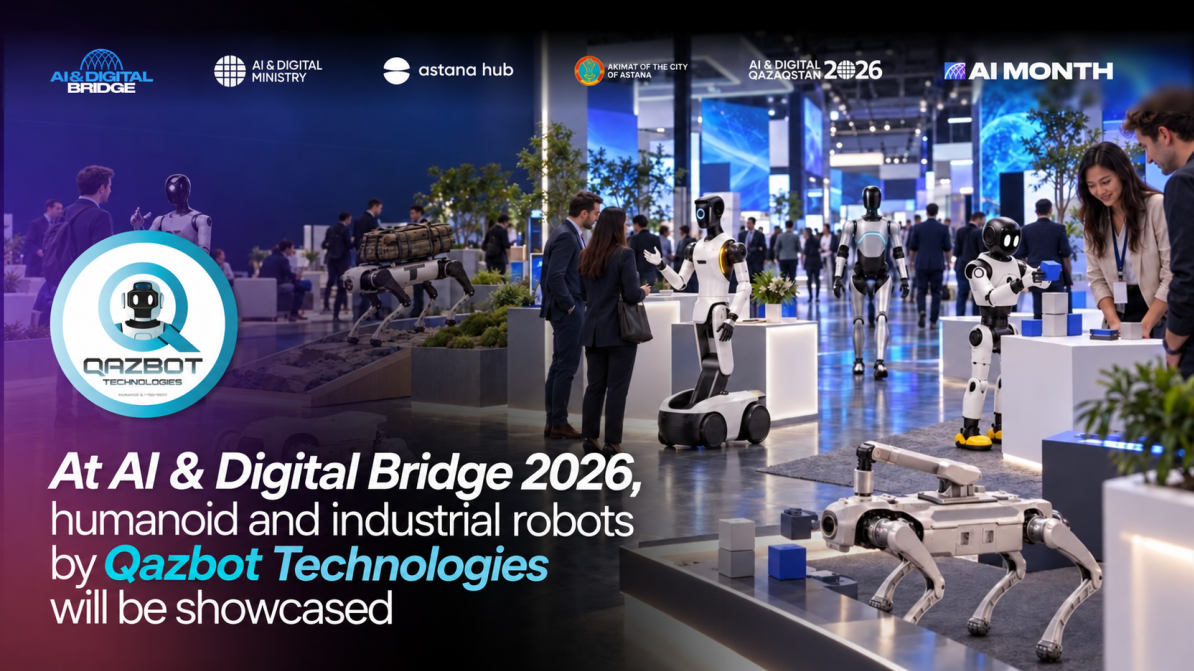
Robots capable of interacting with people, navigating their surroundings autonomously, supporting manufacturing and logistics operations, and providing services at large-scale facilities will be showcased at AI & Digital Bridge 2026 in Astana from 1 to 3 October.
Qazbot Technologies will present a range of robotic systems at the forum, including humanoid, industrial and quadrupedal platforms, while also highlighting its plans to develop a domestic robotics and artificial intelligence industry in Kazakhstan.
Kazakhstan develops humanoid robot manufacturing
In August 2026, construction began in Astana on what the company describes as Kazakhstan’s first humanoid robot manufacturing plant.
The 15,000-square-metre production and technology complex is expected to create more than 150 jobs and combine localised manufacturing, proprietary engineering solutions, an R&D centre, software development and artificial intelligence technologies.
The facility will also house the Qaz Data Factory, an infrastructure centre designed to collect, prepare and process data used to train robotic systems.
According to Qazbot Technologies, another key objective will be to train Kazakhstani engineers and specialists for the country’s emerging robotics and AI sector.
Initial investment in the project is expected to reach approximately $200 million, with projected production capacity of up to 5,000 robotic systems annually.
Partnership with AGIBOT
AI & Digital Bridge 2026 will also feature Xiong Jilin, vice president of AGIBOT PTE. LTD., a strategic technology partner of Qazbot Technologies.
According to Qazbot Technologies, AGIBOT currently accounts for approximately 47 per cent of global humanoid robot shipments. Its technologies are used in applications ranging from human-robot interaction to manufacturing and logistics.
Visitors to the Astana forum will be able to see some of these technologies in operation.
Qazbot Technologies also cited AGIBOT’s performance at the World Humanoid Robot Games 2026, where the company said its team secured 46 medals - 18 gold, 16 silver and 12 bronze, finishing first in both the gold-medal and overall medal standings.
Vladislav Safarov, CEO of Qazbot Technologies, said the company’s strategy extends beyond importing existing technologies.
“It is essential for us not merely to bring ready-made technologies to Kazakhstan, but to build local expertise and a complete technological cycle here,” Safarov said.
“We are consistently building our engineering team, developing software and artificial intelligence, localising manufacturing, and creating infrastructure for further development. Our next objective is to further develop our own solutions and expand into international markets.”
From humanoids to industrial robotics
Among the systems scheduled to be presented are the A2 and A2 Ultra, full-size humanoid robots designed to interact with people.
The robots can recognise faces and voices, identify the source of sounds, hold conversations, respond to commands and assist visitors with navigation. The A2 Ultra is also capable of autonomous navigation over longer distances.
The X2 and X2 Ultra are more compact humanoid models featuring a human-like gait and high manoeuvrability. They can recognise faces and gestures, interact with people, dance and perform complex synchronised movements.
The X2 Ultra can also plan routes independently, avoid obstacles and return autonomously to its charging station.
Robots for industry, logistics andservices
Qazbot Technologies will also present robotic systems designed for specific industrial and service applications.
The G2 is an industrial robotic platform capable of grasping and moving objects, carrying out precision manipulation and sorting tasks. The technology is designed for use in manufacturing plants, warehouses and logistics facilities.
The C5 is an autonomous professional cleaning robot developed for large indoor spaces. It can identify work areas, plan routes, avoid obstacles and perform both dry and wet cleaning.
When connected to a dedicated service station, the C5 can also recharge automatically and carry out system maintenance procedures.
For more challenging environments, the D1 quadruped robot is designed to operate across uneven terrain and in areas where wheeled platforms may have limited access.
Potential uses include industrial inspections, facility monitoring and operations in complex environments.
Embodied AI moves into the physical world
The technologies on display reflect the growing development of embodied AI, which connects artificial intelligence systems with physical machines capable of sensing, making decisions and acting in real-world environments.
While generative AI has largely focused on producing text, images, video and computer code, embodied AI is intended to allow machines to interact directly with their surroundings.
At AI & Digital Bridge 2026, visitors will be able to see how robotic systems are moving from technology demonstrations towards practical applications in services, industry, logistics and infrastructure.
The participation of AGIBOT Vice President Xiong Jilin is also expected to focus attention on the future development of humanoid robotics and the emergence of embodied AI as a standalone technology industry.
AI & Digital Bridge 2026 in Astana
AI & Digital Bridge 2026 will take place from 1 to 3 October at the EXPO International Exhibition Centre in Astana and will serve as the main international event of AI MONTH.
The forum’s central theme is “Kazakhstan is the Eurasian AI Hub”, and the event is being held as part of Kazakhstan’s Year of Digitalisation and Artificial Intelligence.
A special programme on 1 October will bring together government officials, international delegations and technology industry leaders. Attendance on the first day will be by invitation only.
The programme will open to ticket holders on 2 and 3 October.
The announced forum headliners include Balaji Srinivasan, founder of The Network School; Yerzat Dulat, co-founder and CTO of Higgsfield AI; and Jamie Beaton, co-founder and CEO of Crimson Education.
According to the organisers, the event is supported by forum partners and sponsors, with all forum expenses covered through sponsorship funding.














What is your opinion on this topic?
Leave the first comment