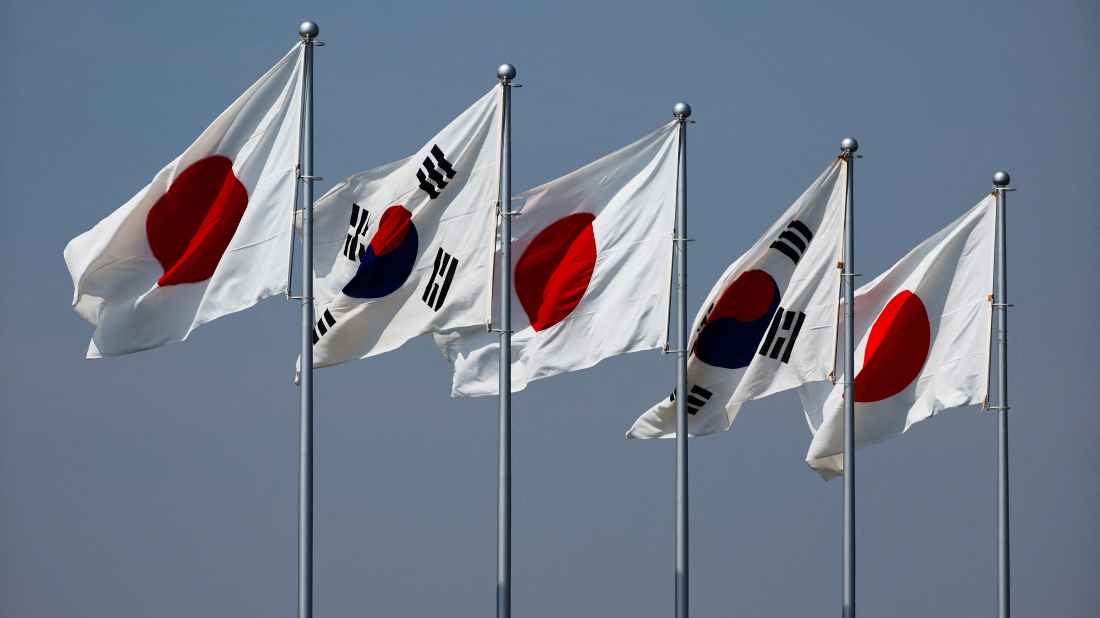
South Korea and Japan have agreed to deepen their cooperation with the United States in addressing regional security challenges, including North Korea, during a bilateral meeting held on the sidelines of the G7 summit in Canada, according to local media reports.
The meeting took place on Tuesday in the resort town of Kananaskis, Alberta, between South Korean President Lee Jae-myung and Japanese Prime Minister Shigeru Ishiba, marking a key diplomatic engagement as both countries seek to reinforce trilateral security alignment.
In a statement released by the South Korean presidential office, the leaders "agreed to further develop trilateral cooperation among the Republic of Korea, the United States and Japan to respond to various regional geopolitical crises, including the North Korean issue," while also committing to enhanced bilateral ties between Seoul and Tokyo.
Relations between South Korea and Japan have long been complicated by historical grievances stemming from Japan’s colonial rule over the Korean Peninsula between 1910 and 1945. However, diplomatic engagement has seen a cautious recovery in recent years.
The recent summit was President Lee’s first overseas trip and foreign diplomatic engagement since taking office on 4 June. His administration follows that of former President Yoon Suk Yeol, who was impeached by South Korea’s National Assembly in December after declaring martial law.
Japanese Prime Minister Ishiba expressed optimism about the future of the partnership, telling reporters, “I hope that collaboration and cooperation between Japan and South Korea will become a big driving force for the benefit of our region and the world,” as quoted by Kyodo News Agency.
In addition to the bilateral talks, President Lee met with Canadian Prime Minister Mark Carney, with discussions focusing on defence, energy security, artificial intelligence, climate change, and industrial cooperation. He also held talks with European Commission President Ursula von der Leyen and European Council President Antonio Costa, exploring opportunities to expand economic collaboration between South Korea and the European Union.
The flurry of diplomatic activity underscores South Korea's intention to strengthen its international partnerships amid a dynamic global security environment and ongoing concerns over North Korea's nuclear and missile programs.
















What is your opinion on this topic?
Leave the first comment