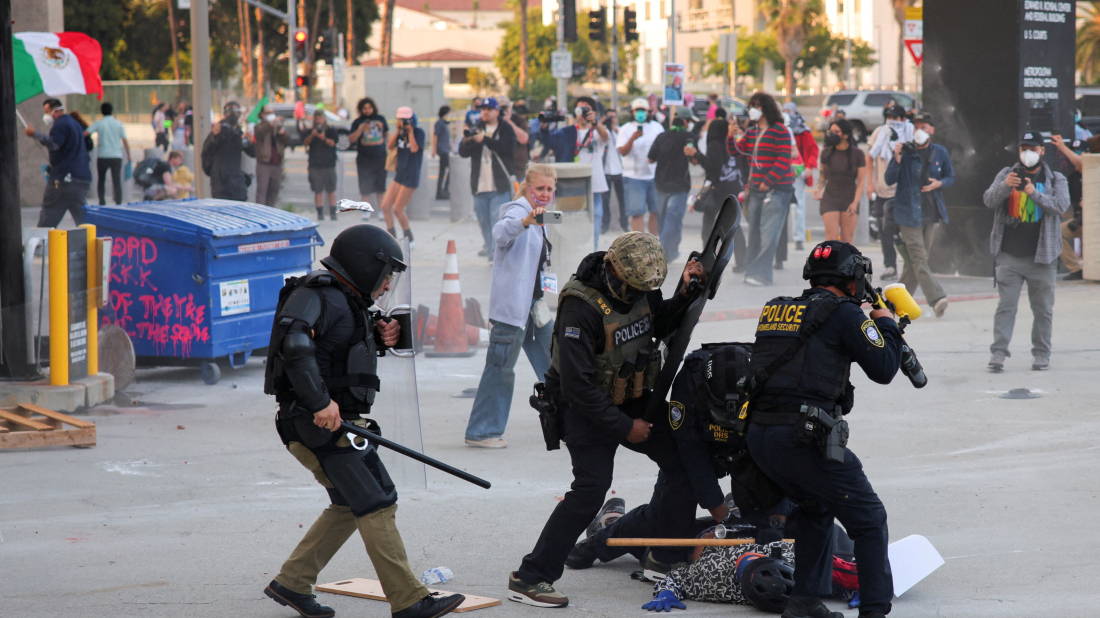
A tense Friday evening descended into chaos in downtown Los Angeles as federal immigration raids ignited furious protests, culminating in a dramatic standoff between demonstrators and helmeted police in riot gear.
The city became a flashpoint, reflecting the deep divisions fueled by President Donald Trump's intensified crackdown on undocumented migrants.
After a day of targeted U.S. Immigration and Customs Enforcement (ICE) operations saw dozens reportedly taken into custody across the city, tensions quickly escalated after nightfall. Live Reuters video showed Los Angeles Police Department (LAPD) officers, armed with batons and what appeared to be tear gas rifles, forming lines against angry crowds. As authorities issued dispersal orders, the confrontation turned volatile. Some protesters hurled chunks of broken concrete towards officers, who responded with volleys of tear gas, pepper spray, and "flash-bang" concussion rounds to break up the gathering. While the immediate aftermath regarding arrests remained unclear, an LAPD spokesperson, Drake Madison, confirmed an unlawful assembly had been declared, subjecting non-compliant individuals to arrest.
Earlier in the day, the sheer scale of the federal operation was evident as caravans of unmarked, military-style vehicles and vans brimming with uniformed agents streamed through Los Angeles streets. ICE agents targeted various locations, including a Home Depot in the Westlake District, an apparel store in the Fashion District, and a South Los Angeles clothing warehouse, according to the Los Angeles City News Service (CNS). Local media reported scores of individuals detained in these sweeps, marking the latest wave in President Trump's aggressive push to arrest and deport undocumented migrants in unprecedented numbers.
Crucially, the LAPD's presence was solely to manage civil unrest, not to participate in the immigration enforcement itself. Protesters, incensed by the raids, had spray-painted anti-ICE slogans on a federal court building and converged outside a nearby jail believed to be holding some detainees. Impromptu demonstrations had also erupted directly at some raid sites earlier in the day. Among those impacted was David Huerta, president of the Service Employees International Union (SEIU) of California, who was injured and detained by ICE at one location. The SEIU stated Huerta was arrested "while exercising his First Amendment right to observe and document law enforcement activity," though details of his injury or any charges were not immediately available, and ICE did not respond to Reuters' inquiries.
Los Angeles Mayor Karen Bass sharply condemned the federal actions, asserting that "these tactics sow terror in our communities and disrupt basic principles of safety in our city." Her statement underscores the growing friction between federal immigration policies and local urban leadership, particularly in cities that serve as havens for large immigrant populations. The events of Friday highlighted not only the federal government's unwavering commitment to its immigration enforcement agenda but also the fierce resistance it continues to face on the ground.









What is your opinion on this topic?
Leave the first comment