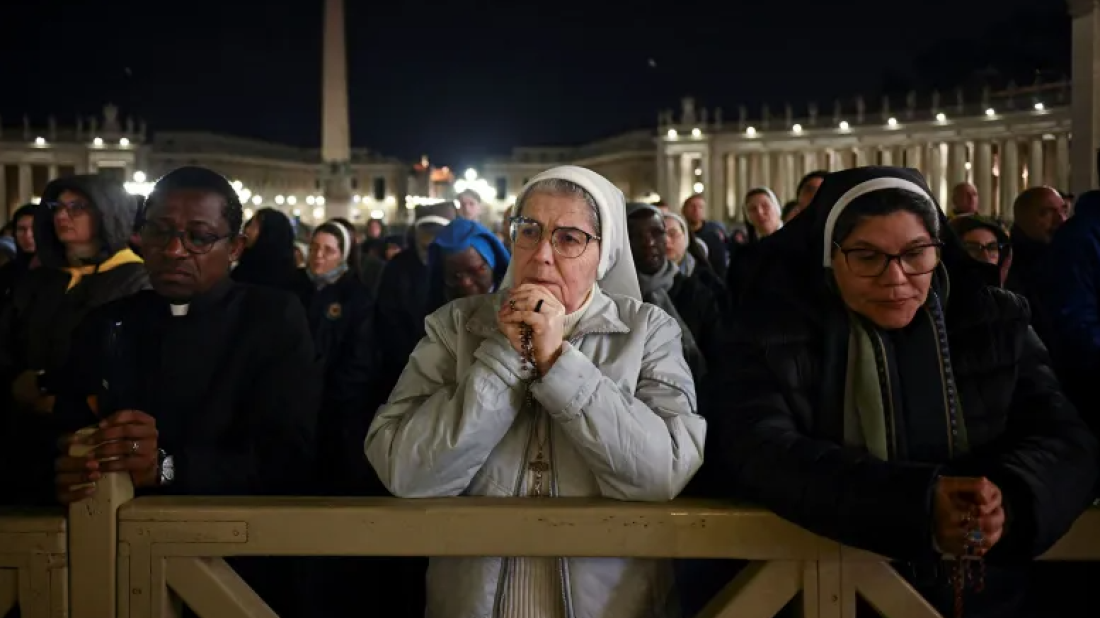
Pope Francis had inhaled “copious” amounts of mucus in another setback in what has become a more than two-week battle to overcome a complex respiratory infection and pneumonia.
Pope Francis suffered two new episodes of acute respiratory crises Monday and was put back on noninvasive mechanical ventilation, the Vatican said.
Francis had inhaled “copious” amounts of mucus in another setback in what has become a more than two-week battle to overcome a complex respiratory infection and pneumonia.
In a late update, the Vatican said the episodes were caused by a “significant accumulation” of mucus in his lungs and bronchial spasms. “Two bronchoscopies were performed with the need for aspiration of copious secretions,” the Vatican said.
Francis remained alert, oriented and cooperated with medical personnel. The prognosis remained guarded.
Earlier Monday, Pope Francis issued a new message from the hospital as Vatican officials begged him to let his voice be heard after disappearing from public view for over two weeks as he recovers.
Francis, 88, denounced the “progressive irrelevance” of international organizations to combat war as he remained at Rome’s Gemelli hospital in stable condition. He was up, had breakfast and was receiving therapies after sleeping “well all night long,” the Vatican said.
The Vatican hasn’t released any photos or videos of Francis since before he entered the hospital on Feb. 14 with a complex lung infection. This has become the longest absence of his 12-year papacy.
The Vatican has provided brief, twice-daily medical updates on his condition, and Francis has begun signing off on documents with “From Gemelli Polyclinic” in an indication that he is up and working.
The Vatican has defended Francis’ decision to recover in peace and out of the public eye. But on Monday one of Francis’ closest friends at the Vatican, Archbishop Vincenzo Paglia, urged him to let his voice be heard, saying the world needs to hear it.
“We need men like him who are truly universal and not only one-sided,” Paglia said, speaking after a press conference to launch the annual assembly of his Pontifical Academy for Life, the Vatican’s bioethics academy, which has as this year’s theme “The End of the World?”
Francis wrote a message to the assembly, dated Feb. 26, in which he lamented that international organizations are increasingly ineffective to combat the threats facing the world and are being undermined by “short-sighted attitudes concerned with protecting particular and national interests.”
It’s a theme he has articulated before. Francis also has repeatedly called for peace between Russia and Ukraine while trying to maintain the Vatican’s traditional diplomatic neutrality, and has tried to achieve a similar balancing act for Israel’s war with Hamas in Gaza.
Even a Vatican ambassador not especially close to Francis, Archbishop Georg Gaenswein, said the faithful needed to hear his voice at a time when war is raging in Europe. Gaenswein was Pope Benedict XVI’s longtime secretary, and Francis exiled him to be the Vatican ambassador in the Baltics after he published a memoir in 2023 that was critical of Francis.
“Pope Francis’ voice is of vital importance for all the world because he’s the only authority who speaks of peace, who condemns war, all the wars under way starting with Ukraine,” La Repubblica quoted Gaenswein as saying.
Francis’ 17-night hospitalization is by no means reaching the papal record that was set during St. John Paul II’s numerous lengthy hospitalizations over a quarter century.








What is your opinion on this topic?
Leave the first comment