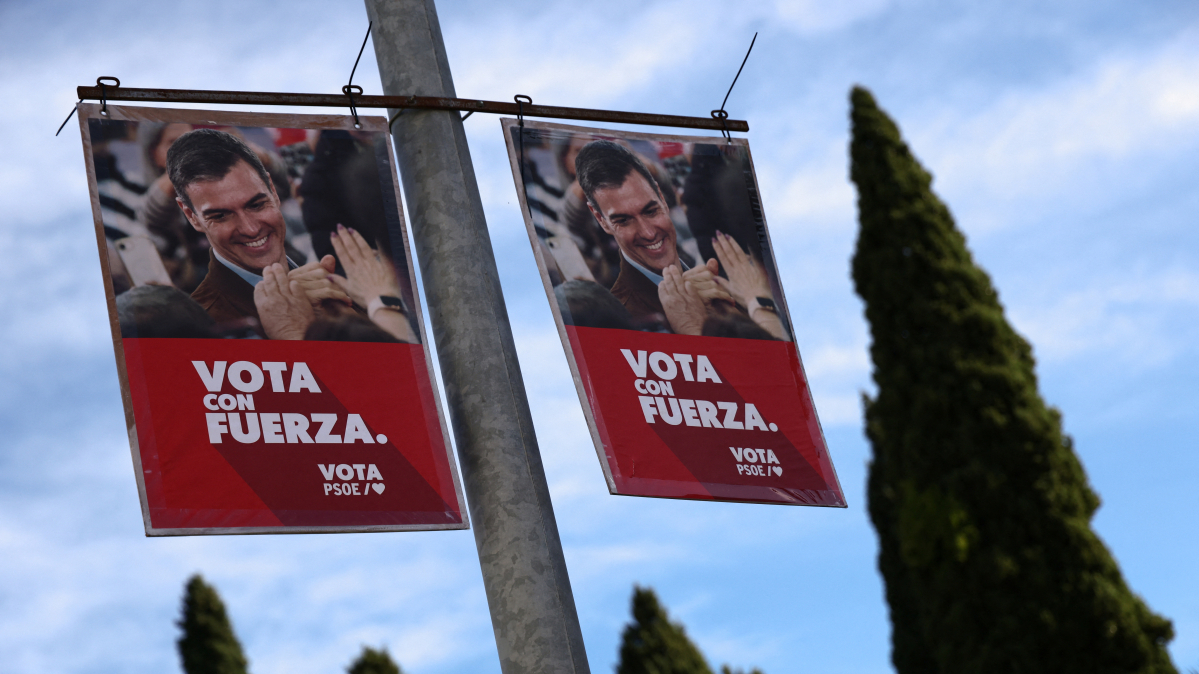
After eight years under Pedro Sánchez’s Socialist-led government, Spain votes on 29 November, choosing between continued left-wing rule and a conservative-led government potentially backed by far-right Vox.
Polls open at 08:00 GMT and close at 19:00 GMT, with results expected an hour later.
Why is the vote taking place now?
Sánchez called the election eight months ahead of schedule after parliament rejected proposed changes to Spain’s housing laws.
The reforms followed nationwide protests over the eviction of Maricarmen Abascal, an 87-year-old woman who died after losing her rented flat in Madrid.
His government also lost the backing of Junts, a centre-right party from the north-eastern region of Catalonia, which sought to protect property owners’ rights.
Housing remains a key election issue, alongside the rising cost of living, corruption and immigration. The vote also comes weeks after a deadly rail disaster that undermined public confidence in Spain’s high-speed rail network.
Who is leading in the polls?
Alberto Núñez Feijóo’s conservative People’s Party (PP) holds a narrow lead over the Socialist Party (PSOE) in most opinion polls.
Feijóo has described the election as potentially Spain’s most significant political moment in 50 years, pledging to reform state institutions, revitalise democracy, restore national unity and rebuild national confidence.
However, he would likely need the backing of far-right Vox, which ranks third in opinion polls, to form a government.
Of Spain’s nearly 50 million inhabitants, almost 39 million are eligible to vote for both houses of parliament: the Congress of Deputies and the Senate.
What have been the key campaign issues?
Spain’s property prices and rents rose by more than 80 per cent between 2015 and 2025, while wage growth failed to keep pace.
High demand and limited supply have deepened the housing crisis. The Bank of Spain estimates that 700,000 additional homes are needed to ease the pressure.
Millions of Spaniards struggle to afford a home, while rising rents leave many tenants at risk of eviction. On 11 November, four million Spaniards joined the country’s first general strike since 2012, according to trade unions.
Housing reform is at the heart of Sánchez’s election campaign. Left-wing parties advocate rent controls and stronger protections against eviction, while right-wing parties favour building more homes, offering tax relief to homebuyers and easing planning restrictions.
Immigration has also become a major campaign issue. Feijóo accused Sánchez of being a “problem for Europe when it comes to immigration” after tens of thousands of migrants entered Spain’s North African exclave of Ceuta from neighbouring Morocco in July.
El Hierro, one of the Canary Islands, also recorded unprecedented arrivals this month, with 2,000 migrants reaching the island on 24 November. Vox leader Santiago Abascal described the situation as “another invasion”.
However, a recent survey by Spain’s Centre for Sociological Research (CIS) found that voters ranked housing, the cost of living, healthcare and working conditions well above immigration among their main concerns.
The PP and Vox have strongly criticised the government’s scheme to regularise undocumented migrants, which attracted 1.2 million applications this year.
Feijóo’s party favours stricter immigration controls, while Vox has called for mass deportations.
Can Sánchez stay in power?
Support for the Socialists has declined since the 2023 election, when Sánchez finished second but secured another term with the backing of other parties, mainly on the left.
An absolute majority in Spain’s Congress requires 176 of its 350 seats. However, support for Sánchez’s potential left-wing allies, particularly the Broad Front (Frente Amplio), has weakened, shifting attention towards Feijóo’s conservatives.
“It is a demobilisation of the left. Sánchez's party is not doing well,” said Jacobo Ramos Folch, a policy analyst and visiting professor at the University of Navarra.
“That lack of majority is really a reality – and the rise of Vox. What is changing that shift of majorities is the rise of Vox.”
What is Vox and what does it stand for?
Founded in 2013, far-right Vox currently holds 33 seats in Spain’s Congress, with opinion polls suggesting the party could nearly double its parliamentary representation.
Its key policies centre on “national priority” – giving Spanish citizens preferential access to subsidies and welfare benefits. The party also advocates the repatriation of migrants “in an illegal situation” and the “remigration” of foreigners it considers not to be contributing to Spain.
How does Spain’s electoral system work?
Spain’s 50 provinces each have a minimum allocation of two seats in Congress.
Ceuta and Melilla are allocated one seat each, while the remaining 248 seats are distributed proportionally according to population size.
Madrid province will have 38 seats, followed by Barcelona with 32 and Valencia with 16.
Parties must secure at least 3 per cent of the vote in a constituency to qualify for parliamentary representation. However, in smaller provinces with fewer seats, the effective threshold is generally higher.
What happens after the election?
Spain’s newly elected Congress will convene on 23 December to elect a speaker. King Felipe VI will then nominate a candidate for prime minister, usually the leader of the party that received the most votes.
The candidate must secure an absolute majority of at least 176 votes in the first parliamentary vote or a simple majority in the second round.
While there is no initial deadline for coalition negotiations, a new prime minister must be elected within two months of the first investiture vote to avoid another election.
Read more on Spain:






















What is your opinion on this topic?
Leave the first comment