Spain votes on 29 November in a snap election that could give the far right a place in national government for the first time since General Francisco Franco's dictatorship ended in 1975.
Spanish Prime Minister Pedro Sánchez announced the vote on 5 October, in the wake of protests over housing costs and his coalition government's failure to pass two emergency housing laws.
The mainstream conservative People’s Party (PP) is the favourite to win the election but is expected to fall short of a majority. Its only route to power is through forming a coalition or voting deal with the ultranationalist Vox party, which is polling in a comfortable third at just under 20 per cent.
What does Vox want?
Vox leader Santiago Abascal set out his conditions for any deal with the PP on the day Sánchez called the election: remigration, deregulation and putting the nation first.
“We must reverse the migratory invasion, which is having so many negative consequences for the wallets of Spaniards, for their security, for their healthcare and even for their ability to access housing,” he said.
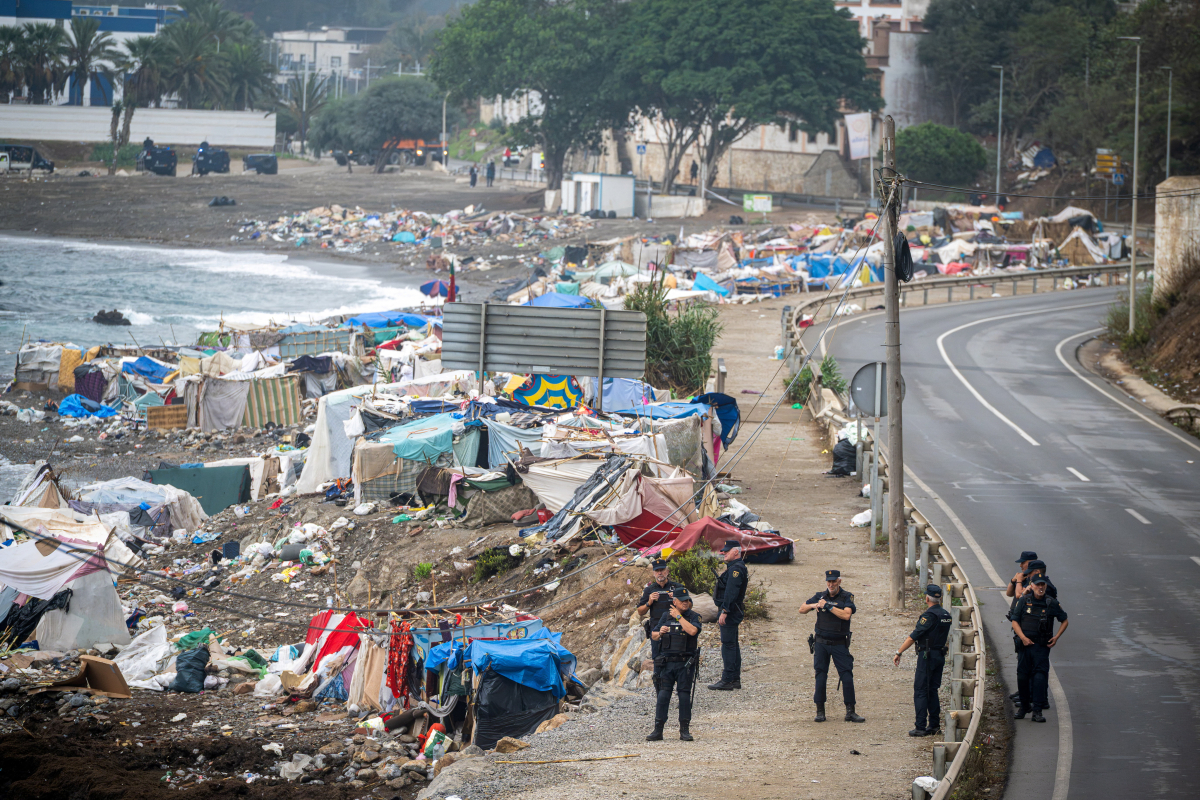
After more than 70,000 migrants illegally crossing into Ceuta from Morocco at the end of July, Abascal visited the Spanish coastal exclave and called for the border to be militarised.
The party's manifesto, whose title translates as “Recover Spain”, promises to expel migrants from Ceuta, give Spaniards priority access to public housing, benefits and social services, and repatriate anyone who entered Spain illegally.
Asked in October by newspaper La Razón how many people that could mean, Abascal replied, “We don't care whether that means a hundred, a hundred thousand, a million or more.”
Immigration and housing are key issues
Abascal’s proposed policies would mark a sharp reversal in the country’s approach to migration. Over the last few years, Spain has stood out as the last major European country to adopt a pro-migration message.
Sánchez’s government implemented a mass migration amnesty in April, allowing undocumented migrants to apply for temporary work and residency permits.
More than one million undocumented migrants and asylum seekers applied to regularise their status following the announcement of the scheme, more than double the number of people it was expected to attract.
Since 2019, Sánchez's first full year in power, Spain's foreign-born population has grown by 3.5 million to 10 million, taking the country's population to almost 50 million, according to the national statistics agency.
Sánchez has argued that migration drives growth. Goldman Sachs forecasts GDP growth of 2.1 per cent in 2026, three times the euro-area rate, and in June Sánchez said that without immigration Spain would lose 19 per cent of its GDP by 2050.
However, per capita GDP growth - which provides a clearer picture of individual living standards - has lagged behind.
The International Monetary Fund projects per capita GDP growth of just 0.9 per cent between 2018 and 2027.
House prices rose at three times the rate of wages last year, and more than half of 18-to-34-year-olds live with their parents or rely on them for living costs.
A survey by market research firm YouGov in October found that more than half (53 per cent) of Spaniards believe housing is the top issue facing the country, followed by immigration levels (35 per cent) and corruption (28 per cent). However among Vox voters, 68 per cent name immigration as the top issue.
The biggest single motive for how people vote was stopping a right-wing government (14 per cent), followed by wanting a change of government (nine per cent), according to the same YouGov data.
Vox's rise to prominence
Vox was founded in 2013 by former PP members unhappy with the party's line on regional nationalism, social issues and corruption. Abascal, one of them, became leader in 2014.
Spanish newspaper El Confidencial once summed up its early priorities as family, Spanish unity, opposition to abortion and opposition to ETA, the Basque armed separatist group which disbanded in 2019. Anti-immigration politics were always on the agenda, but it is only in recent years that they have become the party's main focus.
Vox’s breakthrough came in 2018 when the party entered the southern Spanish province of Andalusia’s regional parliament for the first time. The party entered Spain’s parliament in national elections the following year.
Main national candidates and parties
The main contenders are incumbent Prime Minister Pedro Sánchez (Socialist Party), centre-right opposition leader Alberto Núñez Feijóo (People's Party), far-right leader Santiago Abascal (Vox), and left-wing alliance leader Ada Colau (Broad Front).
Spain's roughly 39 million registered voters decide on 29 November. The new parliament is due to meet on 23 December.
Read more from Spain:
























What is your opinion on this topic?
Leave the first comment