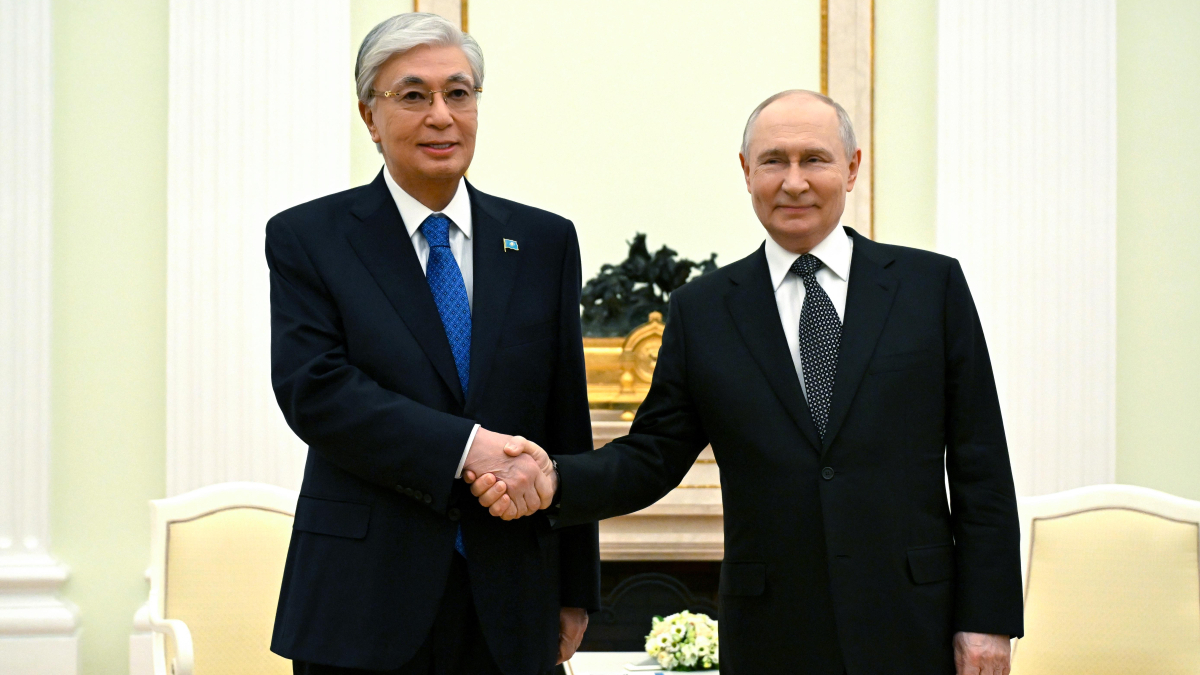
Kazakhstan’s President Kassym-Jomart Tokayev held talks with Russian President Vladimir Putin on trade and technology in Moscow before renewing a proposal to digitise cross-border freight operations.
The Kremlin talks on 25 November marked the start of Tokayev’s two-day working visit. The two leaders had last met a fortnight earlier at a regional security summit in Moscow.
Putin put bilateral trade at just over $28 billion and said more than 90 per cent of payments between the two countries were made in their national currencies. Tokayev said 124 of the 178 joint projects on the bilateral agenda had been completed.
Tokayev brought a delegation of Kazakh businesses using artificial intelligence (AI) and other digital tools. At the Kremlin, he identified cybersecurity as an area in which Kazakhstan could benefit from Russian expertise.
Push for a digital freight corridor
The two presidents attended the AI Journey conference the following day. After touring an exhibition showcasing how cross-border freight could be managed digitally, Tokayev revived his proposal for a digital transport corridor.
He had outlined a pilot scheme in July at a forum in the Russian city of Omsk, proposing the use of existing digital platforms on one of the countries’ busiest freight routes. In Moscow, he said advanced technology would become the central focus of their strategic partnership.
AI investment and technological independence
The scale of investment needed to support AI was also on the agenda. Tokayev cited a forecast that global spending on AI could reach around $2.7 trillion in 2026, with more than $1.5 trillion going towards digital infrastructure.
Putin called for the development of domestic AI models, warning that reliance on foreign providers could leave users without access to their services. He proposed that mobile operating systems used in Russia offer users a choice of AI models, including those developed domestically.
Read more:












What is your opinion on this topic?
Leave the first comment