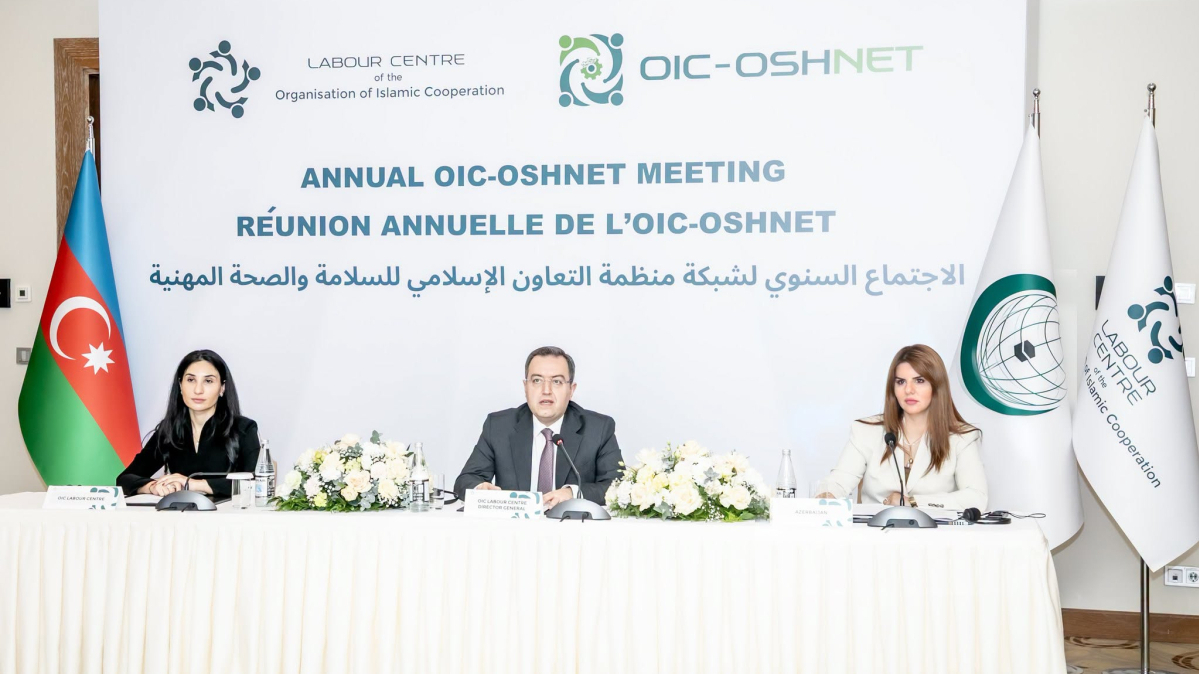
The OIC Labour Centre held two high-level meetings on 23 and 24 November, focusing on strengthening occupational safety and health standards, institutional governance and international cooperation across Member States.
The meetings, held online, brought together government officials, international organisations and labour experts to discuss shared priorities, strategic partnerships and the Centre’s future development.
Strengthening occupational safety and health
The Annual Meeting of the OIC Occupational Safety and Health Network (OIC-OSHNET), held on 23 November under the theme “Towards Shared Occupational Safety and Health Priorities”, brought together more than 100 participants from over 45 Member States and around 10 international organisations.
Opening remarks were delivered by OIC Labour Centre Director General Azar Bayramov and OIC Assistant Secretary-General for Economic Affairs Ahmad Kawesa Sengendo.
Representatives of international labour and social security organisations emphasised the importance of occupational risk prevention, effective national safety systems and international cooperation in creating safer working environments.
Participants adopted the Network’s governance and operational arrangements, electing Saudi Arabia as Chair and Malaysia and Senegal as Vice-Chairs.
Establishing shared workplace safety priorities
The Centre presented the Network’s renewed vision, mission and strategic objectives, alongside its Occupational Safety and Health Excellence Framework (OSHEF).
Discussions focused on strengthening national occupational safety systems through technical cooperation, institutional capacity-building, professional training and knowledge-sharing.
Participants also explored the role of labour inspections, occupational risk prevention and technological innovation in improving workplace safety.
Preparations advanced for the Network’s first two-year work plan, while participants endorsed a needs assessment to identify national priorities, address capacity gaps and develop targeted joint initiatives.
Institutional governance and financial sustainability
On 24 November, the OIC Labour Centre convened its Second Executive Board Meeting, chaired by Azerbaijan’s Deputy Minister of Labour and Social Protection of the Population, Rashad Mustafayev.
The Board reviewed the Centre’s activities and financial performance for 2025, including progress in developing strategic partnerships, international representation and programmes supporting Member States.
Members also discussed institutional policies, the composition and leadership of the Executive Board for the 2027–2029 term and the proposed appointment of the Director General.
Financial sustainability was another key priority, with discussions covering the proposed regular budget for 2026–2028, mandatory contributions from Member States and the establishment of a Financial Control Committee.
The Board acknowledged financial contributions from Saudi Arabia and Pakistan, as well as Azerbaijan’s support towards the Secretariat’s operational costs.
Expanding international cooperation
The Executive Board also discussed cooperation with Senegal in organising the 24th World Congress on Safety and Health at Work, scheduled to take place in Dakar in 2027, with the OIC Labour Centre contributing as a strategic partner.
Members welcomed the outcomes of the OIC-OSHNET Annual Meeting and highlighted the Centre’s coordinating role in promoting higher occupational safety and health standards.
Several draft resolutions were recommended for consideration and adoption at the Second Session of the General Assembly, scheduled for 7–8 December 2026.
About the OIC Labour Centre
Headquartered in Baku, Azerbaijan, the OIC Labour Centre began its operations in 2024 as an international intergovernmental organisation.
The Centre is mandated to strengthen cooperation among the 57 Member States of the Organisation of Islamic Cooperation (OIC) in labour, employment, social protection and human capital development.
Its priorities include promoting decent work, improving workplace safety, expanding employment and skills development opportunities, strengthening social dialogue and supporting sustainable social protection systems.














What is your opinion on this topic?
Leave the first comment