Georgia’s Special Representative to Russia, Giorgi Zurabashvili was left “stunned” after Moscow said it intended to sanction more Georgian wine firms during the first bilateral talks between the two countries in five years.
Russian Deputy Foreign Minister Mikhail Galuzin accuses the targeted Georgian wine companies of providing financial support to Ukraine, pushing anti-Russian views, and producing poor quality wine, during a meeting in the Belarusian capital, Minsk, on 19 November.
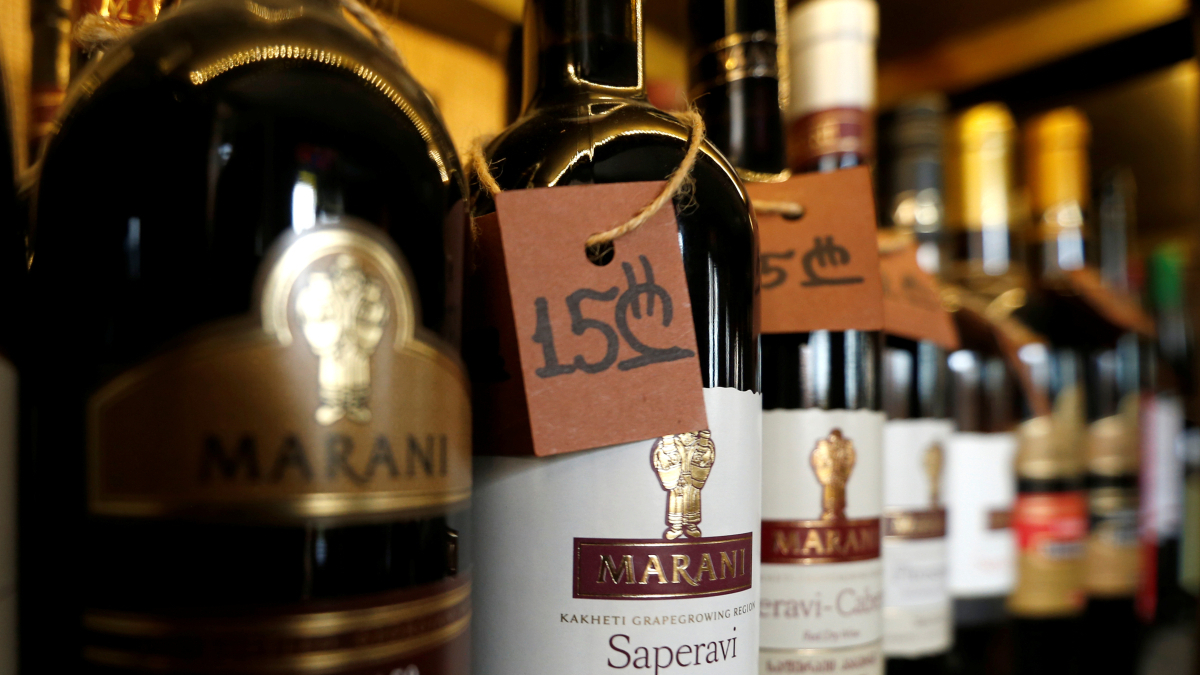
Rospotrebnadzor, Russia’s consumer health agency, introduced a temporary ban on the import of wine from a number of Georgian winemakers on 9 October, citing sanitary and quality violations.
Speaking to Georgian media outlet Imedi, Zurabashvili said he asked Galuzin to explain the restrictions.
“I received three things from him in response: first, in relation to quality; second, as if these companies are financing the war in favor of the Ukrainians, and third, they are engaged in an anti-Russian narrative,” Zurabashvili said.
“Mr. Galuzin informed me that they were going to sanction two more Georgian wine companies. Of course, I was surprised and stunned by this news.”
Zurabashvili said he had expected Russia to lift the restrictions immediately and dismissed Galuzin’s accusations as unsubstantiated.
“Georgian wine is of high quality, it has a number of international certificates and licenses, and this accusation was absolutely groundless, as if Georgian wine is of low quality,” he said.
“As for the other two issues - Ukrainian financing and the anti-Russian narrative - this is also absolutely irrelevant, does not correspond to reality, and nothing like this is happening.”
Importance of Russian to Georgian wine firms
Russia is by far the largest market for Georgian wine, accounting for nearly two thirds (63.9 per cent) of Georgia’s total wine export revenue in the first 10 months of 2026, according to the National Statistics Office of Georgia.
Georgian Prime Minister Irakli Kobakhidze on Thursday (26 November) suggested the “Deep State” may have contributed to Russia’s decision to restrict wine imports from certain Georgian firms.
“The Deep State has very considerable influence, and it is possible that the middle tier here, too, may simply have been bribed,” he told journalists.
Georgia’s ruling party, Georgian Dream, has repeatedly invoked the notion of the “Deep State’ to claim that a shadowy unaccountable international network manipulates Western governments.
No diplomatic relations
Diplomatic relations between Tbilisi and Moscow were severed after the August 2008 war, when Russia recognised the separatist regions of Abkhazia and South Ossetia as independent states.
Ahead of the Minsk talks, Kobakhidze said Georgia would not restore diplomatic relations with Russia while Moscow continued to recognise the breakaway regions.
“There is a natural obstacle to restoring these relations: the occupation of our country’s territories and the recognition of the two occupied regions as so-called states – their so-called recognition. Accordingly, our decision on this matter will not be reconsidered and cannot be reconsidered,” he said.
Read more from Georgia:
















What is your opinion on this topic?
Leave the first comment