Here's your AnewZ Daily Brief for the 20th of November, covering the latest developments across the South Caucasus and Central Asia.
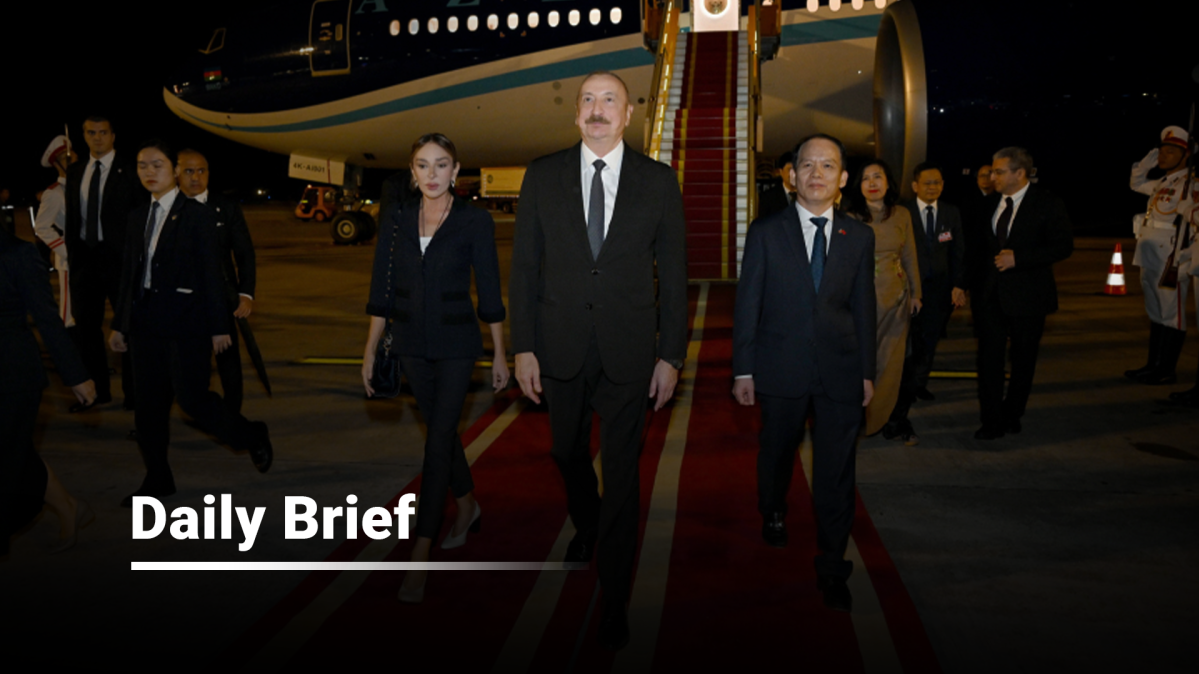
Aliyev arrives in Vietnam for official visit
Azerbaijani President Ilham Aliyev arrived in Hanoi on 19 November for an official visit to Vietnam, accompanied by First Lady Mehriban Aliyeva. The presidential couple were welcomed at Noi Bai International Airport by Vietnamese Justice Minister Hoang Thanh Tung and other officials, with a guard of honour marking their arrival.
The visit comes as Azerbaijan and Vietnam seek to strengthen bilateral relations and expand co-operation in areas including trade, investment and diplomacy.
Pashinyan vows to quit over Armenia Constitution vote
Armenian Prime Minister Nikol Pashinyan has pledged to resign if voters reject his proposed new Constitution in a referendum, or step aside from the next prime ministerial race if it is approved. The changes are significant for the Armenia-Azerbaijan peace process, as Baku wants constitutional references linked to territorial claims against Azerbaijan removed before a final agreement is signed. Pashinyan also needs 70 parliamentary votes to call a referendum, while his party holds 64 seats. Separately, he plans three visits to Russia in December, on the 3rd, 11th and 22nd, for talks, expressing hope that relations with Moscow will remain friendly.
Turkmenistan hosts CIS interparliamentary Assembly for first time
Turkmenistan is hosting the autumn session of the CIS Interparliamentary Assembly for the first time, with delegations from Azerbaijan, Russia, Belarus and other member states meeting in Avaza on 19-20 November. Discussions focus on strengthening parliamentary cooperation and regional ties, with a proposal to grant Turkmenistan observer status in the Assembly also on the agenda. The gathering comes as Turkmenistan holds the CIS chairmanship for 2026, reflecting its efforts to strengthen engagement with other Commonwealth countries.
Afghanistan economy to grow 3% in 2026
Afghanistan’s economy is forecast to grow by 3 per cent in 2026, but rising population levels are expected to outweigh these gains, leading to a 3.3 per cent fall in output per person, according to the World Bank. A strong harvest is expected to drive most of the growth, while falling investment, trade disruptions and worsening food insecurity continue to put pressure on households. The country also faces a growing water crisis, with Kabul extracting groundwater at nearly four times the rate at which it is naturally replenished. The World Bank warns that sustainable recovery will depend on better water management, stronger trade links, job creation and restoring women’s access to education and employment.
Tajikistan waives fuel import duties to diversify supplies
Tajikistan has temporarily scrapped import duties on fuel from countries including Azerbaijan, Iran and Turkmenistan until the end of 2026, in an effort to diversify supplies after disruptions to Russian deliveries caused shortages and price rises. Russia accounted for around 91 per cent of the country's petroleum product imports in the first half of the year. Ukrainian drone strikes on Russian refineries have disrupted production and exports, prompting Dushanbe to seek alternative suppliers, including Iran and Kazakhstan. However, Russia remains Tajikistan's main fuel supplier, leaving the country exposed to further disruptions.
Landmine threat persists in Azerbaijan’s liberated territories
Azerbaijan has recorded 279 landmine incidents in its liberated territories since November 2020, leaving 73 people dead and 371 injured, according to ANAMA. Meanwhile, more than 312,000 hectares have been cleared, with over 271,000 mines and unexploded ordnance detected and destroyed. Landmines remain a major obstacle to reconstruction and the return of former internally displaced persons to Garabagh and East Zangezur. Baku says more than 1.5 million mines were planted during nearly three decades of occupation and continues to call on Armenia to provide minefield maps to speed up clearance efforts.









What is your opinion on this topic?
Leave the first comment