Russia and Ukraine are set to return to Abu Dhabi on Tuesday for a fourth round of U.S.-brokered peace talks, with European participation, security guarantees and territorial disputes expected to shape the negotiations.
The United Arab Emirates has emerged as a key diplomatic venue during the war, hosting prisoner exchanges and, increasingly, direct negotiations between Moscow and Kyiv.
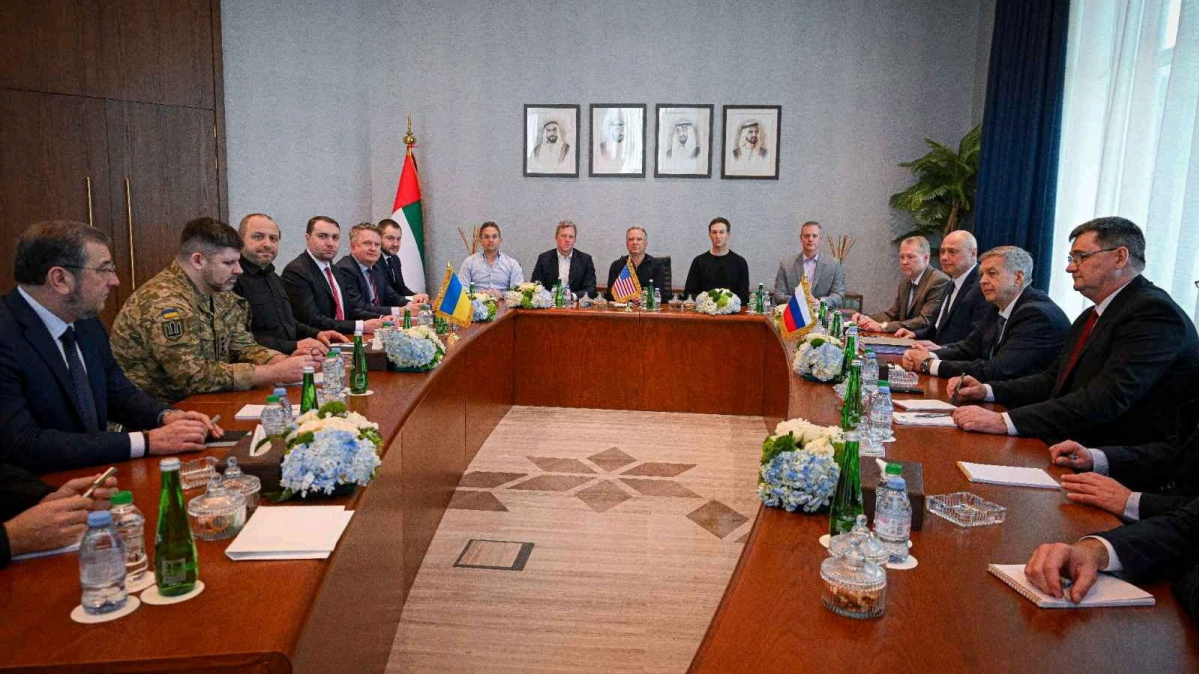
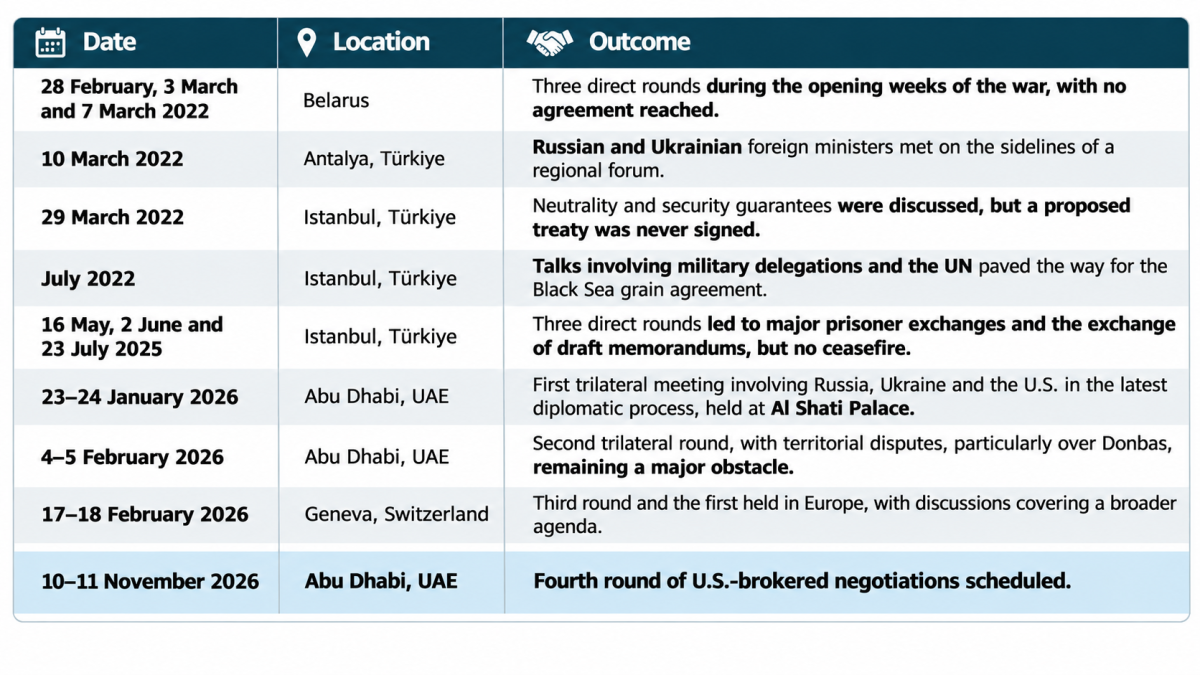
Delegations from Russia and Ukraine, joined by U.S. envoys Steve Witkoff and Jared Kushner, are due in Abu Dhabi on 10–11 November. It will be the fourth round of the U.S.-brokered process and the first since talks in Geneva in February.
Washington says the agenda includes efforts to end the war, post-war security arrangements, de-escalation measures and humanitarian issues.
A breakthrough remains uncertain. While the composition of the delegations has changed, the fundamental disagreements between Russia and Ukraine appear largely unresolved.
How previous talks have unfolded
The current U.S.-led diplomatic process also has roots in Riyadh, where Washington held separate talks with Russian and Ukrainian delegations in March 2025.
Abu Dhabi's involvement dates back further. Reuters reported that Russian and Ukrainian representatives discussed prisoner exchanges and ammonia transit in the emirate as early as November 2022.
Some reports also refer to contacts in Abu Dhabi in November 2025, although these were separate from the current trilateral format. Under that format, Tuesday's meeting would be the third round hosted by the UAE.
Prisoner exchanges strengthen the UAE's role
The UAE's most tangible contribution to diplomacy has been its mediation of prisoner exchanges between Russia and Ukraine.
According to the UAE Foreign Ministry, the 23 October exchange, involving 270 prisoners from each side, marked the 27th UAE-mediated swap since the war began.
The ministry said the latest exchange brought the total number of people released through UAE mediation to 8,537.
The exchange was the third stage of a process launched on 19 August under an agreement brokered by the Trump administration in May, covering approximately 2,000 prisoners of war.
Official UAE figures illustrate the scale of its mediation efforts. By April, the country had facilitated 21 exchanges involving 6,305 people. That figure subsequently rose to 22 exchanges and 6,691 people, followed by 25 exchanges involving 7,791 people during the summer and 26 involving 7,997 people in August.
Several exchanges were conducted through joint UAE-U.S. mediation. Russia's Defence Ministry also confirmed the October exchange and thanked the UAE for its role.
The repeated exchanges highlight Abu Dhabi's ability to maintain working relations with both Moscow and Kyiv, even as their wider political differences persist.
However, negotiating prisoner releases is considerably less complex than resolving disputes over territory, security guarantees and Ukraine's future relationship with NATO. Whether the UAE can help bridge those divisions remains uncertain.
Russia sends senior officials to negotiations
Moscow is sending a more senior delegation to Abu Dhabi, potentially signalling greater attention to the negotiations.
Presidential aide Vladimir Medinsky will lead the Russian team, having headed several previous rounds since 2022.
The delegation will also include Deputy Foreign Ministers Sergei Ryabkov and Mikhail Galuzin, alongside senior General Staff officers, including military intelligence chief Igor Kostyukov.
Kremlin aide Yuri Ushakov is overseeing Russia's diplomatic efforts.
Ukraine's delegation will be led by Rustem Umerov, head of the country's National Security and Defence Council.
The presence of senior officials could allow more substantive discussions, although it does not necessarily indicate greater willingness to compromise.
The U.S.-based Institute for the Study of War has noted that some Russian officials involved in previous negotiations have taken firm positions on Moscow's demands.
The Kremlin has given no indication that its underlying negotiating position has changed.
European participation remains disputed
The possible involvement of European representatives has emerged as a key point of disagreement ahead of the Abu Dhabi talks.
Until recently, Moscow had maintained that negotiations would follow an agreed trilateral format involving Russia, Ukraine and the U.S., without European participation.
However, French Foreign Minister Jean-Noël Barrot said on Sunday that France “will be there” to ensure “Europe's voice is heard.”
He did not specify who would attend or whether French representatives would participate directly in negotiations or act as observers.
Kyiv has repeatedly called for European involvement in discussions over Ukraine's future security.
President Volodymyr Zelenskyy has said Ukraine would continue participating in talks even without European representatives, but believes their involvement is essential.
He has also warned against agreements affecting Ukraine and Europe being negotiated without their direct participation, drawing comparisons with the 1945 Yalta conference.
Referring to a possible agreement suggested by U.S. President Donald Trump, Zelenskyy cited the prospect of a “very big” deal that might “involve all of Europe”. He said he had not seen the proposal and warned that it “can be dangerous.”
On Monday, Kremlin spokesman Dmitry Peskov reiterated that the Abu Dhabi negotiations would take place exclusively between Russian, Ukrainian and U.S. delegations.
His remarks appeared to contradict Barrot's statement about French attendance at the 10–11 November meeting.
Peskov said Ukraine and the U.S. already maintained separate communication channels with European counterparts.
European participation could prove particularly important in discussions about post-war security guarantees, given Europe's potential role in providing military, financial and political support.
Russia, however, has repeatedly opposed the deployment of Western forces in Ukraine, highlighting one of the central obstacles to a lasting settlement.
The distinction between observer status and a formal negotiating role could therefore become a significant issue, with Moscow's response likely to indicate how much flexibility exists within the current format.
What could emerge from the talks?
Expectations for an immediate peace agreement remain low, with negotiators facing longstanding disagreements over territory and security.
The most achievable outcomes may be humanitarian, including another prisoner exchange, limited de-escalation measures, arrangements for aid access or an agreement to continue negotiations.
Bilateral meetings on the sidelines could also help clarify positions ahead of future rounds.
John Herbst, a former U.S. ambassador to Kyiv, has suggested that the talks may produce little more than an agreement to meet again.
The central disputes remain unchanged.
Russia is demanding that Ukrainian forces withdraw from the parts of Donbas still under Kyiv's control and that Ukraine abandon its ambition to join NATO.
Kyiv, meanwhile, is seeking binding security commitments specifying who would respond, how and under what circumstances if Russia launched another attack.
The continuing violence has further complicated diplomatic efforts.
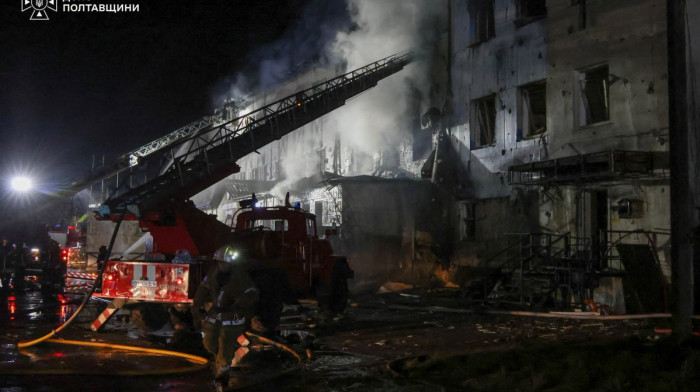
Zelenskyy said Russia launched 36 ballistic missiles towards the Kyiv area on Saturday night, of which only four were intercepted. He accused Moscow of using military aggression alongside diplomacy.
At least 55 people were also reported killed in a guided-bomb strike on an aid site in Komyshuvakha last Monday.
The attacks underscore the difficult backdrop to negotiations, which have repeatedly taken place while fighting continues.
Political developments beyond the battlefield could also influence the diplomatic process.
The prospect of a Democratic-controlled U.S. Congress in January is being closely watched, with Kyiv hoping that a shift in Washington's political balance could strengthen its position.
Meanwhile, speculation about a possible meeting involving Trump, Chinese President Xi Jinping and Russian President Vladimir Putin at the APEC summit in Shenzhen later this month has added another dimension, although details remain limited.
Three developments to watch
The Abu Dhabi talks could provide a clearer indication of whether the negotiating process is moving beyond established positions. Three developments will be particularly important.
First, whether European representatives attend and, if so, whether they are given a formal role in discussions.
Second, whether Russian negotiators engage in detailed talks on security guarantees rather than simply restating Moscow's territorial demands.
Third, whether the delegations announce concrete humanitarian or de-escalation measures, supported by specific dates and implementation arrangements.
Any of these developments could signal progress, although none would guarantee a broader peace agreement.
If the negotiations fail to narrow the main political differences, Abu Dhabi may still deliver a more limited but meaningful result: keeping diplomatic channels open and helping more prisoners return home.









What is your opinion on this topic?
Leave the first comment