It started with classrooms. Too many students, not enough teachers, deteriorating buildings and growing anxiety over what comes after high school. But within weeks, a movement that began outside French lycées had spread across the country.
The movement drew university students into the streets and triggered a much broader confrontation over police violence, politics and even immigration.
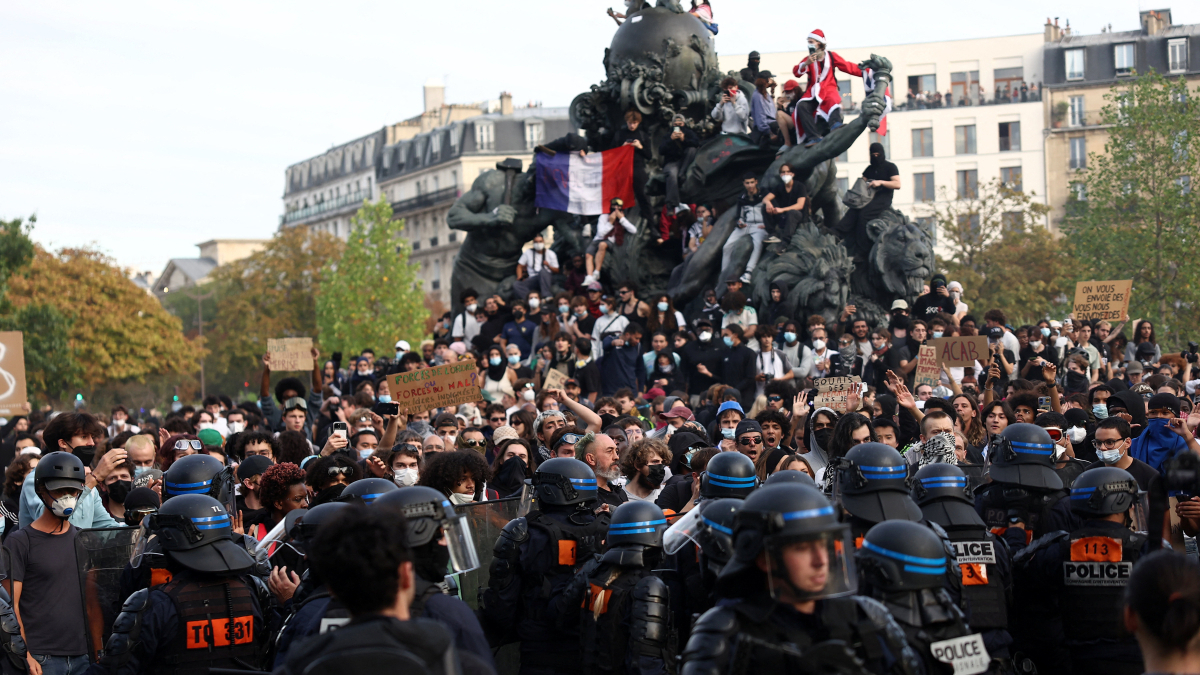
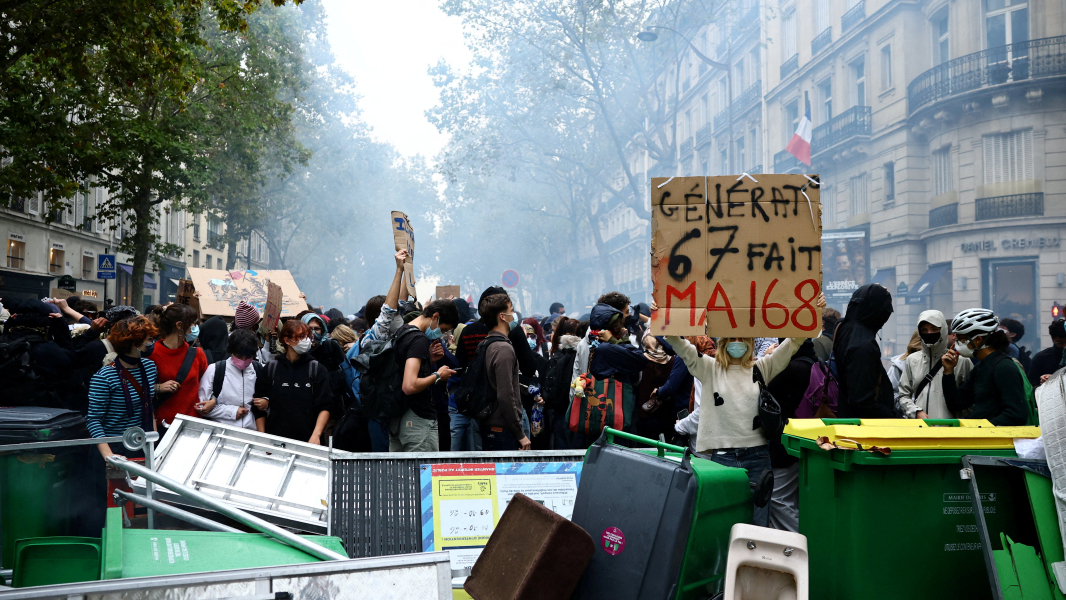
On 6 October, more than 266,000 people demonstrated across France according to authorities, while organisers put the figure at around 450,000.
So how did a protest over education become one of France’s biggest youth movements in years?
What are the students asking for?
The protests began in September, initially around schools in the Paris region, before spreading to hundreds of establishments across France.
Their grievances are remarkably concrete: students complain of overcrowded classrooms, sometimes with more than 30 pupils, missing or unreplaced teachers, understaffed schools and buildings in poor condition.
Some describe classrooms that become extremely hot during summer heatwaves and difficult to heat properly during winter.
Then there is the French school day itself: for many high school students, schedules can stretch from 8 am until 6 pm, before homework begins at home.
And for those approaching graduation, another source of frustration is “Parcoursup”, the national university admissions platform, which has become a symbol of anxiety over access to higher education and students’ futures.
Many of these problems predate President Emmanuel Macron. But after nearly a decade of his presidency, students argue that chronic teacher shortages, inequality between schools and deteriorating infrastructure have still not been resolved.
Some of the reforms introduced under Macron have themselves become targets of anger: Parcoursup was launched in 2018, while his governments also overhauled the lycée and baccalauréat systems.
The protests are unfolding as France prepares a restrictive 2027 budget. The government has proposed increasing education spending by around 1.7 per cent, below inflation, while attempting to make major savings across public spending.
When even France’s most prestigious schools join in
One sign that the movement had moved beyond its original base came from Paris.
Students at Henri-IV and Louis-le-Grand, two of the most prestigious and selective high schools in the country, also joined the mobilisation.
At Louis-le-Grand, one student told Le Monde she was protesting “in support of all the high school students who do not have the same resources as us”.
Students from Henri-IV, Louis-le-Grand, Saint-Louis and Fénelon later met with university students from La Sorbonne before joining demonstrations together.
It was a striking image: a movement that had emerged largely from schools complaining of inequality and insufficient resources had reached institutions traditionally associated with the elite of the French education system.
University students gradually joined too, although high school students remained the driving force behind the mobilisation.
Then the debate shifted to police violence
As the movement grew, so did clashes with police. And several cases involving minors have radically changed the debate around the protests.
In Lens, a 15-year-old boy lost his hand allegedly after a police stun grenade exploded during demonstrations on 5 October.
The incident led Interior Minister Laurent Nuñez to temporarily suspend the use of the EF-SON stun grenade during student protests while investigators determine exactly what happened.
In Tours, a 16-year-old lost the use of one eye allegedly after suffering an injury reportedly compatible with an LBD rubber projectile.
At Saint-Ouen-l’Aumône, a 14-year-old suffered a double jaw fracture and broken teeth allegedly during a police intervention.
In another widely shared video filmed in Alençon, a 14-year-old girl was seen allegedly being restrained around the neck by an officer.
And in Metz, prosecutors opened an investigation into suspected sexual assault after footage showed a plainclothes police officer allegedly touching the chest area of a girl under 15 during an arrest. She denied sexual assault and the officer filed a complaint on Tuesday for “public defamation of a public official,” according to the public prosecutor cited in local media.
The investigations are ongoing, and responsibility has not been established in every case.
But the accumulation of serious injuries involving minors has turned policing into one of the central issues of the movement.
By 5 October, at least 190 students had been reported injured.
The age of many demonstrators and the severity of some injuries caused by riot-control weapons have raised particular concern. Their intensity has also raised a more fundamental question: how can the state police a right that it is itself required to protect?
The right to demonstrate is constitutionally protected in France, even if it is not explicitly written as a standalone right in the 1958 Constitution. The Constitutional Council derives it from the freedom of expression guaranteed by the 1789 Declaration of the Rights of Man and of the Citizen, which forms part of France’s constitutional framework.
French law nevertheless requires that this freedom be balanced against another constitutional objective: maintaining public order and protecting people and property. Police can therefore intervene during demonstrations but the Conseil d’État has made clear that measures restricting or policing protests must be necessary, appropriate and proportionate.
Police officers and school staff have also been hurt
More than 600 officers had been injured by 3 October according to police figures, and there have been cases of officers being attacked, including one female officer kicked while on the ground.
Why are French police using grenades at protests?
France has long had an extensive arsenal for public-order policing. That includes tear gas, rubber projectiles and several types of explosive or stun grenades.
Human rights groups have repeatedly criticised their use. Amnesty International has previously described France as the only European country using certain types of “grenades de désencerclement”, explosive grenades designed to disperse crowds, during public-order operations.
Some police grenades are legally classified in France as category A2 equipment, a category covering military materiel. And the severe injuries they can cause have fuelled a longstanding debate over whether they are appropriate for crowd control.
Amnesty calls for de-escalation
Amnesty International has accused French authorities of using disproportionate force against student protesters. The organisation says young people have faced tear gas, baton strikes, grenades and mass arrests while exercising their right to protest.
According to Interior Ministry figures cited by Amnesty, more than 5,000 people were arrested between 21 September and 2 October, around 85 per cent of them minors.
Ahead of the national mobilisation on 6 October, Amnesty called on authorities to protect young demonstrators and ensure that any use of force remained necessary and proportionate.
But there has also been significant damage
The demonstrations have not remained peaceful everywhere. Schools have been vandalised, fires have been started and objects have been thrown at police. Authorities in the Paris region initially estimated damage to high schools there alone at around $1.1 million (€1 million). As the unrest spread, police put national damage at tens of millions of euros.
The protests have also caused major disruption, with hundreds of schools affected or closed and thousands of arrests.
That creates a difficult balancing act for the French government: acknowledging genuine concerns about the education system while responding to serious violence occurring around parts of the movement.
Macron changes tone, but Nuñez refuses to apologise
The government’s handling of the demonstrations has itself become politically sensitive.
Interior Minister Laurent Nuñez has repeatedly defended the police response as proportionate in the majority of cases. Asked whether he would apologise to injured students, he said he did not believe he had to do so, stressing that the General Inspectorate of the National Police (IGPN) police watchdog was investigating individual incidents.
President Macron, however, has pushed the government towards a somewhat different tone. After the injury in Lens and growing criticism of the police response, Macron summoned senior ministers to the Élysée. The presidency said the response should be based on three principles: proportional policing, dialogue with students and condemnation of politicians accused of inflaming tensions.
That intervention exposed some of the discomfort inside the government over how the protests had been handled.
And then the debate became political
As the demonstrations grew, attention increasingly shifted away from what students were demanding and towards who was supposedly influencing them.
Government figures have repeatedly accused the far-left La France Insoumise party of encouraging unrest. The left-wing to far-left political movement La France Insoumise (LFI) politicians deny orchestrating the movement and argue that they are simply supporting student demands.
Some commentators on conservative and far-right media have gone further, raising the possibility that Islamist networks or the Muslim Brotherhood could be influencing the protests. No credible evidence has emerged showing that the Muslim Brotherhood organised the nationwide student movement.
Students themselves have repeatedly pushed back against claims that they are being manipulated, pointing instead to their demands over teachers, class sizes and school conditions.
And then the debate crossed the Atlantic.
Trump: 'This is about Islam'
U.S. President Donald Trump entered the controversy on 6 October.
“What’s happening in France is nothing less than out of control mass migration,” he wrote on Truth Social. “This isn’t about schools, this is about Islam wanting to take over a once great Country!”
Neither immigration nor Islam appears among the principal demands raised by protesting students. The demonstrations originated around staffing, infrastructure, class sizes and education funding.
Trump’s intervention therefore illustrated just how far the political narrative surrounding the movement had travelled from its starting point.
A dispute that began with students asking why their teachers were missing was now being discussed internationally as a question of Islam and migration.
Is this really unusual for France?
Not entirely. France has a long history of students turning educational grievances into much broader political movements.
The obvious comparison is May 1968.
What began with student demonstrations and university occupations developed into confrontations with police before spreading into a nationwide general strike involving millions of workers. May ’68 has since become part of France’s political mythology.
But it was not an isolated episode.
French students have repeatedly mobilised against education reforms, employment laws and changes affecting young people, often using school occupations, blockades and street demonstrations.
What distinguishes the current movement is that there was no single new law that triggered it. Instead, anger appears to have accumulated around a series of everyday problems: absent teachers, overcrowded classrooms, deteriorating schools, unequal resources and anxiety about the future. That may also explain why the movement spread so quickly. There was no single measure for the government to withdraw. And there is no single demand that would automatically bring the protests to an end.
From working-class schools outside Paris to Henri-IV, from high school gates to university campuses, the same frustration has increasingly been expressed in different forms. And after weeks of clashes, arrests and political accusations, the question that originally brought students into the streets risks becoming the easiest one to forget:
What conditions are young people in France being asked to study in?
Read more:














What is your opinion on this topic?
Leave the first comment