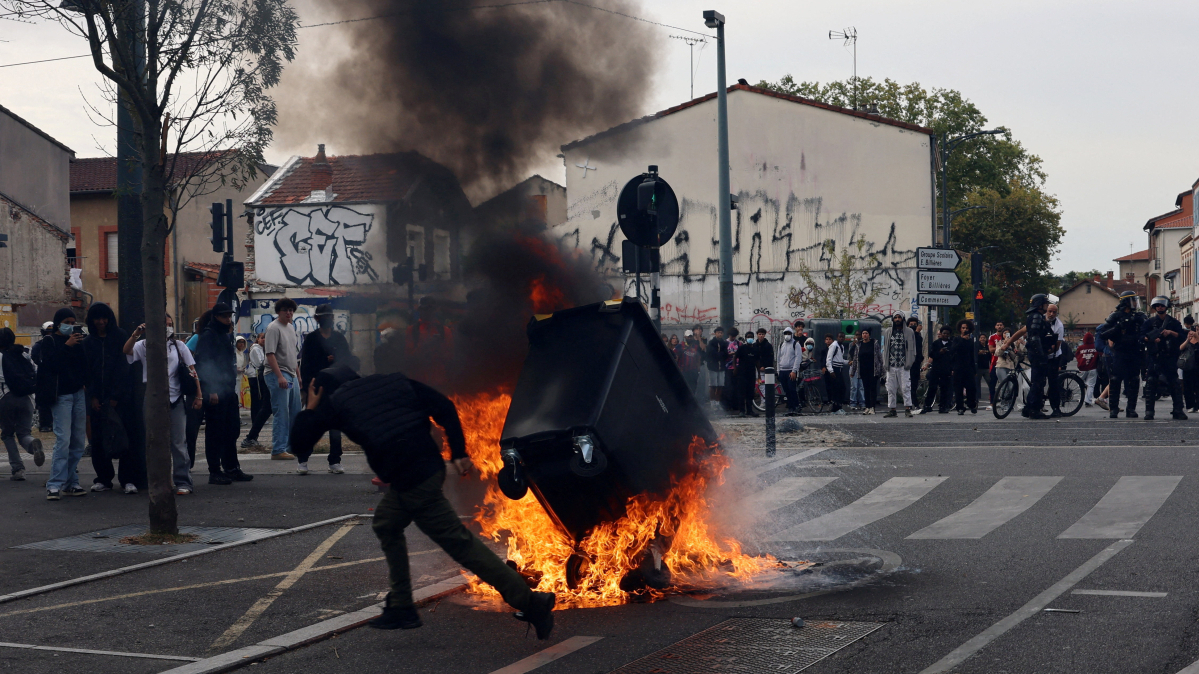
Around 400 schools across France remained closed on Friday as protests over teacher shortages and deteriorating buildings escalated into violence, leaving dozens injured and leading to 2,000 arrests.
Thousands arrested as unrest escalates
Justice Minister Gérald Darmanin said authorities were dealing with an increasingly serious public-order problem after demonstrations that began over conditions in schools spread across the country.
“There is an active and violent minority (participating in the protests) ... We're not entirely sure that they are even high-school students themselves,” Darmanin told RTL radio on Friday.
He said 2,000 people had been arrested since the protests began, with about two-thirds placed in police custody.
“We have gone from high-school student demonstrations to a public-order disturbance. When people target buses and set schools on fire, it is no longer simply a protest issue,” he said.
Education Minister Édouard Geffray said on Thursday evening that “a little over 400 schools and other educational establishments” would remain closed on Friday.
The protests began in the Paris region amid anger over teacher shortages and dilapidated school buildings before spreading nationwide. Dozens of people have been injured as demonstrations and school blockades have become increasingly violent.
Schools and vehicles set alight
Some of Thursday's most serious unrest was reported in Marseille, where two teachers at Victor Hugo high school were inadvertently splashed with petrol as a student attempted to throw it into a rubbish bin.
Outside the city's Saint-Exupéry high school, hundreds of young people forced firefighters to abandon their vehicle before it was set alight. Public transport was suspended after staff were injured.
Elsewhere, a school was set ablaze in Nantes and another building was damaged by fire in Le Havre. A car was torched in Strasbourg, while riot police clashed with youths in Toulouse.
In the Paris suburb of Saint-Denis, young people gathered in front of police lines. One student held a sign reading:
“Can we explain ourselves without being teargassed?”
Students have accused police of heavy-handed tactics, including the use of tear gas and flash-ball guns. The government has condemned violence during the demonstrations while acknowledging that problems in schools need to be addressed.
Interior Minister Laurent Nuñez said troublemakers had moved between schools in some areas in an effort to incite violence. Geffray has urged schools to switch to remote lessons when protesters prevent pupils from entering buildings.
Political row over origins of protests
The unrest has also triggered a political dispute over how the movement began. A source close to Prime Minister Sébastien Lecornu said intelligence agencies told a government crisis meeting on Thursday that hard-left politicians, including members of La France Insoumise (LFI), had initiated the protests.
LFI rejected the allegation.
“LFI has always advocated non-violent demonstrations,” LFI lawmaker Louis Boyard told BFM TV.
“The government, by turning it into a political battle, has added fuel to the fire by insulting and repressing high school students,” he added.
The demonstrations have become a political flashpoint as the government sets out spending cuts in its 2027 budget.
The unrest has also spread beyond France. High-school students began protesting in Liège, Belgium, on Thursday, with local media reporting that authorities had announced the closure of all schools in the city on Friday. A municipal spokesperson had not immediately confirmed the closures.
Read more:











What is your opinion on this topic?
Leave the first comment