The U.S. military has tightened restrictions on its personnel in Okinawa following the arrest of a Marine on suspicion of murder, a case that has reignited long-standing tensions over the American military presence on the southern Japanese island.
Military authorities announced a 48-hour operational pause across U.S. forces in Okinawa, accompanied by a complete alcohol ban, restrictions on off-base activities and a month-long overnight curfew.
The measures were introduced after the arrest of Lance Cpl. Devin Jacob Ballard, a 20-year-old Marine stationed at Marine Corps Air Station Futenma.
Japanese police suspect Ballard of killing Anna Yagi, 39, at a hotel in Naha, Okinawa's capital, during the early hours of Saturday.
Investigators allege Yagi died from asphyxiation after pressure was applied to her neck. Ballard denies the allegations, and the case has been referred to prosecutors.
Announcing the restrictions, Lt. Gen. Benjamin T. Watson, commander of the III Marine Expeditionary Force and Okinawa Area Coordinator, said the behaviour of individual service members directly affects relations with local communities and the broader U.S.-Japan alliance.
During the 48-hour stand-down period, commanders and senior enlisted personnel will conduct mandatory training sessions focused on discipline, conduct and service members' responsibilities as guests in Okinawa.
Watson said all personnel must understand that their actions carry consequences for both the military and the communities that host them.
The additional one-month curfew, which takes effect on Friday, requires military personnel to remain on base between midnight and 5 a.m., with enhanced supervision at military installations across Okinawa.
Public anger mounts
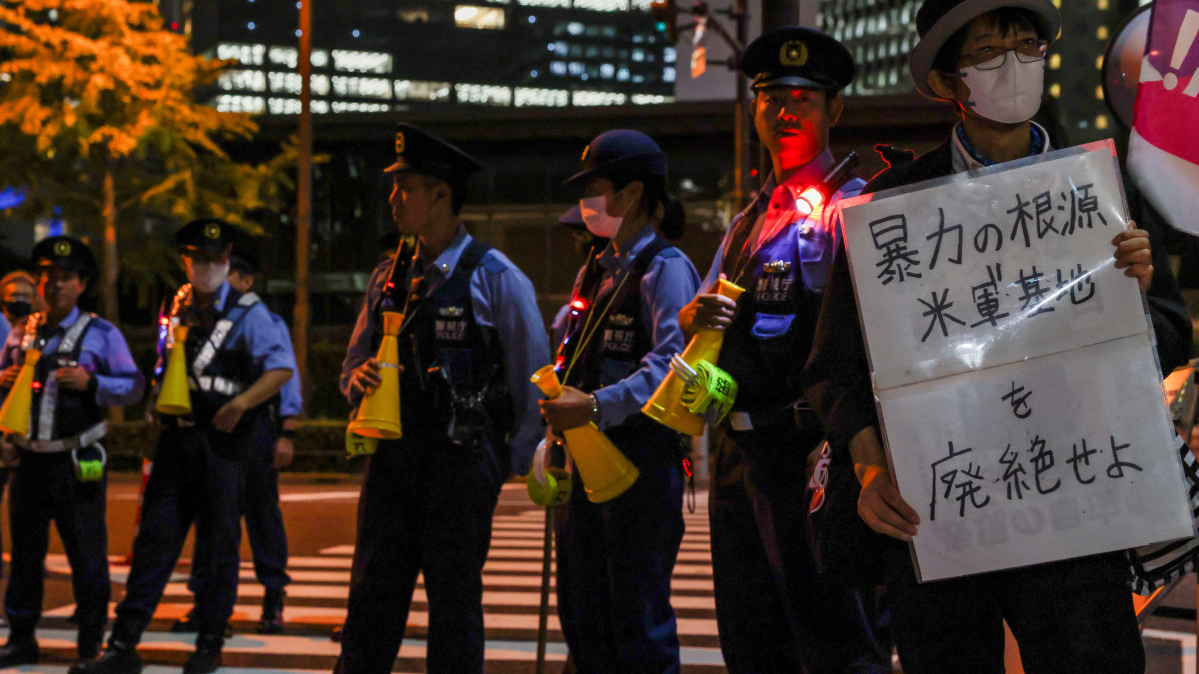
The case has triggered renewed public frustration in Okinawa, where opposition to the heavy concentration of U.S. military facilities has persisted for decades.
Residents gathered for an emergency protest in Okinawa City on Sunday evening, holding a moment of silence for Yagi and voicing criticism over what many described as repeated promises by U.S. forces to improve discipline among service members.
The incident has also become a diplomatic issue. Japan's government summoned the U.S. representative in response to the case, signalling the seriousness with which Tokyo is treating the matter.
The killing has revived a sensitive debate in Okinawa, where previous crimes involving U.S. military personnel have sparked public outrage and calls to reduce the American military footprint on the island.
Okinawa hosts the majority of U.S. military facilities in Japan despite accounting for only a small share of the country's total land area.
Under the U.S.-Japan Security Treaty, between 50,000 and 55,000 American military personnel are stationed across Japan, with a significant concentration based in Okinawa.
Amid the latest controversy, Japanese Defence Minister Shinjiro Koizumi announced measures aimed at easing some of the burden on local residents.
He said certain aircraft training activities currently conducted at Kadena Air Base would be temporarily transferred to Tsuiki Air Base on Japan's main island later this month.
Koizumi said the government recognises the significant burden carried by Okinawa's communities, which continue to host a large share of the security infrastructure underpinning the U.S.-Japan alliance.
This alliance remains a cornerstone of regional security, particularly as tensions persist in the Indo-Pacific. However, incidents involving American service members regularly reignite questions about the social and political costs of hosting large foreign military installations.
As the criminal investigation continues, both U.S. and Japanese authorities will be under pressure to demonstrate accountability while preventing the case from further straining relations with Okinawa's residents.
Read more:















What is your opinion on this topic?
Leave the first comment