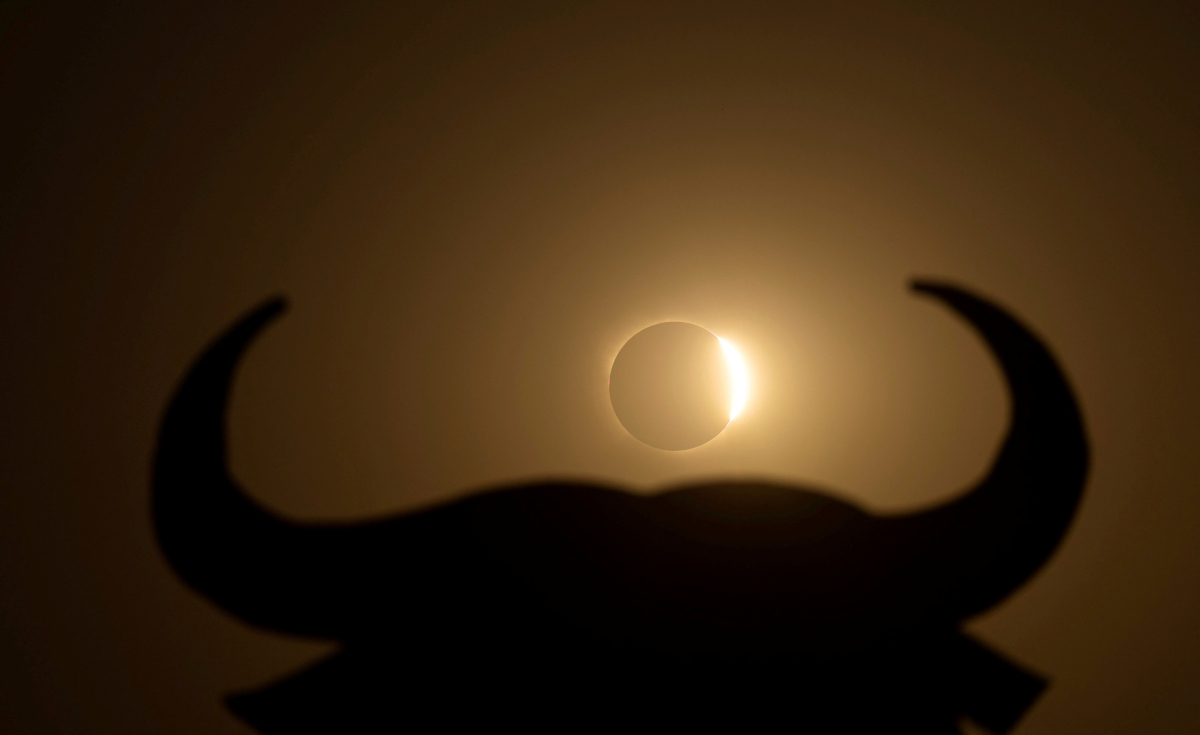
Millions of people across Europe, including northern Spain and Iceland, watched the sky darken on Wednesday evening as Western Europe experienced its first total solar eclipse in 27 years.
Crowds gathered at specially designated viewing sites across rural Spain. In Buitrago de Lozoya, a rural district north of Madrid, spectators clapped and cheered shortly after 20:30 local time (18:30 GMT) as Baily's beads - bright flashes of sunlight visible around the edge of the Moon - appeared on the horizon. Total darkness lasted just under a minute.
Diego Fernandez, a 32-year-old economist watching in Buitrago de Lozoya, said the effect deceived the brain.
"It's impressive how the colours return little by little after totality: first the reds, then the blues,” he added.
Rafael Jiménez, 50, from Madrid, described the atmosphere as otherworldly. "It was an absurd scene. We even got soaked when the garden sprinklers kicked in," he said. "And then, just like that, we were watching the sunset again."
Former Queen guitarist Brian May travelled to an observatory in Spain's Teruel province to witness the event, documenting it for his followers on Instagram as bystanders around him broke into applause.
Cloud cover in Iceland, clear skies in Spain
The eclipse first reached Iceland, where cloud cover obscured much of the view over the capital Reykjavik. However, a break in the clouds over the west of the country allowed some visitors and residents a glimpse.
The moon passed directly between the earth and sun, completely blocking the face of the latter, at around 17:44 GMT. Iceland’s western coast was plunged into darkness for up to two minutes and 13 seconds.
Eduarda Ortiz, a 33-year-old lawyer in Reykjavik, said the experience was unexpectedly emotional. "It was like a whole day just came at once, and I felt goosebumps because it just made us think about the shortness of life," she said.
Iceland, a country of around 400,000 people, saw an influx of up to 80,000 visitors for the event, and eclipse glasses had reportedly sold out days in advance.
Tens of thousands of police deployed
Spanish authorities had prepared for the possibility of up to six million visitors travelling to follow the total solar eclipse across the north of the country and the Balearic Islands. Some 25,000 police officers were deployed alongside almost 100 aircraft and helicopters to manage the crowds.
The eclipse coincided with one of Spain's highest-risk periods for wildfires, and emergency crews were already tackling a number of blazes on Wednesday, including a significant fire in the southern region of Andalucia. A vehicle fire near a viewing point in Peñíscola, in the Valencia region, spread to 33 other cars before firefighters brought it under control.
For many local authorities, the eclipse also offered a rare chance to draw visitors to less visited parts of the country, away from Spain's crowded coastal resorts. According to local media, some couples chose the occasion to get married.
Once in a lifetime event
The Iberian Peninsula last experienced a total solar eclipse in 1912. Two more are due in the coming years: a total eclipse on 2 August 2027 and an annular eclipse in January 2028.
Throughout history, the sudden dimming of daylight during a total eclipse has been interpreted variously as an omen or a sign of divine power.
For many first-time witnesses, though, the reaction was simpler. "Everybody tells you about it, but it is more beautiful than you imagine," said Gema, 43, as she left the viewing point in Buitrago de Lozoya.
Read more about the eclipse:













What is your opinion on this topic?
Leave the first comment