Russia has ruled out reviving a Black Sea grain deal. Moscow and Kyiv traded accusations at a United Nations Security Council meeting on Monday (23 November) over escalating attacks on shipping and energy infrastructure.
'We will not accept any new grain deal,' Anna Evstigneeva, Deputy Permanent Representative of the Russian Federation to the United Nations said.
Russia's representative told the council briefing that Moscow would not agree to a new arrangement, describing it as “nothing other than a scheme of Ukrainian food in exchange for Western weapons”.
“I dwelt on this in detail to ensure that nobody here has any doubt,” the envoy said.
According to Evstigneeva, under the previous grain deal only 3 per cent of exported grain went to countries in need, while up to 70 per cent of Ukrainian agricultural products went to Europe Union and Western markets.
The envoy said Russia supplies food to 160 countries as “one of the chief guarantors for global food security”. The envoy added that Moscow stood “ready to facilitate the replenishment of the possible grain deficit”.
Moscow accuses Kyiv of 'opening Pandora's box'
Russia accused President Volodymyr Zelenskyy and the Ukrainian armed forces of “opening Pandora's box”. It said Ukraine's military had targeted more than 200 commercial vessels in the Black, Azov, Caspian, Baltic and Mediterranean seas since July, killing or wounding 12 seafarers.
Moscow said it strikes only military-logistics vessels and dual-purpose facilities. It dismissed Western calls for an energy and maritime truce as a pretext to arm Ukraine while restricting Russian exports.
Kyiv: 'Not a single day' without attacks on energy
Ukraine's representative said Russia had been targeting civilian power grids since mid-July, damaging virtually every power plant in the country and more than 800 units of energy equipment.
“Since mid-July, not a single day has passed without a Russian attack on Ukraine's energy system,” he said.
He said strikes in November had shut down three thermal power plants and left more than 850,000 people without electricity.
He added that the Zaporizhzhia Nuclear Power Plant had lost off-site power for the 28th time, an issue he argued gets far less attention than its implications for international peace and security deserve. He called for the plant to be urgently returned to Kyiv's control.
He said the Ukraine Energy Support Fund had raised more than $2.6 billion from 41 donors. “But as we approach winter, air defence is our top priority. We need more Patriot systems, in particular PAC-3 interceptors,” he said.
Kyiv reports surge in attacks on ships
On maritime security, the Ukrainian envoy said there had been 89 attacks on civilian vessels between June and August, compared with 25 in the whole of 2025.
He accused Russia of stealing Ukrainian grain and moving it through a “shadow grain fleet”. “Grain stolen from Ukrainian land must be seized, not bought,” he said.
None of the figures given by either side could be independently verified.
U.S. calls for strikes to stop
The U.S. representative urged both countries to stop striking energy grids, civilian ports, food distribution sites and commercial shipping immediately.
“Food distribution sites must not be hit. Colleagues, the best way to protect food supplies on the Black Sea is for the war to end,” the U.S. envoy said. The envoy warned that continuing attacks were sinking grain and fertiliser cargoes and putting merchant sailors at risk.
Washington said it had made progress with Kyiv and European partners on four pillars:
- security guarantees
- a path to EU membership
- a post-war prosperity plan
- post-settlement security arrangements
The U.S. envoy said these aimed to build on recent talks in Abu Dhabi towards a lasting peace.
Clash over Libya strike
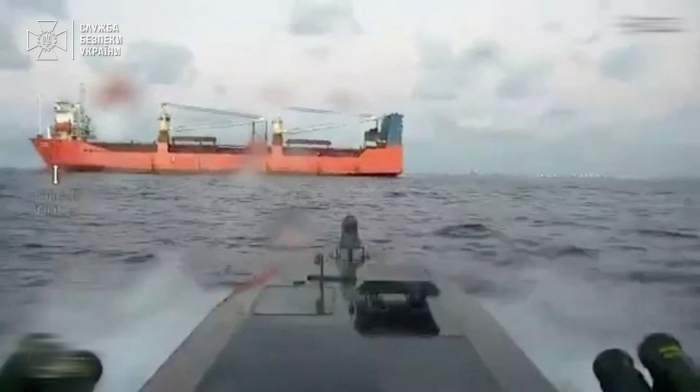
As the session closed, Russia's representative accused Kyiv of “criminally expanding the scope and geography” of its maritime attacks. The envoy referred to the weekend strike off Libya, which Moscow said hit two logistics vessels and an accompanying military boat.
The Russian envoy cited Zelenskyy's public acknowledgement of that strike and of an earlier attack in the Mediterranean on the gas carrier Arctic Metagaz. She said they proved the “terrorist nature of the Kyiv regime”.
Responding just before the meeting adjourned, Ukraine's representative dismissed the allegations as “distortion and finger-pointing”.
“Russia chose to invade Ukraine. Russia continues its aggression, and Russia bears full responsibility for this war,” Volodymyr Pavlichenko, Deputy Permanent Representative of Ukraine to the United Nations said. He urged Moscow to withdraw its forces.
Read more:













What is your opinion on this topic?
Leave the first comment