ASEAN foreign ministers opened the 59th ASEAN Foreign Ministers’ Meeting in Manila on 21 July, launching four days of talks that run until 24 July. The agenda includes South China Sea tensions, Myanmar’s conflict and growing U.S.-China rivalry.
What is ASEAN?
The Association of Southeast Asian Nations (ASEAN) is a regional organisation that brings together 10 countries in Southeast Asia: Brunei, Cambodia, Indonesia, Laos, Malaysia, Myanmar, the Philippines, Singapore, Thailand and Vietnam.
Founded in 1967, ASEAN was created to promote peace, stability and cooperation in a region that had experienced political tensions and conflict.
Today, it is one of Asia’s most important diplomatic organisations, providing a platform for Southeast Asian countries to discuss shared challenges and work together on issues including trade, security and regional development.
ASEAN is built around three main areas, known as its pillars: political-security cooperation, economic cooperation and socio-cultural cooperation.
Unlike the European Union, ASEAN does not operate as a single political or economic bloc. Its decisions are based on consultation and consensus, with members maintaining full control over their own national policies.
Why is the ASEAN meeting taking place?
ASEAN foreign ministers gathered in Manila on 21 July for the 59th ASEAN Foreign Ministers’ Meeting, hosted by the Philippines under its 2026 ASEAN chairmanship.
The meeting comes at a challenging time for Southeast Asia. The region is facing growing competition between major powers, tensions in the South China Sea, the continuing conflict in Myanmar and uncertainty in the global economy.
The discussions will help prepare recommendations for ASEAN leaders ahead of the organisation’s summit in November.
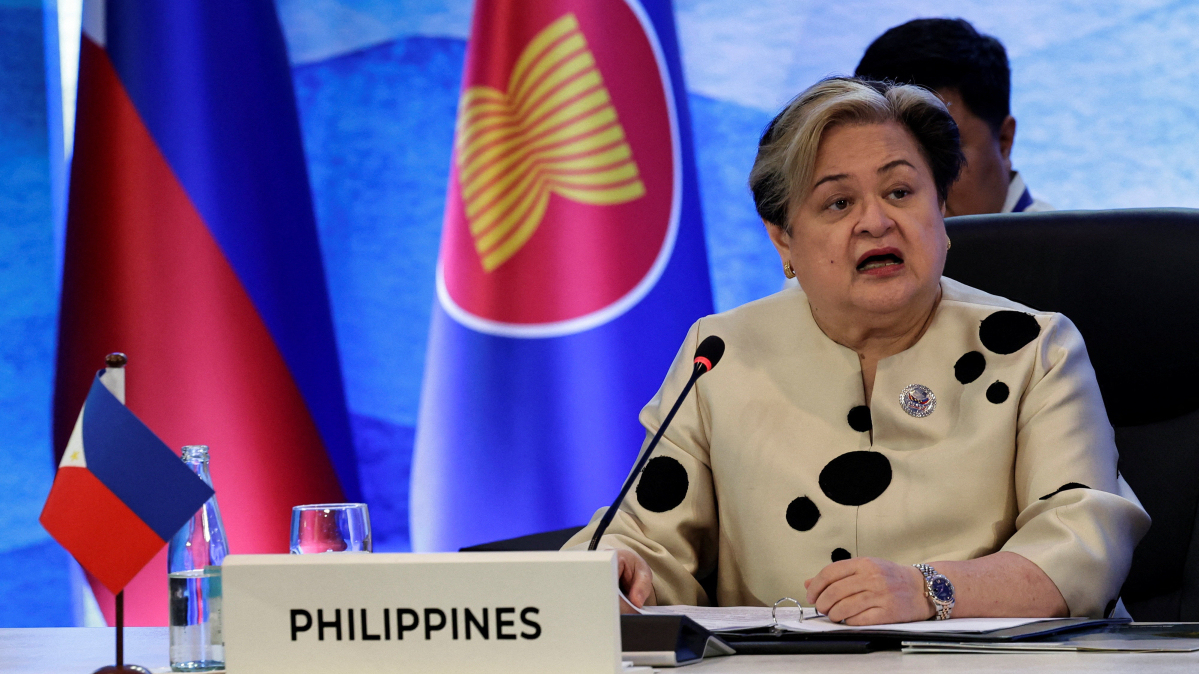
Philippine Foreign Affairs Secretary Ma. Theresa P. Lazaro, who opened the meeting, said ASEAN needed to respond to today’s challenges with “active, deliberate problem solving” in a world marked by “upheaval, uncertainty and unpredictability”.
Using the Philippines’ chairmanship theme, “Navigating Our Future, Together”, Lazaro said ASEAN countries needed to actively shape events rather than simply react to them.
“We do not just drift with the tide; we steer the ship as we chart the course,” she said.
Who is attending?
The meeting has brought together foreign ministers and senior officials from ASEAN’s 10 member states.
The wider discussions in Manila also include meetings with major external partners through forums such as:
- ASEAN Plus Three, which includes ASEAN countries plus China, Japan and South Korea.
- The East Asia Summit, which brings together regional and global powers.
- The ASEAN Regional Forum, a platform focused on security cooperation.
Participants include representatives from the U.S., China, Russia, Japan, India and the European Union, making the gathering a significant diplomatic event beyond Southeast Asia.
Five key takeaways from the ASEAN meeting
1. ASEAN is calling for unity in an increasingly divided world
The strongest message from the opening day was the need for ASEAN members to remain united.
Lazaro warned that countries needed to work together as global tensions increase and uncertainty grows.
She highlighted the Treaty of Amity and Cooperation (TAC), which marks its 50th anniversary this year, as the foundation of ASEAN’s approach. The treaty promotes respect for sovereignty, non-interference and the peaceful resolution of disputes.
“In a fractured global landscape, no single nation can weather these storms alone. Our strength and resilience lie in our community,” Lazaro said.
She added that if ASEAN countries failed to move together, “we risk being pulled apart”.
2. South China Sea tensions remain a major concern
The South China Sea is expected to be one of the most important issues discussed during the meeting.
Several ASEAN members, including the Philippines, Vietnam, Malaysia and Brunei, have competing territorial claims with China in the strategically important waterway.
Ministers are expected to discuss efforts to restart negotiations on a Code of Conduct for the South China Sea, aimed at creating clearer rules and reducing the risk of conflict.
The issue has become more urgent following recent confrontations between Chinese and Philippine vessels.
U.S. Secretary of State Marco Rubio raised the issue during his meetings in Manila, saying recent incidents represented an escalation that benefited no one.
He also reaffirmed Washington’s support for the Philippines under the two countries’ mutual defence treaty.
“We intend to live up to our treaty obligations,” Rubio said.
3. Myanmar’s conflict remains ASEAN’s biggest political challenge
The continuing crisis in Myanmar remains one of ASEAN’s most difficult challenges.
The country has been in conflict since the military seized power in 2021, leading to widespread fighting and a humanitarian crisis.
ASEAN’s peace plan, known as the Five-Point Consensus, calls for an end to violence, dialogue between opposing sides and humanitarian assistance. However, progress has been limited.
At the Manila meeting, ministers are expected to discuss ways to revive the initiative and develop a stronger regional response.
The situation also highlights a long-standing challenge for ASEAN: balancing the principle of non-interference with pressure to respond to regional crises.
4. The U.S. and China are trying to manage their rivalry
One of the most closely watched meetings on the sidelines of the ASEAN gathering was between U.S. Secretary of State Marco Rubio and Chinese Foreign Minister Wang Yi.
The talks lasted around 90 minutes and focused on managing tensions between the world’s two largest economies.
Rubio said both countries had serious disagreements but needed to maintain communication.
“There are areas of great differences. Both sides will acknowledge that,” he said. “We’ll have to work through those.”
He added that there were still “areas of potential cooperation”.
The discussions covered trade, Taiwan and broader U.S.-China relations. Rubio said it was important for the two countries to continue talking despite their differences.
“It would frankly be reckless and irresponsible for the U.S. and China not to have a relationship, given the impact our countries have on the global economy and on the world,” he said.
5. ASEAN wants to strengthen its role as a regional power
The meeting is not only focused on immediate crises. ASEAN is also looking at its longer-term future.
Ministers are reviewing progress on regional integration and cooperation under the ASEAN Community Vision 2045, which aims to build a stronger, more resilient and more connected Southeast Asia.
The organisation is also seeking to protect its role as a neutral diplomatic platform where competing powers can communicate.
With major countries including the U.S., China, Japan, India and Russia taking part in related meetings, ASEAN is aiming to remain at the centre of regional diplomacy.
Read more:














What is your opinion on this topic?
Leave the first comment