Days after Beijing imposed fresh restrictions on 56 U.S. companies, China's Ministry of Commerce said it remained committed to pursuing tariff cuts and mutually beneficial cooperation with Washington.
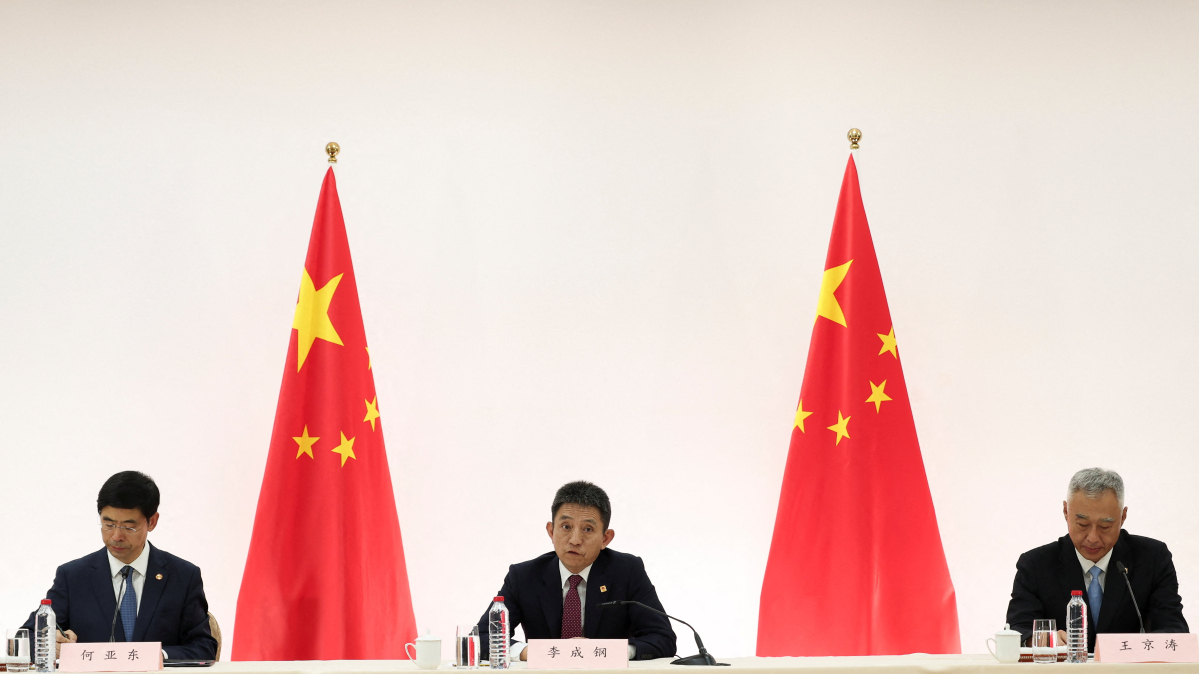
Both sides will continue discussing reciprocal tariff reductions within the framework of a newly established trade board, while also encouraging cooperation in aircraft and agricultural products, according to Ministry of Commerce spokesman He Yadong.
"The economic and trade teams of both sides will carry out further consultations on this matter," he said at a press conference on Thursday (25 June).
The trade board He Yadong referred to was one of the concrete outcomes of last month's Trump-Xi summit in Beijing, a structure designed to give both sides a regular, formal channel for managing their economic relationship.
China's ambassador to the United States, Xie Feng, has since proposed expanding the limit on tariff-free goods covered by the board tenfold , from $30 billion to $300 billion.
That is an ambitious number, and one that shows Beijing is genuinely interested in using the board to make progress rather than simply having it sit on paper.
Beijing calls out U.S.
At the same time, China made clear it has not forgotten what Washington has been doing.
He specifically called out what Beijing describes as malicious trade acts by the United States - a reference to the Pentagon's decision to add major Chinese companies including Alibaba, Baidu, and BYD to its military blacklist, and to separate U.S. moves to propose new tariffs on Chinese goods under a Section 301 investigation into forced labour.
The U.S. Trade Representative has proposed a new tariff of 12.5 per cent on China following a Section 301 investigation into forced labour practices - one of two investigations launched earlier this year that could lead to additional tariffs on Chinese goods later in 2026.
Previous hikes to tariffs
The U.S.-China trade relationship has been through an extraordinary amount of turbulence over the past few years. Tariffs escalated sharply in early 2025, at one point reaching 145 per cent on Chinese goods in the United States and 125 per cent on American goods in China - levels so high that trade between the world's two largest economies was effectively being disrupted.
A truce negotiated in October 2025 brought those rates down dramatically, with the U.S. reducing tariffs on Chinese goods to 30 per cent and China cutting its tariffs on American products to 10 per cent. The truce was extended for a year following the Trump-Xi meeting in Busan in May, giving both sides breathing room to negotiate something more durable.
Last month's summit
The Beijing summit last month was supposed to build on that breathing room. And in some ways it did - the trade board was established, agricultural and aircraft cooperation was reaffirmed, and both leaders spoke warmly about the potential for win-win outcomes.
But since the summit, both sides have also continued doing things the other side finds objectionable. The Pentagon blacklist additions came just weeks after Trump left Beijing.
China's response of restricting 56 American companies , followed shortly after. And now Washington is proposing new tariffs under a forced labour investigation.
The effective tariff rate on many Chinese goods shipped to the United States remains close to 30 per cent - still the highest of any country. That is where things stand after all the negotiating, all the summits, and all the talk of cooperation.
Uncertainty for businesses
For businesses on both sides trying to plan their supply chains and investment decisions, that uncertainty is the real cost of the relationship as it currently exists.
Beijing's message on Thursday was, in essence, that they want to keep talking and keep reducing tariffs, but will also keep pushing back when Washington does things we consider unfair.
That dual posture of being cooperative and confrontational at the same time is a sign that China has decided the two things can and must coexist for global stability.





















What is your opinion on this topic?
Leave the first comment