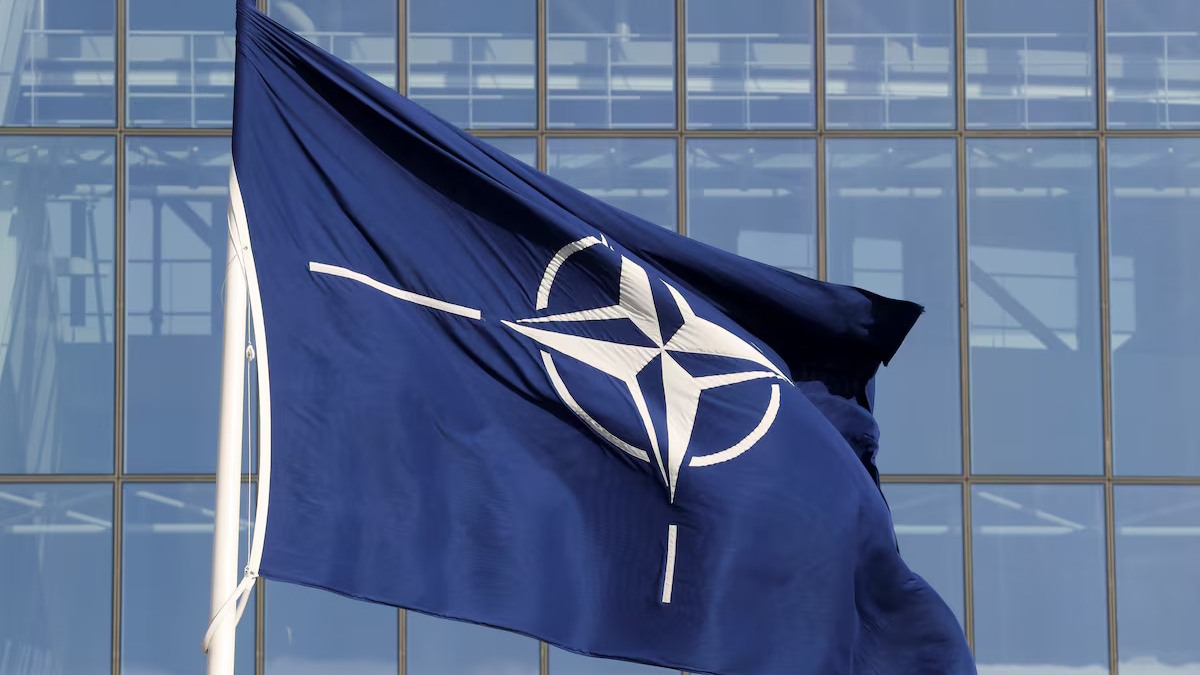
NATO has grown from 12 founding members in 1949 to a 32-country alliance spanning Europe and North America. Its combined military strength, defence spending and future ambitions underline its position as the world's largest military alliance.
From 12 members to 32
NATO was founded in 1949 in Washington, D.C., with 12 members committed to collective defence under Article 5, which states that an attack on one member is considered an attack on all.
Today, the alliance is headquartered in Brussels and has expanded to 32 member states through successive rounds of enlargement, most recently with Finland in 2023 and Sweden in 2024.
Its founding members included the U.S., the United Kingdom, France, Italy and Canada, alongside several Western European states, forming the core of a transatlantic security pact that has shaped post-war European security.
1,300 kilometre border with Russia
NATO's enlargement accelerated after the Cold War, with Central and Eastern European countries joining in waves in 1999 and 2004.
The expansion following Russia's full-scale invasion of Ukraine added Finland and Sweden, significantly reshaping the alliance's northern flank and extending NATO's border with Russia by more than 1,300 kilometres.
Three countries - Ukraine, Georgia, and Bosnia and Herzegovina - continue to express aspirations to join, although no accession timetables have been confirmed.
3.3 million military personnel
Collectively, NATO members field around 3.3 million active military personnel, compared with Russia's estimated 1.3 million.
The alliance also maintains a significant advantage in aircraft, naval vessels and main battle tanks, according to defence data compiled by Statista.
The U.S. remains the alliance's largest military contributor, while Türkiye, France, Germany, Italy, the United Kingdom and Poland are among its biggest European contributors.
Despite differences in size between member states, NATO's strength lies in its integrated command structure and the interoperability of its armed forces.
$1.6 trillion in defence spending
Defence spending has become a central political issue within the alliance, particularly since 2014, when members committed to the guideline of spending at least 2% of GDP on defence.
By 2025, all 32 members were expected to meet or exceed that benchmark, with Poland leading at more than 4% of GDP.
Collectively, NATO members spend more than $1.6 trillion on defence each year, with the U.S. accounting for roughly 60% of the total.
European allies and Canada have significantly increased defence investment since 2022 in response to heightened security concerns following the war in Ukraine.
The 5% target and future commitments
At the 2025 summit in The Hague, NATO leaders agreed a new long-term target of spending 5% of GDP on defence-related expenditure by 2035.
The framework divides spending between core military capabilities and broader security investments, including cyber defence and infrastructure resilience.
The move represents one of the most ambitious long-term financial commitments in the alliance's history.
NATO funding
In addition to national defence budgets, NATO operates a shared funding model covering its headquarters, command structures and joint infrastructure.
Although the common-funded budget represents only a small proportion of overall defence spending, it supports critical capabilities including satellite communications, pipelines and operational coordination.
The U.S. and Germany contribute the largest shares, followed by the United Kingdom, France and Italy.
30 non-member countries
NATO maintains structured partnerships with more than 30 non-member countries across Europe, the Mediterranean, the Gulf and the Asia-Pacific region.
These include the Partnership for Peace, the Mediterranean Dialogue and the Istanbul Cooperation Initiative, alongside bilateral cooperation with countries including Japan, Australia and South Korea.
Summit amid political strain
The upcoming NATO summit will bring leaders together against a backdrop of internal tensions, particularly over defence spending, burden-sharing and transatlantic relations.
The meeting is also expected to focus on continued support for Ukraine and the alliance's long-term strategic priorities.
As NATO enters its next phase of development, questions over unity, deterrence and strategic direction are expected to dominate discussions.

















What is your opinion on this topic?
Leave the first comment