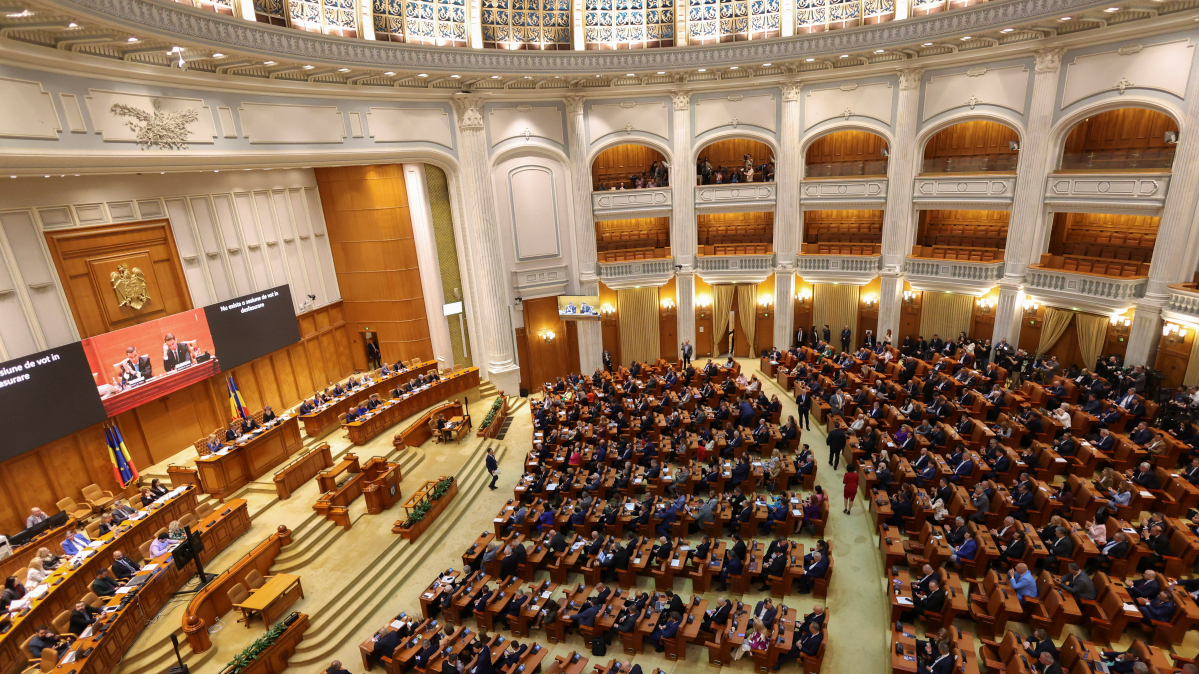
Romania’s prime minister-designate Adrian Vestea failed to secure parliament’s confidence late on Monday after the far-right opposition withheld support, prolonging a political crisis that could affect the country’s access to European Union funds and weigh on its credit standing.
Vestea received 189 votes, short of the 233 needed to form a government.
The failed vote now puts pressure on centrist President Nicușor Dan, who must nominate another candidate under Romania’s constitutional framework.
Under Romanian law, the president can dissolve parliament and call snap elections if two prime ministerial nominees fail to win approval within 60 days.
Romania has never held an early parliamentary election since the fall of communism, and the next scheduled vote is not due until 2028.
Analysts say parliament is likely to approve the next nominee, particularly as the far-right Alliance for the Union of Romanians (AUR) continues to lead in opinion polls.
Vestea, a member of the centre-right Liberal Party, was nominated by Dan without formal party consultation, in what observers viewed as an attempt to quickly rebuild a pro-European government capable of tackling reforms and reducing Romania’s large budget deficit.
Political landscape reshaping
Romania’s previous broad pro-European coalition collapsed in May after the Social Democrats, parliament’s largest party, left government and joined the opposition in backing a no-confidence motion against Prime Minister Ilie Bolojan.
Although the Social Democrats later backed Vestea’s bid, the Liberals and two smaller former coalition partners refused to support him, effectively leaving his fate dependent on AUR.
AUR leader George Simion said his party would not support Vestea, accusing mainstream parties of unfairly branding AUR as extremist.
The party, which opposes military aid to Ukraine and has criticised EU defence initiatives, has gained momentum in recent polling.
Political analysts say a minority government, either led by the Social Democrats or a smaller centre-right bloc, now appears the most likely outcome, though such administrations have historically struggled to govern effectively in Romania’s fragmented parliament.
Read more:














What is your opinion on this topic?
Leave the first comment