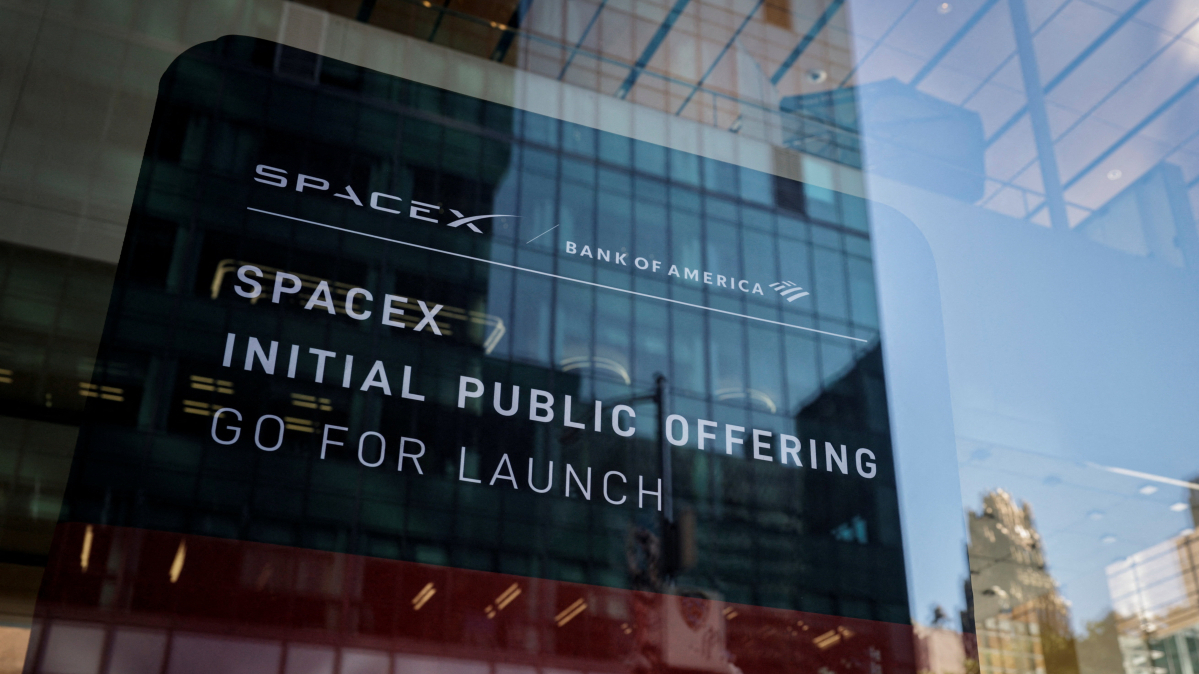
SpaceX has made history with the largest initial public offering ever in the United States, pricing its shares at $135 each and achieving a market valuation of $1.77 trillion.
The offering raised an unprecedented $75 billion through the sale of 555.56 million shares, cementing the company’s position among the world’s most valuable corporations.
The IPO marks a major milestone for Elon Musk’s space and technology empire, bringing the company to public markets after years of rapid expansion in satellite communications, launch services, and artificial intelligence.
One of America's most valuable companies
When trading begins on the Nasdaq on Friday, SpaceX will rank as the seventh-largest publicly listed company in the United States. Its valuation surpasses those of major firms including JPMorgan Chase, Berkshire Hathaway, Eli Lilly, Meta Platforms and even Musk’s electric vehicle maker, Tesla.
The previous record for the largest IPO was held by Saudi Aramco, which raised $25.6 billion during its 2019 public debut.
Musk rewrites the IPO playbook
The offering showcased Elon Musk’s unconventional approach to finance and corporate governance. SpaceX allocated 30% of its shares to retail investors, significantly higher than the norm for large public offerings.
The company also finalised its IPO price before the traditional investor roadshow process was completed, breaking from longstanding Wall Street practices. Musk further structured the company to retain substantial founder control, leaving him with an 82% ownership stake following the IPO.
In another unusual move, SpaceX announced its pricing while U.S. markets were still open, rather than waiting until after the close of trading.
Starlink drives revenue growth
Although SpaceX is best known for its rockets and ambitious plans for space exploration, the majority of its current revenue comes from its Starlink satellite internet business.
The company says Starlink serves millions of residential, business and government customers across 164 countries and territories. Meanwhile, SpaceX claims responsibility for more than 80% of the total mass launched into orbit globally over the past three years.
Last week, the company also announced a multi-year cloud computing agreement with Google, securing additional computing capacity as competition in artificial intelligence continues to intensify.
AI ambitions fuel investor interest
SpaceX has increasingly highlighted the role of artificial intelligence in its future strategy. The company points to its connection with xAI, arguing that access to computing infrastructure and real-time data from X provides a significant competitive advantage.
The company estimates its total addressable market at $28.5 trillion, describing it as the largest commercial opportunity in human history.
Challenges behind the record valuation
Despite investor enthusiasm, some analysts question whether SpaceX’s valuation can be justified given its financial performance. The company reportedly posted losses last year, while its revenue remains far below that of many technology giants with similar market values.
Competition is also intensifying. Rivals such as Blue Origin, founded by Jeff Bezos, are expanding their launch capabilities and pursuing government contracts in an effort to capture a larger share of the growing space economy.
IPO market rebound gains momentum
The success of the SpaceX offering is expected to boost confidence in the U.S. IPO market. Goldman Sachs has forecast that IPO proceeds could reach a record $160 billion in 2026, driven by a strong pipeline of companies preparing to go public, including artificial intelligence firms OpenAI and Anthropic.
For now, SpaceX’s blockbuster debut stands as a defining moment for both Elon Musk and the broader public markets, signalling strong investor appetite for companies operating at the intersection of space technology, artificial intelligence, and communications.


















What is your opinion on this topic?
Leave the first comment