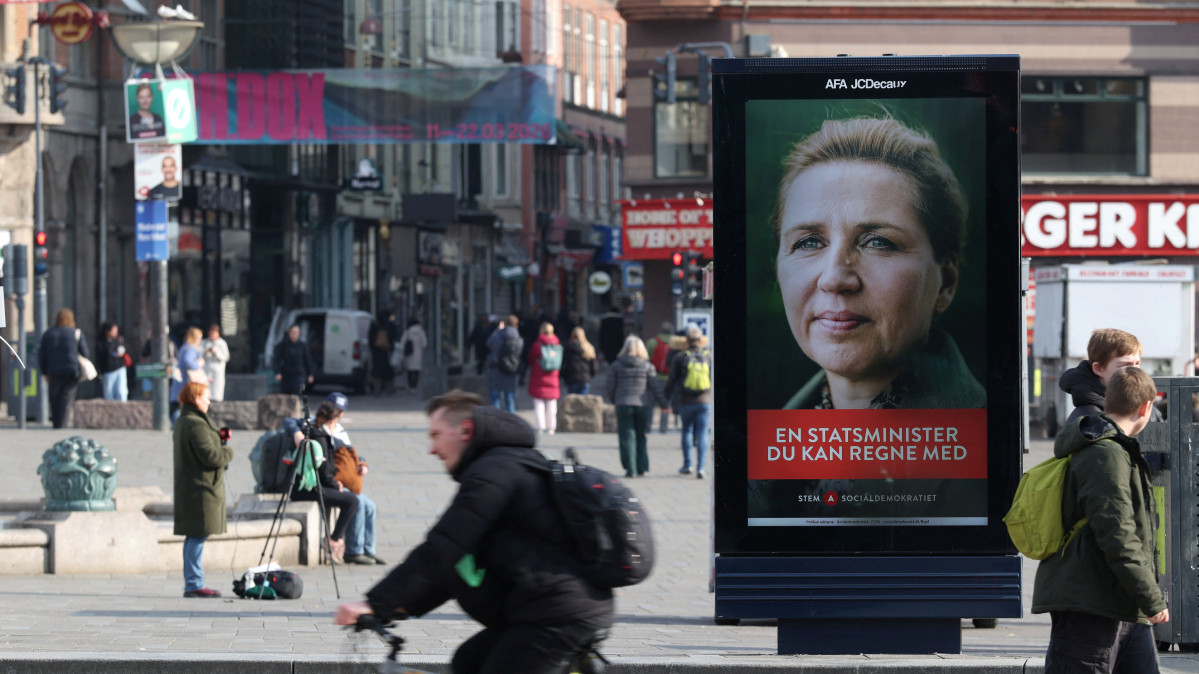
As Denmark gears up for a general election on 24 March, opinion polls show a narrow lead for Prime Minister Mette Frederiksen, whose numbers have been boosted by her firm stance against U.S. President Donald Trump’s push to annex Greenland to the U.S.
Frederiksen, the youngest prime minister to hold office in Denmark since 2019, has led her campaign with the slogan “Safe through uncertain times”, tapping into calls for national unity in response to Trump’s renewed interest in Greenland. Some analysts say this has given her party, the Social Democrats, which she has led since 2015, the political space to pivot away from difficult domestic issues such as welfare reform and inflation.
Analysts expect a coalition to emerge from the 12 parties contesting the election. Frederiksen will have to contend with Troels Lund Poulsen, leader of the centre-right Liberal Party (Venstre), as well as Alex Vanopslagh, the 34-year-old leader of the Liberal Alliance.
The Danish Parliament (Folketing) has 179 seats, with 175 elected in mainland Denmark. The remaining four seats are divided between the Faroe Islands (two) and Greenland (two).
Greenland’s decisive factor
Greenland is a semi-autonomous constituent country within the Kingdom of Denmark. It manages its own domestic affairs, including its judicial system and natural resources, while Denmark retains responsibility for foreign policy, defence and monetary matters.
Historically, Greenlandic MPs have leaned left, often supporting the incumbent Social Democrats. However, tensions linked to Trump have begun to shift Greenland’s internal politics. If voters in Greenland feel Denmark is not giving them a sufficiently prominent role in negotiations with Washington, they may elect representatives less inclined to support the Social Democrats, potentially shifting the balance of power to the opposition.
Despite its geographic distance, Greenland sends two representatives to the Danish parliament, and in a tight election those seats could prove decisive in coalition-building. Increased global attention has also empowered Greenlandic politicians to push for greater autonomy and influence, meaning their alignment could help determine which bloc forms a government.
The Trump effect
U.S. interest in Greenland has accelerated debates within the territory about greater autonomy from Denmark. It has also reframed Greenland from a distant autonomous territory into a strategic asset at the centre of global power competition, placing Danish politicians in a difficult position.
The political left generally advocates a gradual, respectful pathway towards increased autonomy, aiming to keep Greenland within the Kingdom through soft power.
The right, by contrast, tends to emphasise the “unity of the Realm” and the financial subsidies Denmark provides, arguing that a strong, integrated kingdom is the best way to resist pressure from larger global powers.
Voters in Denmark are now weighing which approach will best preserve the Kingdom’s integrity at a time when the Arctic has become a key area of strategic interest for the U.S.
The election results will likely reflect whether the public prefers a government that takes a more confrontational, “Europe-first” stance in response to U.S. pressure, or one that seeks to ease tensions while maintaining traditional NATO ties.
Why does Trump want Greenland?
According to a BBC report, Greenland is believed to sit atop large oil and natural gas reserves. It is also thought to hold deposits of 25 out of the 34 minerals classified as “critical raw materials” by the European Commission.
However, Trump has argued that his interest is not driven by natural resources. Speaking to reporters at the World Economic Forum in Davos in January, he said: “I want Greenland for security - I don’t want it for anything else.” He added that extracting resources would be difficult, noting that “you have to go 25 ft down through ice to get it. It’s not something that a lot of people are going to do or want to do”.
Both Greenland and Denmark have firmly rejected Trump’s interest in acquiring the territory for the U.S.














What is your opinion on this topic?
Leave the first comment