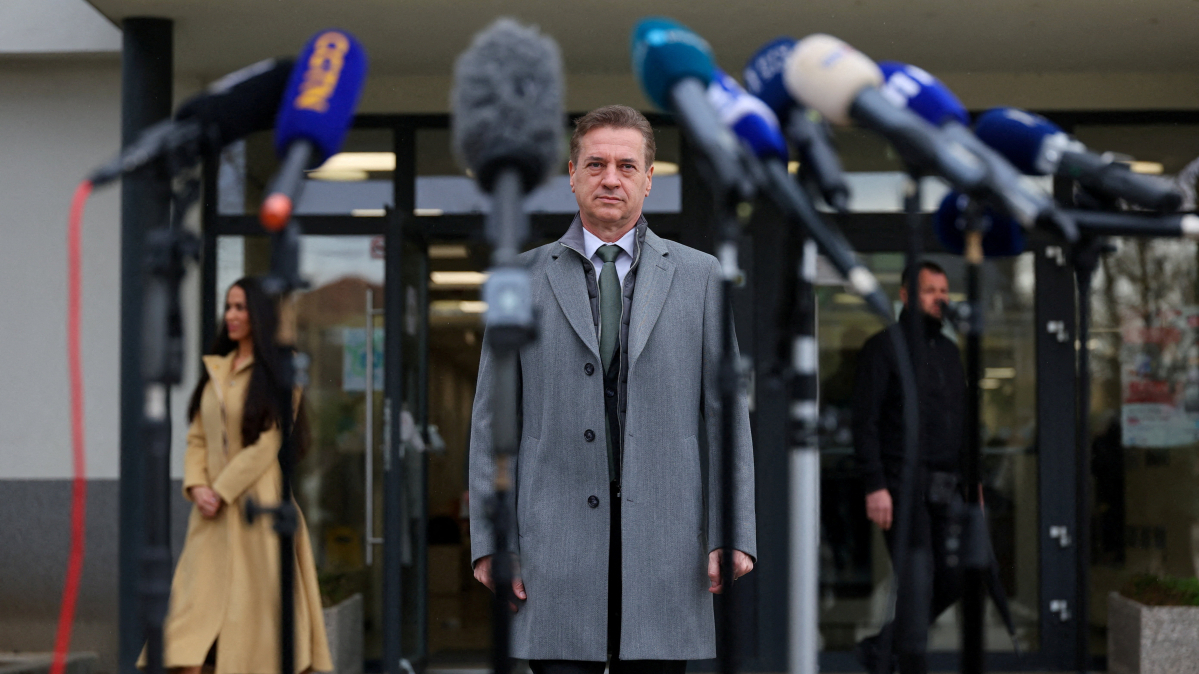
FinaFinal results from Slovenia’s parliamentary elections indicate a near tie between the Slovenian Democratic Party (SDS) and the liberal Freedom Movement Slovenia (GS), leaving neither side with a clear path to power.
With 99.45% of ballots counted, GS, led by Prime Minister Robert Golob, secured 29 seats, narrowly ahead of SDS, led by former prime minister Janez Janša, on 28. Under Slovenia’s constitution, a party or coalition requires 46 seats in the 90-member National Assembly to command a majority - a threshold neither side has reached.
Even with the support of smaller parties, Golob’s bloc is projected to hold around 40 seats. Meanwhile, Janša’s camp could reach 43, pointing to the likelihood of complex and potentially prolonged coalition negotiations.
Allegations of discrepancies
Janša has accused election authorities of irregularities involving around 50,000 votes. Speaking on local television, he said: “I call upon those responsible at the national election commission - those who manage the computer programme - to understand that I will recount every vote from all polling stations if we organise ourselves accordingly.”
Political analyst Aljaž Pengov Bitenc warned that forming a stable government could prove difficult. “I expect very long coalition negotiations, as hammering out priorities will be challenging and will require a significant degree of political patience, wisdom and experience,” he said.
He added that Golob may still hold an advantage in negotiations, owing to a broader potential coalition base.
Foreign interference claims
Slovenia’s Intelligence and Security Agency (SOVA) said it had evidence of a December meeting between three members of the Israeli private intelligence firm Black Cube and Janša, describing it as potential “foreign interference” in the electoral process.
Janša confirmed meeting a representative of the firm but said he was unaware of its background and denied that the meeting involved intelligence-sharing or any related requests.
What is next?
Under Article 111 of the Constitution of Slovenia, there is no single mechanism to resolve a deadlock. Instead, the process unfolds in several stages if no candidate secures a parliamentary majority.
An excerpt of the constitution, in English, outlines the next possible steps:
- If no candidate is elected Prime Minister pursuant to the last preceding paragraph, then, unless the National Assembly, within 48 hours, resolves by a majority of those Deputies present and voting to conduct a further vote for the office of Prime Minister, the President of the Republic shall dissolve the National Assembly and call new elections for the same.
- At any such further vote for the office of Prime Minister, a new Prime Minister may be elected by a majority of those Deputies present and voting. A vote shall be taken in respect of each candidate earlier proposed pursuant to the last preceding paragraph, ranked according to the number of votes received by each such candidate in the earlier voting.
- If no such candidate is elected, a vote shall be taken in respect of each new candidate proposed prior to the voting conducted pursuant to this paragraph, with any candidate of the President of the Republic as the subject of the first vote. If, after all votes conducted pursuant to the last preceding paragraph, no candidate receives the requisite number of votes for election, the President of the Republic shall dissolve the National Assembly and call new elections for the National Assembly.










What is your opinion on this topic?
Leave the first comment