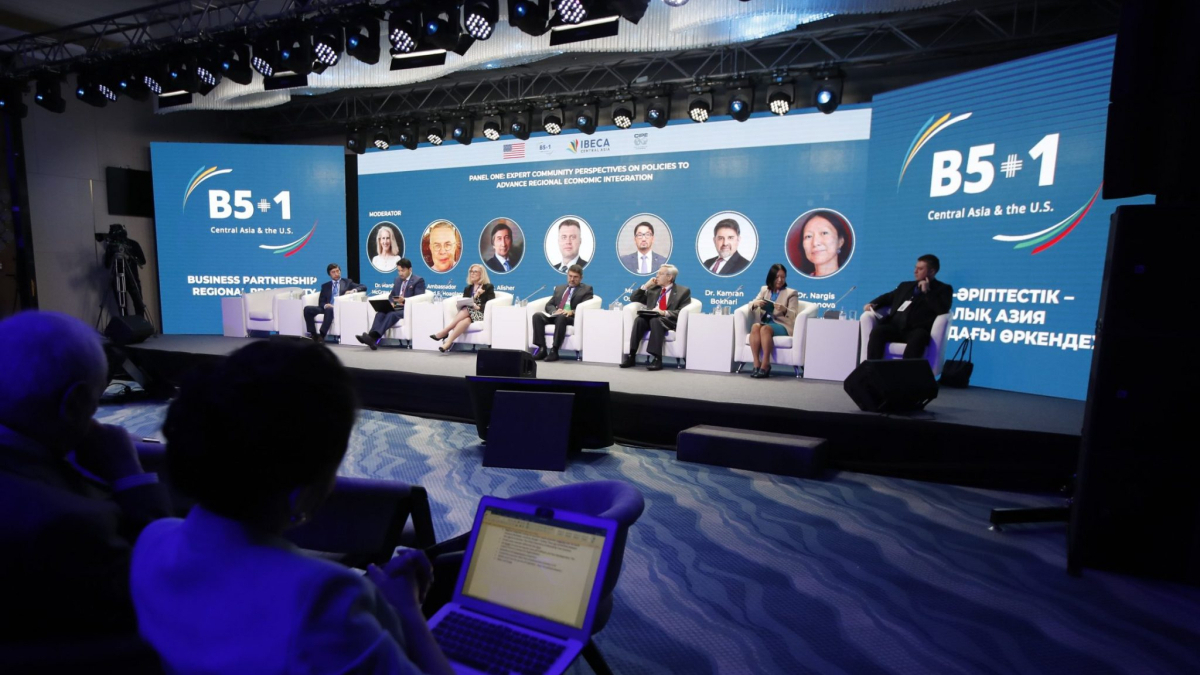
A landmark gathering of commercial and political minds has convened in the Kyrgyz capital, signalling a significant shift in Washington’s foreign policy approach towards the Eurasian heartland.
As the B5+1 Business Forum gets under way in Bishkek, the United States has signalled its intent to consolidate influence in the Eurasian heartland through major transport projects and unprecedented commercial outreach, moving beyond traditional diplomacy towards concrete economic integration.
Infrastructure as a vehicle for peace: The TRIPP initiative
The forum - which links the U.S. with five Central Asian countries - Kazakhstan, Kyrgyzstan, Tajikistan, Turkmenistan and Uzbekistan - has served as the launchpad for a new geopolitical framework, with U.S. officials unveiling the “Trump Route”, officially known as the TRIPP project, as a cornerstone of regional stability. Speaking on the sidelines of the event, Sergio Gor, the U.S. President’s Special Envoy for Central Asia, described the initiative as far more than a logistics corridor, positioning it as a guarantor of security for the wider region. The project is designed to create a seamless transport artery linking Central Asia directly to Western markets via the South Caucasus, bypassing traditional routes long affected by geopolitical friction.
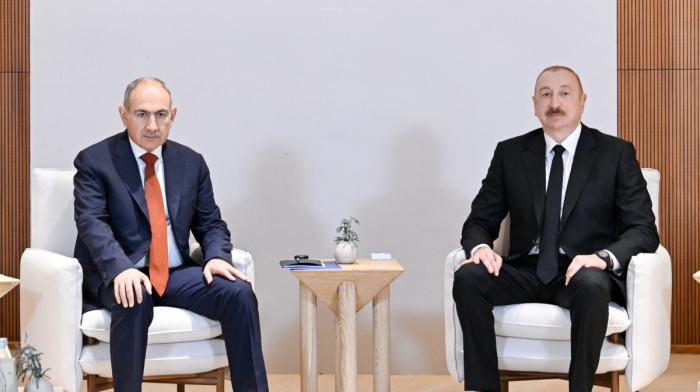
Gor said the infrastructure push is closely tied to diplomatic breakthroughs achieved last year, citing the Washington summit held on 8 August 2025 as a catalyst for the new economic vision. That meeting saw U.S. President Donald Trump mediate between Azerbaijani President Ilham Aliyev and Armenian Prime Minister Nikol Pashinyan, helping to ease decades of tensions and open the way for cross-border cooperation. According to the envoy, the TRIPP project represents the practical outcome of that diplomacy, repositioning the South Caucasus as a connectivity hub rather than a zone of conflict.
The administration’s logic is that economic interdependence serves as the strongest foundation for sustainable peace. By integrating the economies of the South Caucasus with the resource-rich nations of Central Asia, the US aims to foster a corridor where stability is profitable for all actors involved. "We have continued to promote the Trump Route," Gor said, noting that the administration recognises the strategic necessity of the region. This route is expected to expedite the flow of energy and goods, reducing transit times significantly while offering Central Asian nations a reliable, US-backed outlet to the global economy.
Recalibrating relations: A commercial pivot to Central Asia
Beyond geopolitics, the B5+1 Forum - a successor to the diplomatic C5+1 Leaders’ Summit - has underscored a significant shift in Washington’s economic approach to Central Asia. The mood in Bishkek contrasts with previous years, with the emphasis moving away from security assistance towards private investment. U.S. officials say this is reflected in the arrival of the largest American commercial delegation ever to visit the region.
Over the course of the two-day event, more than 300 participants, including captains of industry and government ministers, are engaging in high-level dialogue to dismantle trade barriers. Gor said the United States views Central Asia as a “priority region” over the next three years, with a particular focus on diversifying supply chains. The delegation includes representatives from U.S. firms specialising in critical minerals, artificial intelligence, e-commerce and agricultural technology. Interest in critical minerals is especially strong, as Washington seeks to secure supplies vital for the energy transition and advanced manufacturing while reducing dependence on competitors.
The forum is structured to produce practical outcomes rather than mere pleasantries. Participants are currently assessing the progress made since the inaugural meeting in Almaty, with panel discussions dedicated to presenting concrete roadmaps for logistics and digital infrastructure. The event will culminate in the signing of a comprehensive communique, outlining an updated action plan to integrate Central Asian markets more deeply into the Western economic sphere. Furthermore, the diplomatic weight of the visit is underscored by Gor’s scheduled meeting with Kyrgyz President Sadyr Japarov, signalling high-level U.S. backing for American companies seeking to expand their presence in the region.










What is your opinion on this topic?
Leave the first comment