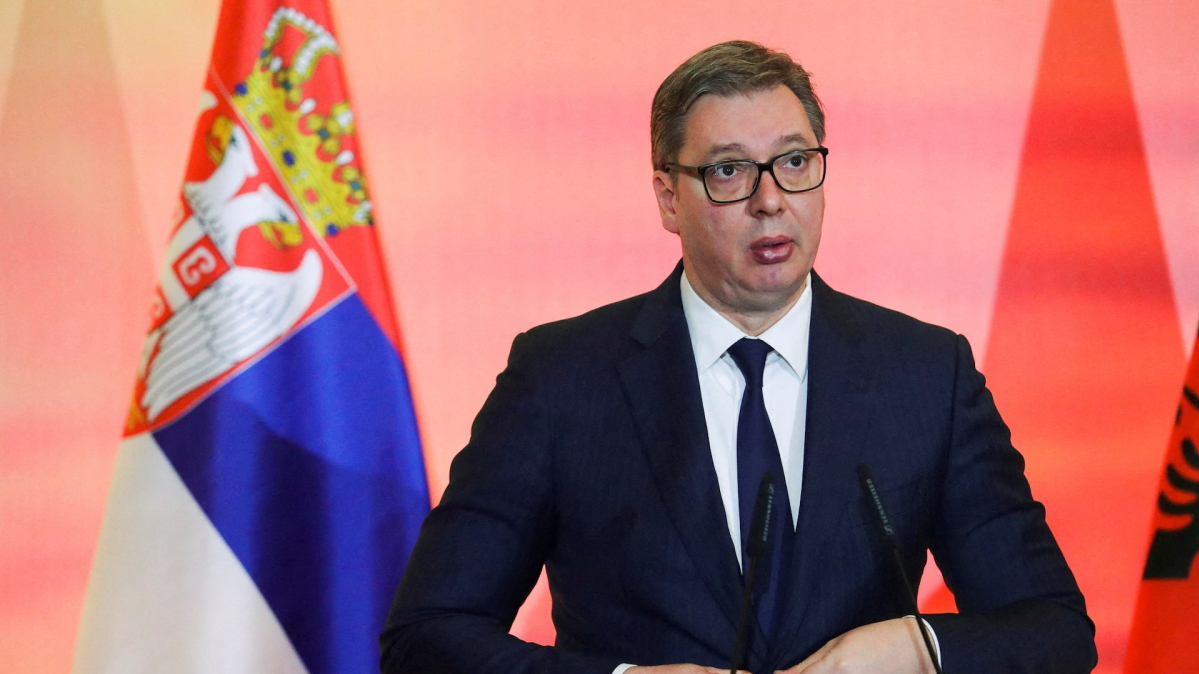
Serbian President Aleksandar Vučić, often viewed as a bellwether for the complex diplomatic currents between the Kremlin and the West, has issued a startling prediction regarding the endgame of the war in Ukraine.
Serbian President Aleksandar Vučić has suggested that a rapidly accelerated entry for Kyiv into the European bloc could emerge as the decisive geopolitical concession required to halt the hostilities on the eastern front.
Addressing government officials in Belgrade, the Serbian leader indicated that the standard bureaucratic metrics of accession might be swept aside in favour of a grand strategic bargain.
According to the Serbian leader, the integration of Ukraine into the European Union by January 1, 2027, is currently being weighed as a core component of a broader international peace plan.
While Serbia itself remains committed to its own European path, Vučić’s comments reflect a growing realisation in Balkan capitals that the rules of engagement are being rewritten by the exigencies of war.
In his remarks to Vecernje Novosti, Vučić outlined a scenario where the cessation of bloodshed takes precedence over the European Union's rigorous entrance criteria.
"If they want to prevent further killings, Ukraine must be in the European Union," the Serbian President stated, framing the potential membership not as an economic reward but as a vital security imperative.
This aligns with recent diplomatic whispers that major Western powers are seeking a mechanism to anchor Ukraine firmly in the West without crossing the Kremlin's "red line" of immediate NATO membership.
By granting EU status, the West would offer an economic and political shield, theoretically satisfying Kyiv's demand for security guarantees while avoiding the immediate trigger of Article 5 mutual defence clauses associated with the Atlantic alliance.
President Vučić's comments appear to corroborate earlier reporting by the Financial Times, which indicated that a specific settlement plan handed over to the United States explicitly envisaged Ukraine’s accession to the European Union by the January 1, 2027 deadline.
This suggests that the timeline is not merely a rhetorical flourish by the Serbian President but a concrete date being circulated in high-level diplomatic cables between Washington, Brussels, and Kyiv.
The involvement of the United States in pushing for an EU accession date is significant; while the US is not a member of the bloc, Washington views EU membership as the financial and political corollary to its own military support.
The logic underpinning this push is that a peace deal must offer Ukraine a "golden bridge" to the future. However, the practicalities of such an accelerated timeline would imply a radical revision of admission procedures,essentially rewriting the EU constitution on the fly to accommodate a "political accession" rather than a technical one, a concept that places immense pressure on the European Commission.
Internal friction and Balkan stagnation
While the geopolitical logic may be sound to strategists in Washington, Vučić was quick to highlight the inevitable internal friction such a move would cause within Europe itself.
"I think that there will be a lot of differences on various issues within the European Union," he noted, predicting that "some EU member states will not agree on this."
The Serbian President's assessment touches on a deep fault line within the bloc. Fast-tracking a war-torn nation of some 40 million people would require a complete overhaul of the EU’s budget, particularly the Common Agricultural Policy and cohesion funds.
Member states that are currently net beneficiaries could become net contributors overnight. Furthermore, nations that strictly adhere to the rule of law and fiscal discipline,such as the "frugal" northern states or politically divergent members like Hungary and Slovakia, may view a politically motivated accession in 2027 as a destabilising breach of the EU’s foundational treaties.
The prospect of Ukraine jumping the queue to join the EU by 2027 has also generated complex emotions across the Western Balkans, a region where countries have spent decades harmonising their legislation with Brussels only to face repeated delays.
Vučić’s comments carry an undertone of the frustration felt in Belgrade, Tirana, and Skopje. Serbia, for instance, applied for EU membership in 2009 and began negotiations in 2014, yet its path remains obstructed by diplomatic hurdles, particularly regarding Kosovo.
If Ukraine were to be admitted in 2027, effectively completing in a few years what other nations have failed to achieve in twenty, it would signal the definitive end of the "merit-based" accession process.
This sentiment is reinforced by the historical context of Türkiye’s bid, which began in 2005 and has effectively died a slow diplomatic death.
EU membership talks are traditionally a technocratic marathon aimed at synchronising a candidate country’s judiciary and economy with the EU acquis.











What is your opinion on this topic?
Leave the first comment