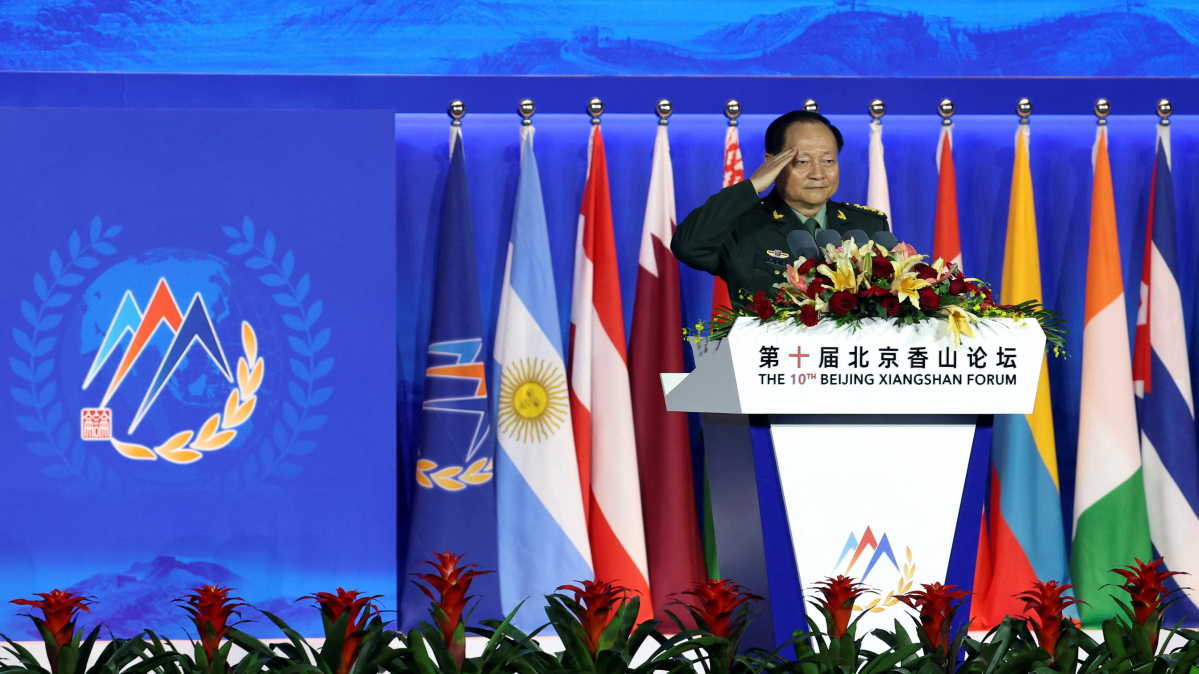
China’s most senior military general is under investigation, the defence ministry announced on Saturday, marking the highest-profile purge of top military leadership as Beijing continues to modernise its armed forces and project greater power.
Zhang Youxia, vice-chairman of the Central Military Commission (CMC) and second only to President Xi Jinping in the military hierarchy, has long been regarded as Xi’s closest ally within the armed forces.
The ministry said Zhang and Liu Zhenli, chief of staff of the CMC’s Joint Staff Department, are being investigated for suspected serious violations of discipline and law.
Zhang is also a member of the Communist Party’s elite Politburo and is among the few senior officers with direct combat experience.
Sweeping crackdown targets military
The military has been a central focus of Xi’s wide-ranging anti-corruption campaign since 2012. The drive intensified in 2023 when the elite Rocket Force was targeted.
Zhang’s removal would be only the second time since the 1966–76 Cultural Revolution that a serving CMC general has fallen from grace. He has not appeared publicly since November 20, when he met Russia’s defence minister in Moscow.
Diplomats and security analysts are closely monitoring developments, given Zhang’s proximity to Xi and the commission’s key role in command, military reform and modernisation.
China flexes its might
Although China has not fought a major war in decades, it has adopted a more assertive posture in the East China Sea, South China Sea and towards Taiwan, which Beijing claims as its own. China conducted its largest-ever military drills around Taiwan late last year.
James Char, a China security expert based in Singapore, said the military’s daily operations were likely to continue despite the purges, but targeting Zhang suggested Xi was responding to criticism that earlier crackdowns had been too selective.
“Xi has been appointing second-tier PLA officers to fill vacated posts, mostly on an interim basis,” said Char of the S. Rajaratnam School of International Studies.
“China’s military modernisation will continue to pursue Xi’s goals of completing reform by 2035 and becoming a world-class force by 2049.”
Zhang is the second CMC vice-chair to be purged in recent months. His predecessor, He Weidong, was expelled from the party and the PLA for corruption in October last year and replaced by Zhang Shengmin.
Eight senior generals were expelled from the Communist Party on corruption charges in October 2025, including He. Two former defence ministers have also been purged in recent years, slowing weapons procurement and affecting revenues at major defence firms.
Children of civil war veterans
Xi and Zhang both hail from Shaanxi province and are sons of senior officials who fought together during China’s civil war in the 1940s.
Born in Beijing, Zhang joined the army in 1968 and steadily rose through the ranks, joining the CMC in late 2012 as the military modernisation drive accelerated.
A U.S. Pentagon profile published in 2023 noted Zhang was expected to retire in 2022 at the age of 72, in line with standard practice, but was retained for a third term.
The report said his continued presence likely reflected Xi’s desire to keep a trusted and experienced adviser at the top of the military.
Zhang fought in China’s brief but violent border war with Vietnam in 1979 and later in another clash in 1984. Sent to the front lines at 26, he was rapidly promoted and later emerged as a strong advocate of modern tactics, improved weaponry and better-trained forces, according to state media and academic assessments.










What is your opinion on this topic?
Leave the first comment