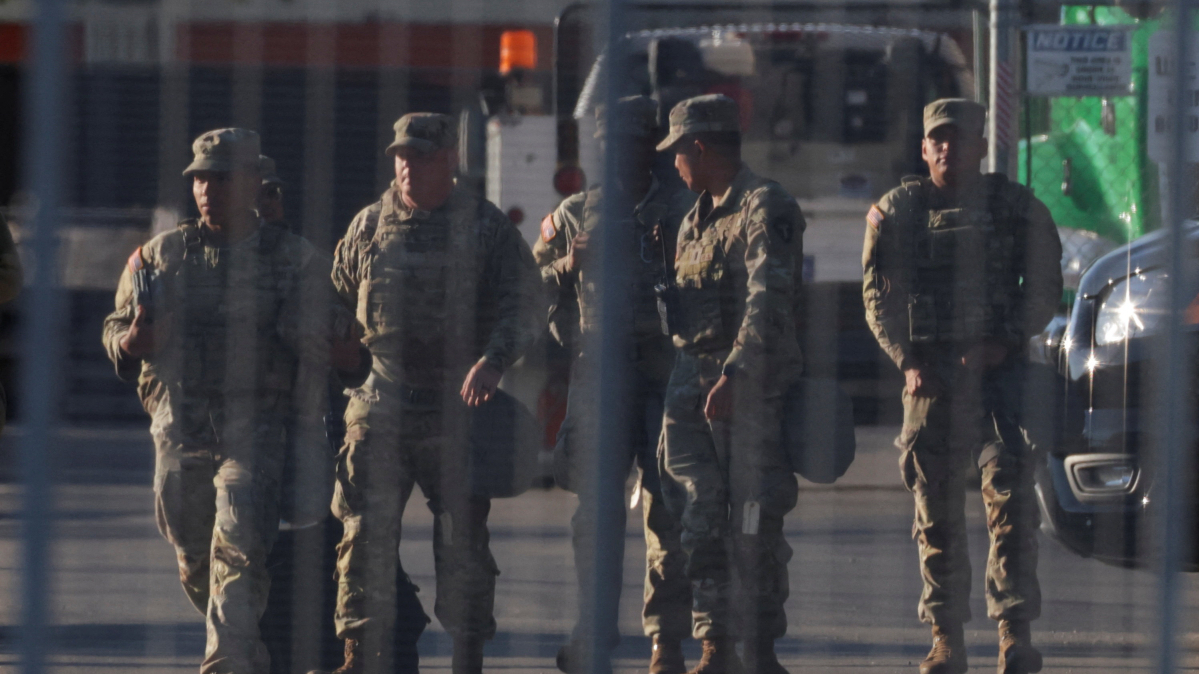
The U.S. Supreme Court blocked Donald Trump's attempt to send National Guard troops to the Chicago area, amid concerns that the Republican president is using the military in Democratic-led regions to punish opponents and suppress dissent on Tuesday.
The justices let stand for now a judge’s order blocking the deployment of hundreds of National Guard troops in a legal challenge brought by Illinois officials and local leaders. The U.S. Justice Department had sought to allow the deployment while the case proceeds.
"At this preliminary stage, the Government has failed to identify a source of authority that would allow the military to execute the laws in Illinois," the court's majority held in an unsigned order.
The order said the president's authority to take federal control of National Guard troops likely only applies in "exceptional" circumstances.
Three conservatives on the court said they dissented from the order: Justices Samuel Alito, Clarence Thomas and Neil Gorsuch.
White House spokeswoman Abigail Jackson said in a statement that Trump "promised the American people he would work tirelessly to enforce our immigration laws and protect federal personnel from violent rioters" and that "(n)othing in today’s ruling detracts from that core agenda."
Illinois Governor JB Pritzker called the ruling "an important step in curbing the Trump Administration's consistent abuse of power and slowing Trump’s march toward authoritarianism."
High court ruling a rare setback for Trump
It was a rare setback for Trump's administration at the high court, which has a 6-3 conservative majority and has frequently backed his broad assertions of presidential authority since his return to the White House.
The National Guard serves as state-based militia forces that answer to state governors except when called into federal service by the president.
Trump ordered troops to Chicago, the third-largest U.S. city, and to Portland, Oregon, following his earlier deployments to Los Angeles, Memphis and Washington, D.C.
The case has been characterized by starkly different portrayals of the protests against Trump's aggressive immigration enforcement in and around Chicago.
Trump and his allies have described Democratic-led cities as lawless, crime-ravaged and plagued with vast, violent protests.
His administration has said troops are needed to protect federal property and personnel at a U.S. Immigration and Customs Enforcement detention facility that has become a flashpoint for Chicago activists opposed to Trump's immigration crackdown.
Democratic mayors and governors, along with other Trump critics, have said these claims are a false account of the situation and a pretext for sending troops, accusing Trump of abusing his power.
Federal judges skeptical of administration's view
Federal judges have expressed skepticism over the administration's dire view of protests that local law enforcement officials have called limited in size, largely peaceful and manageable by their own forces - far from the "war zone" conditions described by Trump.
Trump has relied on a law that lets a president deploy state National Guard troops to suppress a rebellion, repel an invasion or if he is "unable with the regular forces to execute the laws of the United States."
Illinois and Chicago sued after the administration federalized 300 Illinois National Guard troops and also ordered Texas National Guard troops into the state, calling the actions unlawful. Officials have since announced the administration was sending home hundreds of National Guard troops who were dispatched to Portland from California, and to Chicago from Texas.
Chicago-based U.S. District Judge April Perry temporarily blocked the move on October 9, finding that the claims of violence during protests at an immigration facility in the Chicago suburb of Broadview, Illinois, where a small group of demonstrators had gathered daily for weeks, were unreliable.
Perry, an appointee of Democratic former President Joe Biden, found that there was no evidence of rebellion or that the law was not being enforced, faulting officials for "equating protests with riots and a lack of appreciation for the wide spectrum that exists between citizens who are observing, questioning and criticizing their government, and those who are obstructing, assaulting or doing violence."
A National Guard deployment would "only add fuel to the fire," Perry said.
A three-judge panel of the Chicago-based 7th U.S. Circuit Court of Appeals declined to lift Perry's order blocking the deployment, concluding that "the facts do not justify the president's actions in Illinois." Two of the three judges were appointed by Republican presidents, including one by Trump.
The Justice Department told the Supreme Court that the assessment by local officials of the protests was "implausibly rosy," and that federal agents "have been forced to operate under the constant threat of mob violence."
Lawyers for Illinois and Chicago told the justices that the local protests have "never hindered the continued operation" of the Broadview facility, and that state and local authorities have responded to every request for assistance and contained any sporadic disruption.
Officials from Portland and Oregon are pursuing a separate legal challenge to Trump's planned deployment to that city. U.S. District Judge Karin Immergut, a Trump appointee, permanently blocked that deployment in a November 7 ruling. The administration has appealed that ruling.
The Supreme Court in October asked the administration as well as Illinois and Chicago to provide written arguments over how to interpret the words "regular forces" in the law at issue in the case.
In an October 10 written ruling, Perry said that historical sources indicate that "regular forces" means only members regularly enlisted in the military, including the Army and Navy, as opposed to the National Guard.
Trump's administration "made no attempt to rely on the regular forces before resorting to federalization of the National Guard," Perry said, adding that there are other limits on the use of the military for domestic law enforcement purposes.
The administration repeatedly has sought the Supreme Court's intervention to allow implementation of Trump policies impeded by lower courts. The Supreme Court has sided with the administration in almost every case that it has been called upon to review since Trump returned to the presidency in January.










What is your opinion on this topic?
Leave the first comment