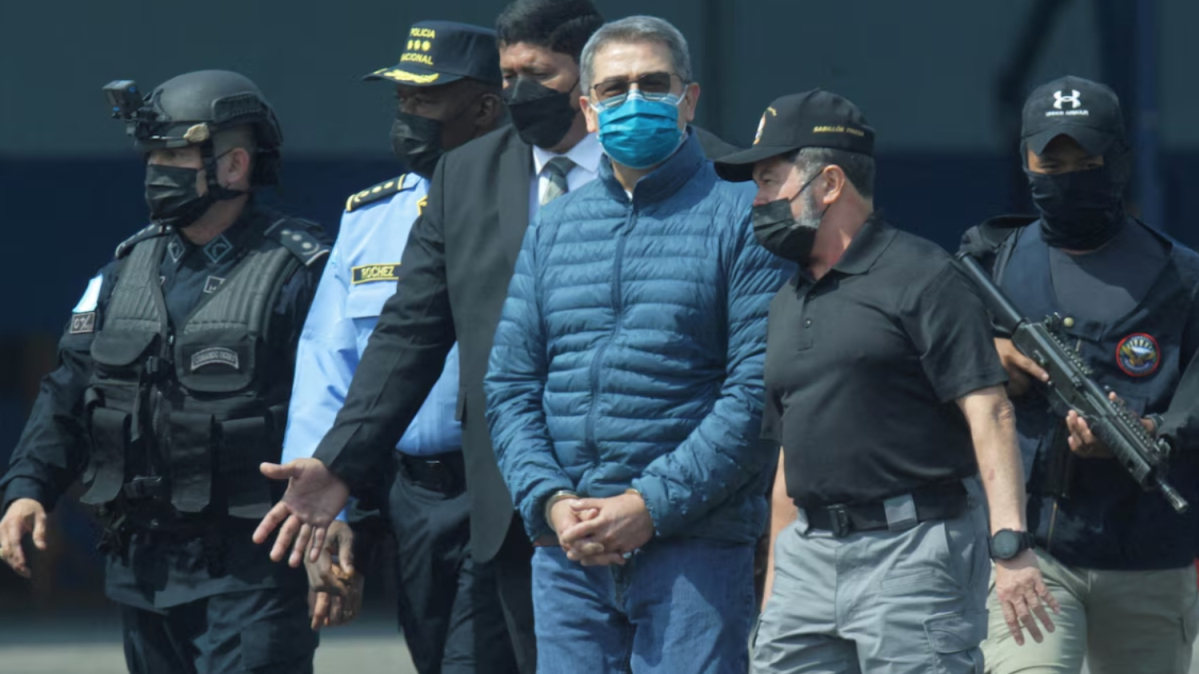
Former Honduran President Juan Orlando Hernández, who was serving a 45-year prison sentence in the United States for helping drug traffickers smuggle more than 400 tons of cocaine into the country, was released on Tuesday after being pardoned by U.S. President Donald Trump.
Hernández, who led Honduras from 2014 to 2022, was arrested in Tegucigalpa in February 2022, just weeks after leaving office, and extradited to the U.S., where he was convicted in March 2024.
In June, a federal court in New York sentenced him to 45 years in prison, describing him as a key facilitator in a massive narcotics network that operated under the guise of political authority.
Speaking to reporters aboard Air Force One on Sunday, Trump defended his decision to pardon the former leader, claiming that the conviction was politically motivated.
“They basically said he was a drug dealer because he was the president of the country. And they said it was a Biden administration set-up,” Trump said. “I looked at the facts and I agreed with them.”
The White House later issued a brief statement confirming the pardon, describing it as “a corrective act of justice for a political prosecution.”
Family expresses gratitude
Hernández’s wife, Ana García, celebrated the decision, saying the pardon “restored our hope.”
“After almost four years of pain, of waiting and difficult challenges, my husband Juan Orlando Hernández returned to being a free man, thanks to the presidential pardon granted by President Donald Trump,” she wrote on X, posting a photo of the U.S. Bureau of Prisons record confirming her husband’s release.
García thanked Trump for “recognising a truth that we always knew.”
Throughout his trial, Hernández maintained that he was innocent, claiming he had been targeted by drug traffickers he had previously extradited to the United States. He accused prosecutors of relying on testimonies from criminals seeking lighter sentences.
During sentencing, U.S. District Judge P. Kevin Castel said Hernández’s case should serve as a warning to those who believe political power places them above the law.
“This sentence is for the well-educated, well-dressed people who think their status will insulate them from justice when they do wrong,” Castel said in June.
Honduran Attorney General Johel Zelaya responded to the pardon on Tuesday, saying his office would continue to pursue justice domestically.
“Our duty is to put an end to impunity,” he wrote on social media, without specifying whether Hernández could face new charges in Honduras.
Controversial figure
Hernández’s presidency was marred by accusations of corruption, election fraud, and human rights abuses. During his tenure, U.S. prosecutors alleged that he accepted millions of dollars in bribes from cartels, including from Joaquín “El Chapo” Guzmán, in exchange for political protection.
His release has sparked outrage among anti-corruption groups in Honduras, who called the pardon “a setback for justice.”












What is your opinion on this topic?
Leave the first comment