Start your day informed with AnewZ Morning Brief: here are the top news stories for the 11st of November, covering the latest developments you need to know.
1. U.S. Senate passes bill to end government shutdown and sends it to House
The U.S. Senate approved a compromise on Monday to end the longest government shutdown in U.S. history. The 60-40 vote had support from nearly all Republicans and eight Democrats, who unsuccessfully tried to link funding to health subsidies.
The agreement sets up a December vote on health subsidies benefiting 24 million Americans but does not guarantee their continuation. The deal restores funding for federal agencies that had expired on 1 October.
2. U.S. and Syrian presidents had ‘constructive’ talks on Syria’s unity, reconstruction
Syrian President Ahmad al-Sharaa held a “constructive” meeting with U.S. President Donald Trump in Washington on Monday. The talks focused on Syria’s unity, reconstruction, and removing obstacles to its recovery, according to Syria’s foreign minister.
Trump said the U.S. will take all possible steps to aid Syria as it emerges from decades of Assad family rule. Al-Sharaa spent nearly two hours at the White House meeting with Trump and senior officials. This was the first visit by a Syrian leader to the White House since Syria gained independence nearly 80 years ago.
3. Delhi car blast being probed under anti-terrorism law
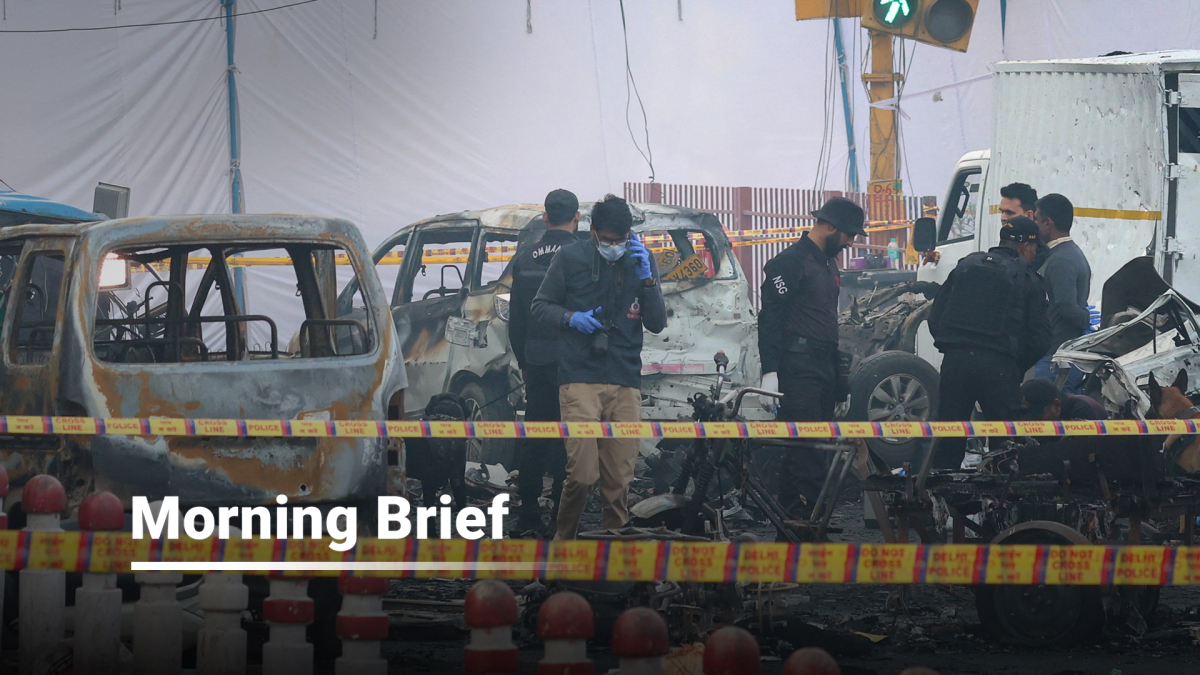
Indian police are investigating a deadly car blast in Delhi near the historic Red Fort, which killed at least eight people and injured 20 others.
The probe is being conducted under the Unlawful Activities (Prevention) Act and other criminal laws, with forensic teams examining the site. According to reports, a slow-moving car exploded near a traffic signal, damaging nearby vehicles and leaving mangled bodies on a congested street.
Authorities have placed several states and key facilities on high alert while tracing the car’s owner and investigating all possible angles.
4. Iraqis begin voting in parliamentary elections
Iraqis began voting on Tuesday to elect a new 329-member parliament, with polling set to close at 6:00 p.m. Prime Minister Mohammed Shia al-Sudani is seeking a second term, but his bloc is expected to fall short of a majority, likely leading to months of post-election negotiations.
The new government will face pressures from both domestic demands for reform and the influence of regional powers, including the U.S. and Iran, while managing armed groups loyal to Tehran.
5. Brazil's COP30 climate summit opens with a plea for countries to get along
The COP30 climate summit opened on Monday in Belem, Brazil, with the United Nations climate chief urging countries to cooperate rather than clash over priorities. Host country Brazil set the agenda for the two-week talks, focusing on achievable goals like deforestation while sidestepping contentious issues such as climate finance and carbon taxes.
A new UN analysis estimates global greenhouse gas emissions will fall 12% by 2035 compared with 2019 levels, short of the 60% reduction needed to limit warming to 1.5°C.













What is your opinion on this topic?
Leave the first comment