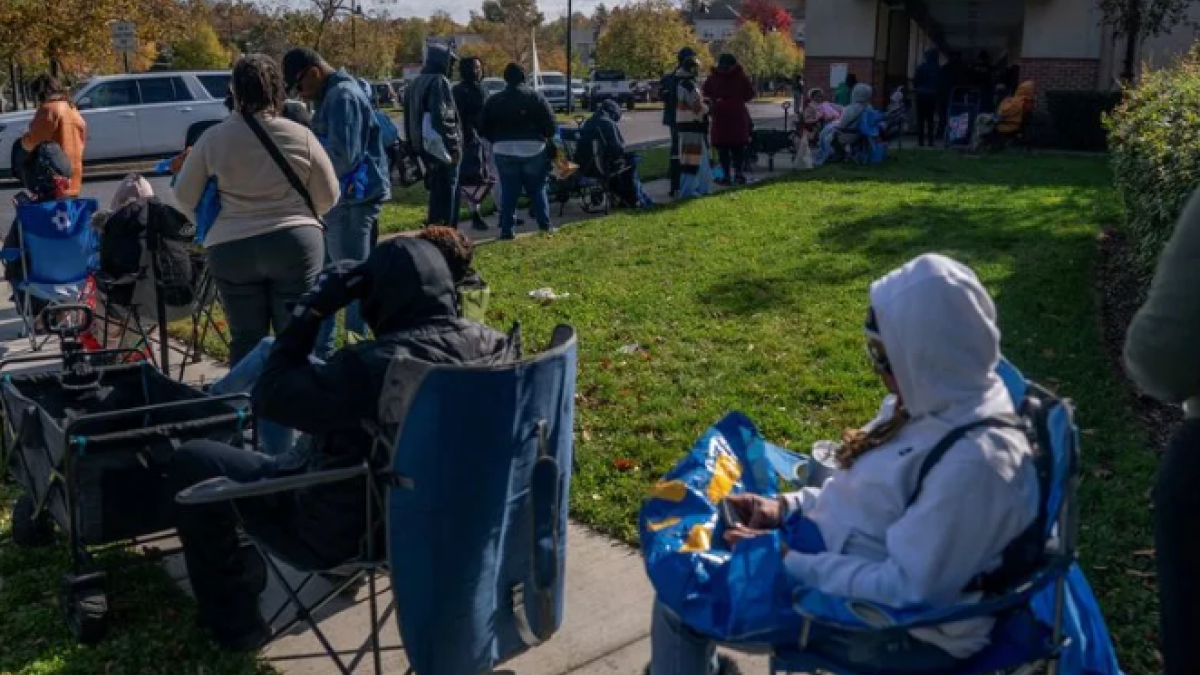
Nearly 42 million Americans face the loss of food assistance as the United States enters one of its longest government shutdowns, with no resolution in sight between Democrats and Republicans.
The lapse in funding for the Supplemental Nutrition Assistance Program (SNAP), commonly known as food stamps, is expected to begin on Saturday (November 1), threatening one of the country’s most vital social safety nets.
SNAP, which provides essential food aid to low-income households, supports roughly one in eight Americans. “The easiest way to define SNAP benefits is to say it's the new name for food stamps,” explained Dr. Larry Sabato, a professor at the University of Virginia. “It’s encouraging that we reach those in need, but also shocking that 42 million Americans rely on food aid — and they really do.”
The U.S. Department of Agriculture’s refusal last week to draw from a $5.5 billion emergency contingency fund to sustain part of November’s SNAP payments has deepened partisan tensions. Democrats argue the agency is legally required to use the funds, while Republicans accuse their rivals of obstructing broader efforts to reopen the government.
Senate Minority Leader Chuck Schumer condemned the lapse in funding as “unprecedented,” noting that no administration — Democratic or Republican — has ever allowed SNAP to expire during a shutdown. “Trump himself funded SNAP throughout his last shutdown,” Schumer said on the Senate floor. “So this argument that he can’t do it, that it’s not legal, is just self-serving nonsense.”
Republican Senate Majority Leader John Thune countered that his party had repeatedly tried to fund essential services. “SNAP recipients shouldn’t go without food. People should be getting paid in this country. We’ve tried to do that 13 times — Democrats voted no 13 times,” Thune said.
Vice President JD Vance also criticised Democrats, urging them to “end the charade and reopen the government.” He warned that the shutdown’s effects would soon become visible in key sectors, from aviation to food assistance. “The American people are already suffering, and the suffering is going to get a lot worse,” he said.
The growing crisis has prompted several states to take emergency measures. On Thursday, New York Governor Kathy Hochul declared a “food emergency” and announced $65 million in state funding to support local food banks. “It’s immoral for people to suffer because Republicans will not unleash the food emergency funds that are sitting there,” Hochul said. She acknowledged, however, that no state could replace the roughly $650 million in monthly federal support New York receives for SNAP. Oregon and Virginia have also declared emergencies to release limited funds for food assistance.
For recipients, the uncertainty is deeply unsettling. “I rely on that to eat for the month,” said Bakersfield resident Y’Chantiz McDonald. “If that goes away, I wouldn’t know what to do.” Another recipient, Stevee Moore, called SNAP “a blessing,” saying it allows struggling families to feed their children during hard times.
Political analysts say the standoff is beginning to erode public confidence. “Both Democrats and Republicans are acknowledging this as a serious problem,” said Dr. Sabato. “If it continues, it could become a political and humanitarian disaster. People can get by for a week or two, but as it drags on, it’s going to be sad and miserable.”
Polls show most Americans blame President Donald Trump and Republicans for the impasse, though many also hold Democrats responsible for the gridlock. “There isn’t a clear edge for one party,” Sabato said. “But if Democrats find a way to end this soon, they could emerge stronger — because the public is already tilting toward them.”
With food banks across the country bracing for an influx of demand and families anxiously awaiting clarity, the fate of millions of Americans now hinges on whether Washington can find common ground — before hunger spreads further across the nation.


















What is your opinion on this topic?
Leave the first comment