Thailand and Cambodia agree to ceasefire after renewed border clashes, Trump says
Thailand and Cambodia have agreed to halt all shooting from Friday evening following renewed fighting along their shared border, U.S. President Donald...
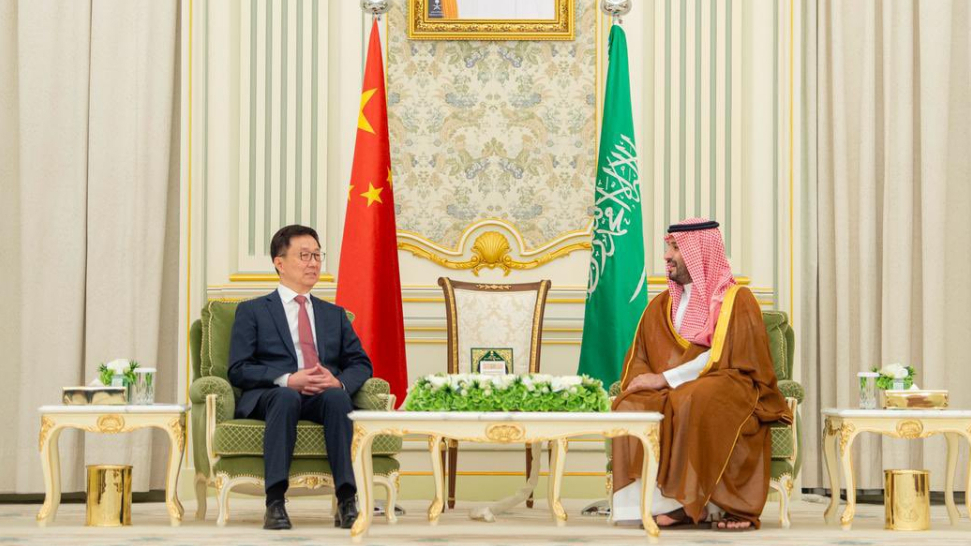
China’s Vice President Han Zheng met with Saudi Arabia’s Crown Prince Mohammed bin Salman in Riyadh on Wednesday.
The meeting is part of efforts to reaffirm Beijing’s commitment to strengthen strategic coordination and deepen economic cooperation with the Gulf kingdom.
It highlighted both nations’ commitment to sustain the momentum in their rapidly growing partnership, even as Saudi officials quietly voiced unease about the impact of cheap Chinese imports on local industry.
According to Chinese state media, Han expressed Beijing’s readiness to “enhance high-level exchanges and mutual support” across political, economic, and technological fields.
He emphasised that China views Saudi Arabia as a key partner in advancing cooperation under the Belt and Road Initiative and in promoting stability and development across the Middle East.
For Riyadh, the visit comes at a delicate moment; while Saudi Arabia continues to court Chinese investment and technology as part of its ambitious Vision 2030 plan, local manufacturers have raised concerns that a flood of low-cost Chinese goods could undercut domestic production and hinder the kingdom’s industrial diversification goals.
Crown Prince Mohammed bin Salman welcomed China’s continued engagement but reportedly stressed the need for more balanced trade and collaboration that supports Saudi Arabia’s drive toward self-sufficiency in high-value manufacturing.
The meeting follows a series of high-level contacts between the two nations in recent years, reflecting a steady strengthening of ties beyond the traditional oil trade.
China has emerged as one of Saudi Arabia’s largest trading partners and a growing player in its infrastructure, digital technology, and energy transition projects.
The encounter highlights the careful balancing act both sides are attempting, by maintaining strong political alignment and economic partnership while managing the frictions that come with deeper integration.
For Beijing, Saudi Arabia remains a critical pillar in its Middle East diplomacy; for Riyadh, China is both an essential partner and a formidable competitor in its race to diversify away from oil.

Japan has lifted a tsunami advisory issued after an earthquake with a magnitude of 6.9 hit the country's northeastern region on Friday (12 December), the Japan Meteorological Agency (JMA) said. The JMA had earlier put the earthquake's preliminary magnitude at 6.7.
The United States issued new sanctions targeting Venezuela on Thursday, imposing curbs on three nephews of President Nicolas Maduro's wife, as well as six crude oil tankers and shipping companies linked to them, as Washington ramps up pressure on Caracas.
Iran is preparing to host a multilateral regional meeting next week in a bid to mediate between Afghanistan and Pakistan.
Kyiv has escalated its naval campaign against Moscow’s economic lifelines, claiming a successful strike on a vessel suspected of skirting international sanctions within the Black Sea.
The resignation of Bulgaria's government on Thursday (11 December) puts an end to an increasingly unpopular coalition but is likely to usher in a period of prolonged political instability on the eve of the Black Sea nation's entry into the euro zone.
Türkiye’s Trade Minister Omer Bolat said Friday that discussions in Washington with U.S. officials have strengthened efforts to expand bilateral trade, moving closer to a $100 billion target.
Lebanon is prepared to demarcate its border with Syria, President Joseph Aoun said on Friday, while noting that the dispute over the Shebaa Farms could be addressed at a later stage.
Greek farmers blocked the Port of Thessaloniki on Friday as part of nationwide protests demanding delayed European Union subsidies and compensation for rising production costs and livestock losses.
Türkiye’s President Recep Tayyip Erdoğan and Pakistani Prime Minister Shahbaz Sharif held talks on Friday during the International Peace and Trust Forum in Ashgabat, Turkmenistan, focusing on bilateral relations as well as regional and global issues
ussian President Vladimir Putin described Moscow’s relations with Baghdad as historically strong and unbroken during a meeting with Iraqi President Abdul Latif Rashid in Turkmenistan.
You can download the AnewZ application from Play Store and the App Store.
What is your opinion on this topic?
Leave the first comment