Three major companies announced on Tuesday that at least $80 billion worth of nuclear reactors will be built across the United States in partnership with the U.S. government.
The initiative marks one of the largest U.S. investments in nuclear energy in decades and aligns with President Donald Trump’s “energy dominance” policy, which prioritises oil, gas, coal, and nuclear power. It comes as soaring electricity consumption from artificial intelligence data centres drives the country’s first significant rise in power demand in 20 years.
Under the deal with Westinghouse Electric, Cameco (CCO.TO) and Brookfield Asset Management (BAM.TO), Washington will arrange project financing and streamline the permitting process for reactors built using Westinghouse technology. In exchange, the government will gain a participation interest entitling it to 20 percent of any cash distributions exceeding $17.5 billion once its stake vests. The companies did not specify when that would occur, only that a final investment decision and related agreements must first be completed.
Challenges and concerns
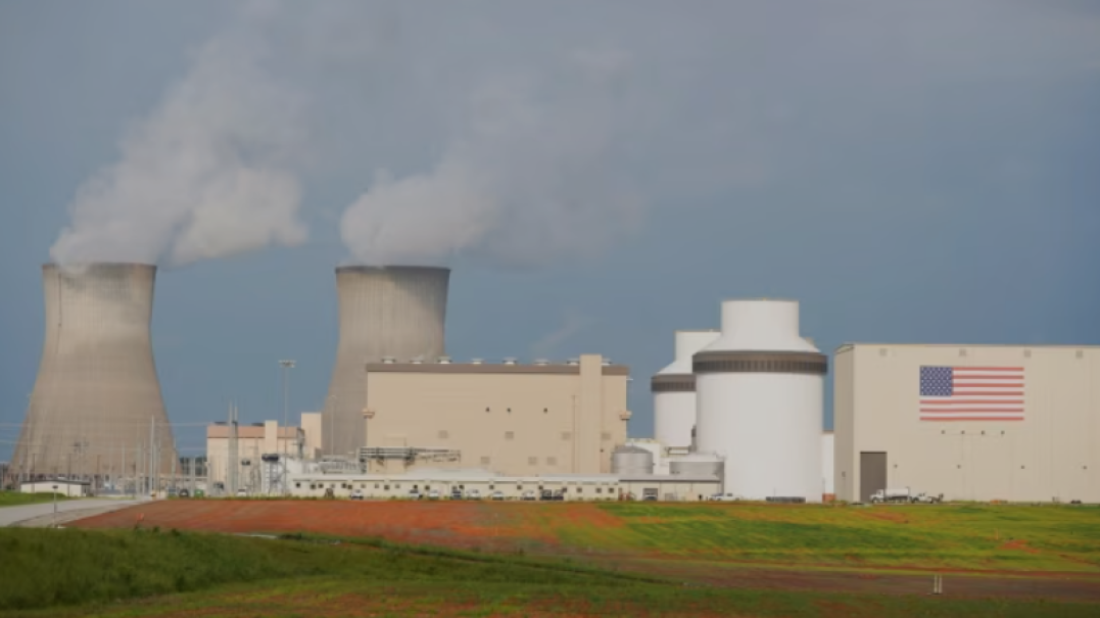
Building new reactors in the U.S. has long proven difficult due to spiralling costs and delays. The most recent additions — two Vogtle units in Georgia completed in 2023 and 2024 — came online seven years late at a total cost of $35 billion, more than double their original estimate. No large-scale reactors are currently under construction.
Opponents continue to warn that the country still lacks a permanent repository for radioactive waste, which remains hazardous for millennia. Waste is currently stored on-site at plants in cooling pools and then transferred into reinforced casks.
AI demand revives nuclear momentum
Despite these challenges, renewed enthusiasm for nuclear power is being fuelled by surging 24/7 electricity needs from hyperscale cloud providers that power AI operations. On Monday, NextEra Energy (NEE.N) and Google (GOOGL.O) announced plans to restart an idle nuclear plant in Iowa.
The latest partnership also gives Washington the option to require Westinghouse to launch a public share offering if its participation interest vests and the firm’s valuation reaches $30 billion or more by January 2029.
Market reaction and industry context
Cameco and Brookfield Renewable Partners (BEP.N) acquired Westinghouse in 2023 for $7.9 billion, including debt, following Brookfield Business Partners’ earlier $4.6 billion purchase from Toshiba in 2018 after its bankruptcy. Cameco’s U.S.-listed shares surged over 15 percent in premarket trading following the announcement.
The deal follows a May executive order from President Trump promoting nuclear power and targeting an additional 5 gigawatts of reactor capacity by 2030. The new units will use Westinghouse’s advanced nuclear technology.
Technology giants including Google, Microsoft (MSFT.O), and Amazon (AMZN.O) have already committed to sourcing energy from next-generation nuclear technologies such as fusion and small modular reactors. Constellation Energy (CEG.O) and Microsoft have also teamed up to restart a Three Mile Island unit in Pennsylvania to supply power for Microsoft’s data centres.


















What is your opinion on this topic?
Leave the first comment